Clear Window Pouch Design Guide: Window Position, Barrier Impact and Sealing Considerations
Équipe de révision technique Huasheng Packaging · Publié: · Mis à jour:
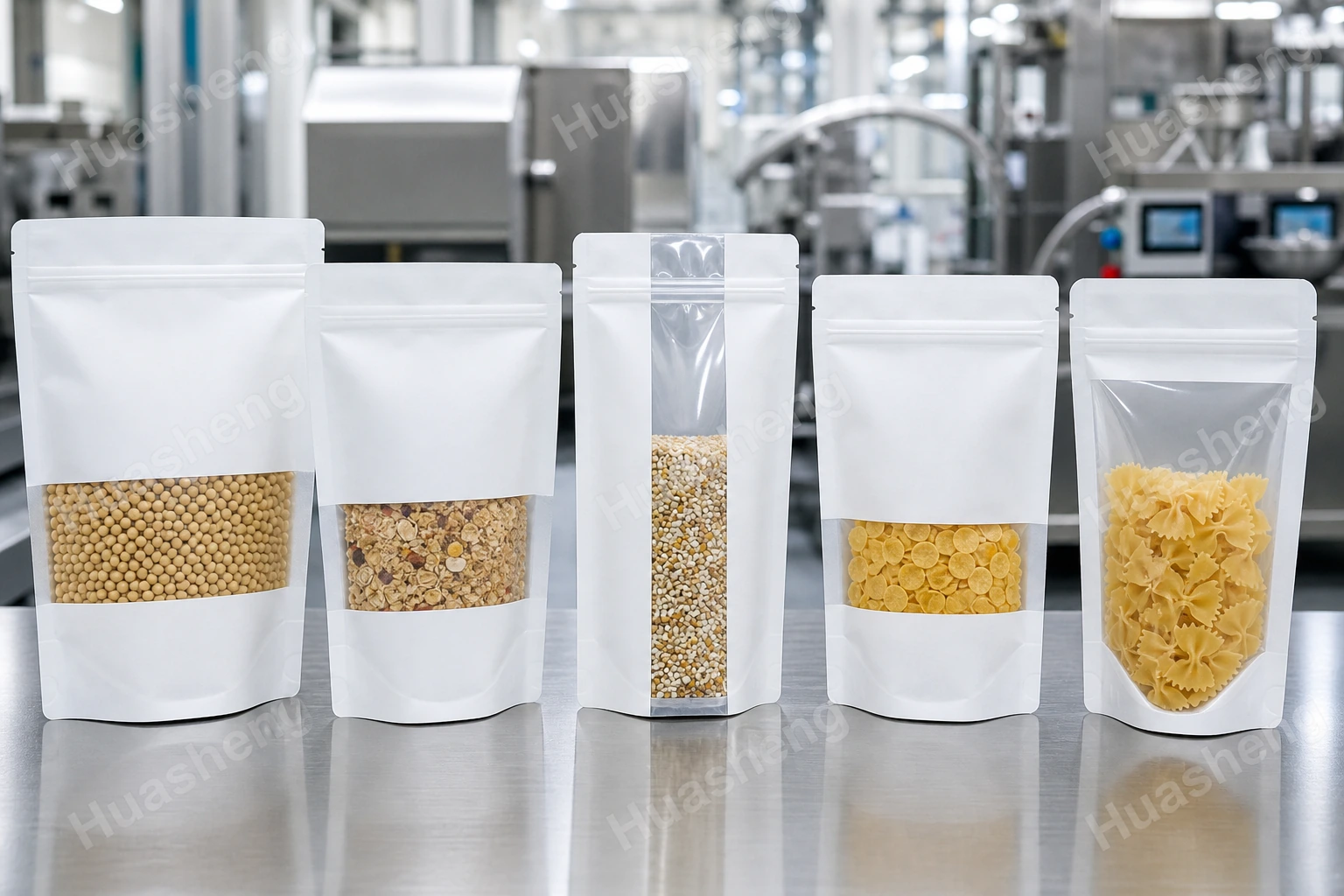 Clear window pouch hero image for barrier and sealing guide.
Learn how to design clear window pouches for dry food, snacks and cereals, including window position, barrier impact, sealing area and quotation details.
Réponse directe
Cette section fournit des repères spécifiques sur clear window pouch design barrier sealing et relie l’achat au produit réel, au mode de remplissage et au marché visé.
Guide technique avec preuves examinées
2026-08-11 · Huasheng Packaging Technical Content Review
Portée des preuves
Window artwork, transparent-barrier direction, seal-area control and the evidence needed before a window pouch is approved.
Portée et limites
No window size, laminate or varnish design is universally suitable. Final clarity, barrier and seals require the actual artwork, converted sample and filled-pack validation.
Points clés
- Window clarity depends on film, ink coverage, varnish and conversion.
- Transparent-barrier film data must be checked after printing, lamination and pouch making.
- Keep window, white-ink, varnish, zipper and seal boundaries explicit in the approved artwork.
Why Food Brands Use Clear Window Pouches
Pour évaluer clear window pouch design barrier sealing, définissez d’abord l’usage réel, les contraintes techniques et le mode de défaillance à maîtriser.
Window Position: Front Lower Window, Side Window or Shaped Window
Pour clear window pouch design barrier sealing, ne choisissez pas uniquement selon le prix ou l’apparence ; vérifiez aussi la compatibilité du matériau, de la machine et des conditions d’utilisation.
Barrier Impact of Clear Window Design
Pour clear window pouch design barrier sealing, comparez les solutions selon la fonction et la performance requise, puis confirmez le choix avec un échantillon ou un essai représentatif. Conservez sans modification ces termes techniques et ces valeurs dans la spécification : ALOX, EVOH, SiOx.
 Clear window and barrier structure comparison for dry food packaging.
Sealing and Production Considerations
Le contrôle qualité de clear window pouch design barrier sealing exige des critères mesurables pour le matériau, l’impression, le scellage et le comportement de l’emballage rempli.
Sealing area and safe zone concept for window pouches.What to Prepare Before Quotation
Pour chiffrer précisément clear window pouch design barrier sealing, préparez les données produit, le format, la structure, la quantité, le fichier graphique, la machine et le marché cible.
Produits associés
Guides d'emballage associés
Claim-to-source evidence matrix
| Reviewed claim | Support | Sources | Boundary |
|---|
| Transparent oxide-coated film performance can change during conversion into a printed laminate and pouch. | direct | [1] | The cited study concerns AlOx-coated films and does not qualify every transparent substrate. |
| EVOH barrier behavior must be interpreted with humidity and laminate design. | direct | [2] | The article does not assign a universal EVOH thickness or target. |
| Barrier decisions require defined OTR/WVTR methods and specimens rather than visual transparency alone. | contextual | [3], [4] | The methods support measurement discipline, not a shelf-life guarantee. |
| Window design must preserve a seal system that can be validated on the final package. | contextual | [5] | Exact clearance and acceptance limits remain project-specific. |
JSON · CSV
Preuves techniques et références
- Conversion of Aluminium Oxide Coated Films for Food Packaging Applications - From a Single Layer Material to a Complete Pouch · Food Packaging and Shelf Life · peer-reviewed
AlOx-coated transparent film performance can change during printing, lamination and pouch conversion - Effect of Humidity on Mechanical, Thermal and Barrier Properties of EVOH Films · Journal of Membrane Science · peer-reviewed
EVOH oxygen-barrier behavior is sensitive to moisture and therefore to laminate design and use conditions - ASTM D3985-24: Oxygen Gas Transmission Rate Through Plastic Film and Sheeting Using a Coulometric Sensor · ASTM International · standard
OTR is measured for a defined specimen under a named method and agreed test conditions - ASTM F1249-25: Water Vapor Transmission Rate Through Plastic Film and Sheeting Using a Modulated Infrared Sensor · ASTM International · standard
WVTR applies to defined flexible barrier specimens and stated test conditions - Understanding the Factors Affecting the Seal Integrity in Heat Sealed Flexible Food Packages: A Review · Packaging Technology and Science · peer-reviewed
Seal integrity is affected by material properties, process parameters and contamination
Questions fréquentes
Can high barrier pouches have a clear window?
Yes, but the window area changes barrier behavior and should be reviewed against the product and shelf-life target.
Is a larger window always better?
No. A larger window shows more product, but it can reduce the barrier area and create more design risk near the seals.
Where should the window be placed?
The lower front area is common, but side windows or shaped windows can also work depending on the pouch style and artwork.
Does a clear window affect shelf life?
It can. The window design should be checked together with the product, filling and storage conditions before final order.
Will matte varnish affect a transparent window?
It may reduce visual clarity if it covers the window. Buyers should confirm whether the window remains clear and whether matte varnish is applied only outside the window area.
How should the artwork show a clear window?
The window should be identified as an ink-free area, and opaque printed graphics may need a separate white-ink layer. The final setup should be checked against the supplier dieline and production sample.
What products are suitable for window pouches?
Dry food, cereal, snacks and pet food often use window pouches when product visibility is important.
What information is needed for quotation?
Please provide product type, bag type, filling weight, target shelf life, window size and position, material preference, quantity, artwork and target market.