Coffee Bag Valve and Material Guide for Custom Coffee Packaging
Huasheng Packaging 技術コンテンツ審査チーム · 公開: · 更新:
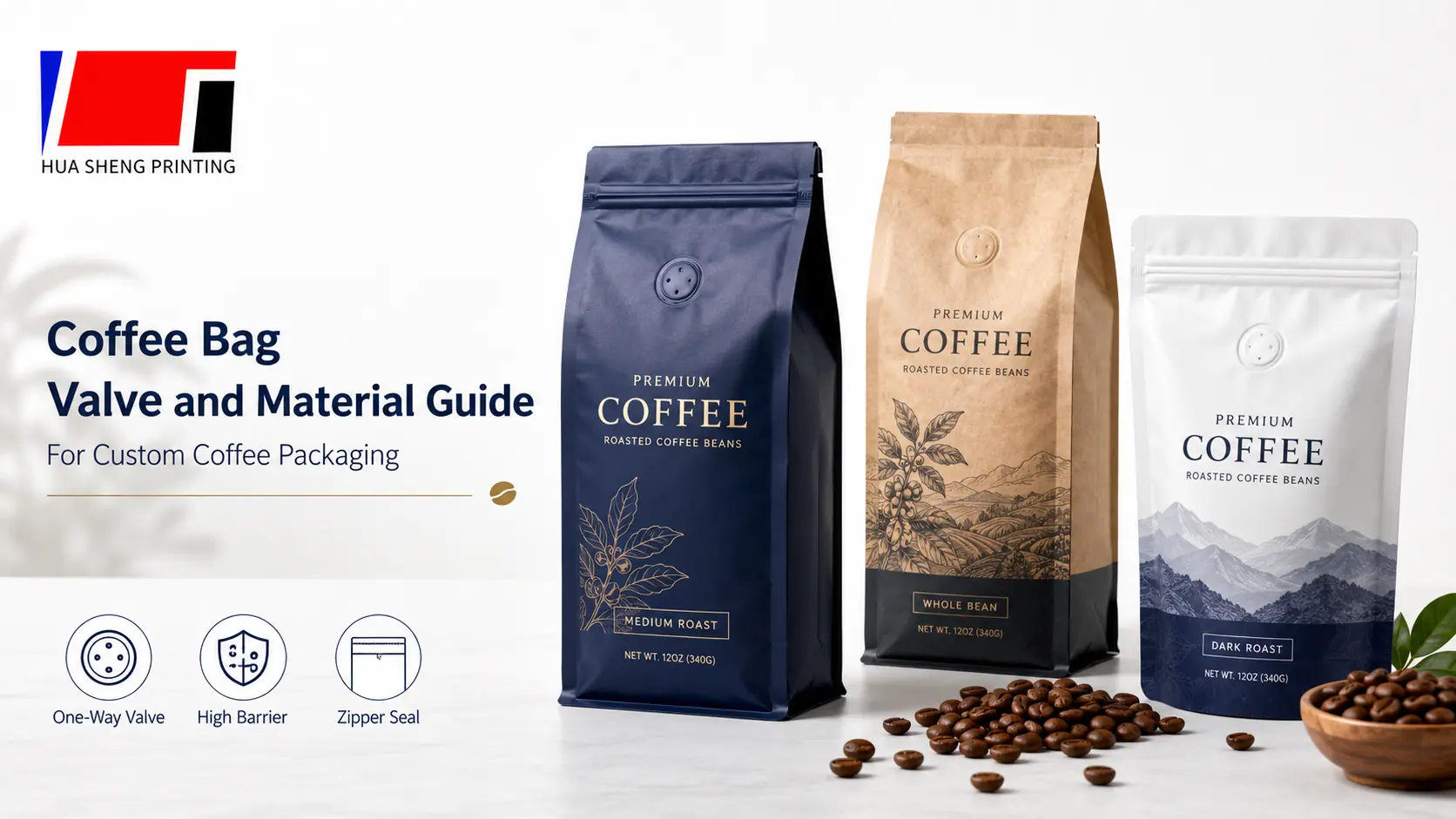 Technical guide visual for Coffee Bag Valve and Material Selection Guide.
Guide to coffee bag valves, degassing, material selection and shelf life. Learn about one-way valves, barrier structures and packaging formats for whole bean, ground and specialty coffee.
先に結論
Coffee packaging is unique because freshly roasted coffee releases CO2 gas. Without proper degassing, coffee bags can inflate, burst or lose aroma. The one-way degassing valve allows CO2 to escape while preventing oxygen from entering, keeping coffee fresh. Beyond the valve, material structure, barrier properties and bag format all affect coffee quality, shelf life and the customer unboxing experience.
Problem Scenario
Common coffee packaging problems:
- Bag inflating or ballooning due to trapped CO2 from freshly roasted beans
- Coffee going stale quickly due to oxygen ingress through the packaging
- Valve not functioning properly — either not releasing gas or letting air in
- Oil from dark roast coffee penetrating the inner layer and causing delamination
- Aroma loss through the packaging material
- Poor seal integrity leading to oxygen exposure
- Bag format not providing enough shelf presence for specialty coffee brands
- Zipper or resealable closure failing after repeated opening
Common Mistakes
Frequent mistakes in coffee packaging:
- Choosing packaging without a degassing valve for freshly roasted coffee
- Using low-cost valves that don't have consistent one-way function
- Ignoring the oil resistance requirement for dark roast or flavored coffee
- Using the same material structure for ground coffee and whole bean
- Not checking the valve placement position (should avoid zipper and seal areas)
- Overlooking the importance of opaque or metalized layers for light-sensitive coffee
- Choosing a bag format that doesn't match the brand positioning
Recommended Coffee Packaging Formats & Materials
Recommended bag formats for coffee:
- Flat bottom pouch with valve: best shelf presence, stable standing, premium look
- Stand up pouch with valve: versatile, cost-effective, good for various sizes
- Quad seal bag with valve: premium square shape, excellent shelf display
- Side gusset bag with valve: traditional coffee bag format
Recommended valve types:
- Standard one-way degassing valve (PP or PE base)
- Low-profile valve for compact packaging
- Transparent valve for design-focused packaging
Recommended material structures:
- PET / AL / PE: highest barrier, best for long shelf life and specialty coffee
- PET / VMPET / PE: good barrier with metallic look, popular for coffee
- Kraft paper / PET / AL / PE: natural kraft look with high barrier interior
- Matte PET / AL / PE: premium soft-touch finish for specialty brands
Quality Check Points
Quality checks for coffee packaging:
- Valve function test: check that gas flows out but not in
- Valve welding strength and position accuracy
- Seal strength test on all sides including zipper area
- Oxygen transmission rate (OTR) test for barrier materials
- Water vapor transmission rate (WVTR) test
- Oil resistance test for inner layer (especially for dark roast)
- Zipper open/close cycle test (minimum 10-20 cycles)
- Drop test with actual coffee weight
What to Prepare Before Inquiry
Prepare the following:
- Coffee type: whole bean or ground
- Roast level: light, medium, dark
- Target bag size and weight capacity
- Desired bag format: flat bottom, stand up, quad seal, side gusset
- Valve requirement: yes/no, position preference
- Zipper or tin tie requirement
- Shelf life target
- Quantity
- Brand positioning (mass market vs specialty/premium)
- Reference sample or photo if available
関連製品
関連包装ガイド
よくある質問
Do I need a valve on my coffee bag?
If you package freshly roasted whole bean or coarse ground coffee within 48 hours of roasting, a one-way degassing valve is strongly recommended to release CO2 and prevent bag inflation. For pre-ground coffee packaged long after roasting, a valve may not be necessary but still adds quality perception.
What material is best for long shelf life coffee?
PET / AL / PE (with aluminum foil) provides the highest oxygen and moisture barrier. Combined with a one-way valve and nitrogen flush, this structure can achieve 12-18 months shelf life for whole bean coffee.
Can I use kraft paper for coffee bags?
Yes, kraft paper gives a natural, artisanal look popular with specialty coffee brands. However, kraft paper alone has no barrier properties, so it must be laminated with barrier layers like AL or VMPET and PE for sealing.
How does the degassing valve work?
The one-way valve contains a thin silicone or rubber membrane that opens when internal pressure exceeds external pressure (CO2 release) but seals when external pressure is higher (preventing oxygen ingress).
What causes coffee oil to damage the packaging?
Dark roast coffee releases more oil which can react with certain PE formulations. An oil-resistant inner layer (modified PE or CPP) should be specified for dark roast or flavored coffee products.