Roll Film for Automatic Packaging Machines: Materials, Printing and Machine Compatibility
Equipo de revisión técnica de Huasheng Packaging · Publicado: · Actualizado:
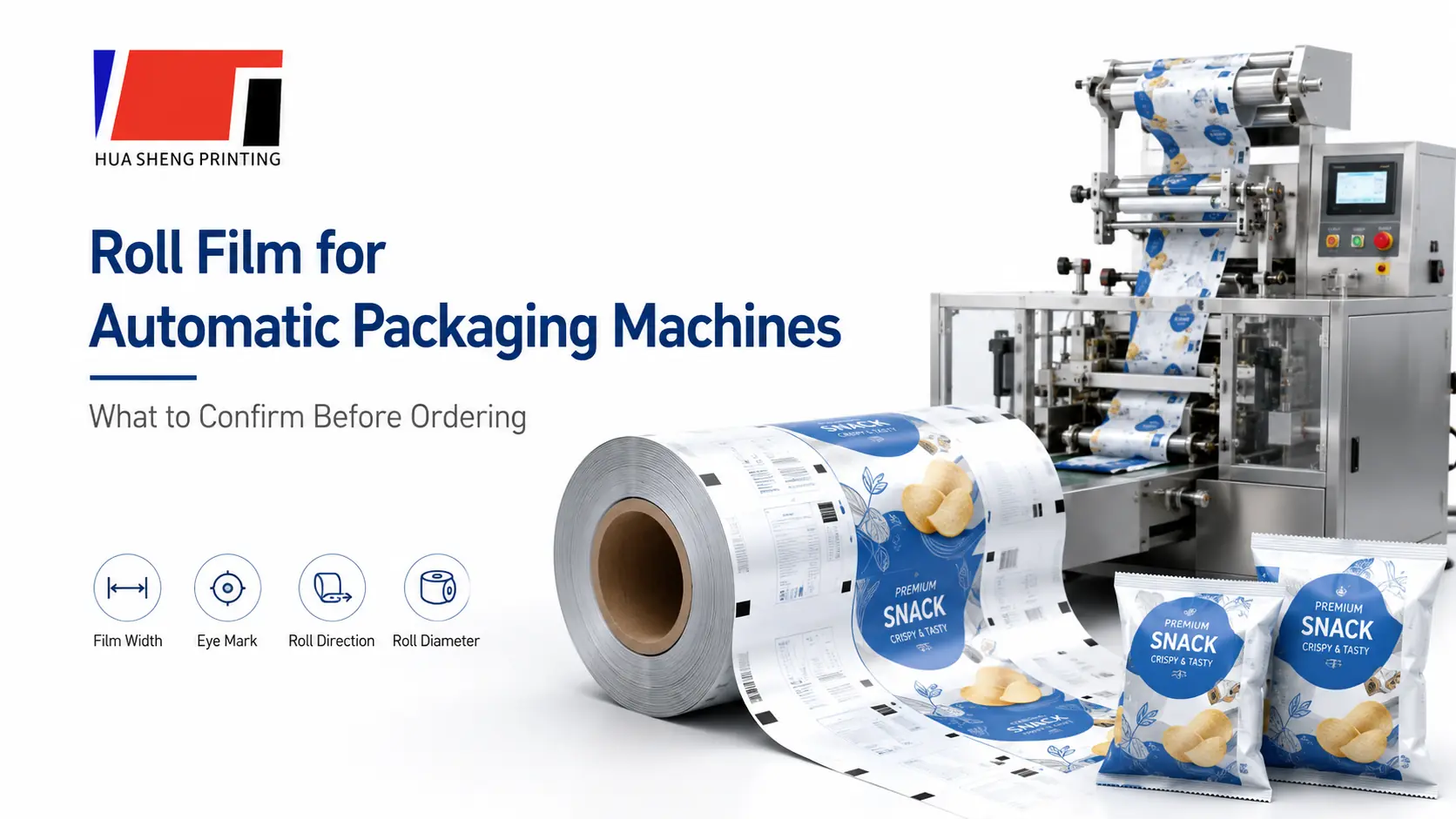 Technical guide visual for Roll Film for Automatic Packaging Machines: Specification, Trial and Handover.
Guide to printed roll film for automatic packaging machines. Learn about film materials, VFFS/HFFS compatibility, surface treatment and key specifications for smooth production.
Respuesta directa
Printed roll film is the backbone of high-speed automatic packaging lines for food, snack, powder, liquid and daily-use products. Unlike pre-made pouches, roll film is fed directly into form-fill-seal (FFS) machines which form, fill and seal the package in one continuous process. The right film structure, surface treatment, COF (coefficient of friction) and winding quality can mean the difference between smooth production and constant machine stoppages.
Problem Scenario
Common problems with roll film in automatic packaging:
- Film slipping or not tracking properly on the machine
- Poor heat sealing: weak seals, uneven sealing or burn-through
- Film wrinkling or curling during unwinding
- Static electricity causing film to stick or attract dust
- Print registration errors due to unstable film tension
- Film tearing at high-speed operation
- Winding too tight or too loose causing unwinding issues
- Surface treatment degradation over time (dyne level drop)
- Incompatible film structure for the specific machine type (VFFS vs HFFS)
Common Mistakes
Frequent mistakes when ordering roll film:
- Not specifying the machine type (VFFS, HFFS, thermoform, etc.)
- Not providing machine specifications (seal bar type, film width, roll diameter)
- Ordering film with wrong COF for the machine
- Ignoring the required dyne level for printing and lamination
- Not checking film thickness tolerance across the roll width
- Wrong core size (76mm vs 152mm)
- Incorrect winding direction (print in vs print out)
- Not specifying splice requirements or splice-free roll length
- Overlooking storage and shelf life of the roll film
Recommended Film Structures by Application
Common film structures for automatic packaging:
Snack and dry food (VFFS):
- BOPP / VMPET / PE: excellent moisture barrier, crisp appearance
- BOPP / PE: basic structure for short shelf life snacks
- Matte BOPP / VMPET / PE: premium soft-touch finish
Frozen food:
- PET / PE: good cold resistance, anti-fog option available
- PET / VMPET / PE: improved barrier for frozen products
Powder and granule:
- PET / AL / PE: maximum barrier and puncture resistance
- PET / VMPET / PE: moderate barrier with metallic look
Liquid and sauce (stick pack / sachet):
- PET / AL / PE: highest barrier, good for liquid sachets
- PET / PA / PE: improved puncture resistance for sharp-edged products
Key specifications to confirm:
- Film width and thickness
- Core size (76mm standard, 152mm for larger rolls)
- Maximum roll outer diameter
- Winding direction: print-in or print-out
- Surface COF: typically 0.2-0.4 for smooth machine running
- Dyne level: minimum 38 dynes/cm for printing, 42+ for lamination
Quality Check Points
Quality checks for roll film:
- Thickness measurement across the web width (profile scan)
- Surface treatment level (dyne test at multiple points across the roll)
- COF test (static and dynamic)
- Seal strength test at different temperatures (seal curve)
- Hot tack test for high-speed filling lines
- Print registration accuracy check
- Winding tension consistency check
- Roll hardness and appearance inspection
- Splice count and marking verification
- Lamination bond strength test
- Solvent retention test for food safety
- Pinhole inspection for barrier films
What to Prepare Before Inquiry
Prepare these specifications:
- Machine type and brand (VFFS, HFFS, thermoform, stick pack, etc.)
- Film width and thickness requirements
- Core size and maximum roll diameter
- Winding direction (which side out?)
- Packaging speed (pcs/min)
- Sealing type: heat seal bar, impulse seal, ultrasonic
- Filling product type and characteristics
- Target shelf life
- Printing design and color count
- Quantity (kg per SKU)
- Reference roll sample if available
Productos Relacionados
Guías de Envasado Relacionadas
Preguntas Frecuentes
What is the difference between VFFS and HFFS film requirements?
VFFS (Vertical Form Fill Seal) typically uses film with specific COF ranges for vertical tube forming and requires good hot tack for vertical sealing under product weight. HFFS (Horizontal Form Fill Seal) may require different stiffness and curl characteristics for horizontal forming and filling.
What COF should my film have?
For most VFFS machines, a static COF of 0.2-0.4 and dynamic COF of 0.15-0.35 is typical. Too high and the film will not slide properly; too low and it may slip or cause tracking issues. Always check your machine manual for recommended ranges.
Why does the dyne level matter?
The dyne level (surface energy) determines how well inks and adhesives bond to the film surface. For printing, minimum 38 dynes/cm is standard. For lamination, 42+ dynes/cm is recommended. Surface treatment degrades over time, so fresh film should exceed the minimum by 2-4 dynes.
What is the standard core size for roll film?
76mm (3 inches) is the most common core size. Larger rolls for high-speed lines may use 152mm (6 inches) cores. Always specify the core size and whether you need notched or plain cores.
How long can roll film be stored before use?
Typically 6-12 months under proper storage conditions (cool, dry, away from direct sunlight). Surface treatment (dyne level) can degrade over time, so film should be used within the recommended period, especially for lamination-grade film.
What winding direction do I need?
Print-out (image facing out) is most common for VFFS machines. Print-in (image facing in) may be required for certain HFFS machines or when specific surface contact is needed. Always confirm with your machine operator.