Flexible Packaging Filling and Sealing Problems: A Buyer Troubleshooting Guide
Huasheng Packaging Technical Content Review · Published: · Updated:
 Seal performance should be reviewed with defined specimens, conditions and failure observations.
Troubleshoot pouch and roll-film leaks, weak seals, wrinkles and contamination by checking material, temperature, pressure, dwell time and machine fit.
Direct answer
A leaking or weak seal does not identify one cause by itself. Isolate material, seal contamination, temperature, pressure, dwell time, jaw condition and film or pouch handling, then test the intended pack with the real product on the production line.
Evidence-reviewed technical guide
2026-08-11 · Huasheng Packaging Technical Content Review
Evidence scope
Symptom isolation across material, machine, process and product variables, followed by controlled seal and leak verification.
Scope and limitations
The guide does not prescribe machine settings or acceptance limits. Methods, specimens and limits must be agreed for the actual package, product and line.
Key takeaways
- A visible seal defect can have more than one cause.
- Seal strength, visual integrity and gross-leak tests answer different questions.
- Use representative filled packs and change one controlled variable at a time.
Build a Symptom-to-Check Matrix Before Changing the Line
Record the defect, location, timing and frequency before adjusting the machine. Weak top seal: check contamination, sealant compatibility, temperature, pressure, dwell and jaw contact. Intermittent channel leak: check folds, product particles, jaw alignment and pouch or web presentation. Wrinkles or cut-position drift: check tracking, tension, repeat, eye-mark sensing and unwind. Spout or zipper leakage: isolate the accessory weld, surrounding laminate and final top seal.
Separate observations from conclusions. A photograph can show a wrinkle or channel but usually cannot prove whether material, equipment or product caused it. Retain failed and acceptable packs from the same run, mark the time and machine cycle, and compare where the defect begins. This makes the next trial repeatable and reduces uncontrolled setting changes.
Do Not Treat Seal Strength, Visual Inspection and Leak Testing as the Same Check
ASTM F88/F88M measures the force required to separate a seal strip and identifies the failure mode. ASTM F1886/F1886M covers visual inspection under a defined scope and notes that visibility depends on channel size, contrast, material, lighting and inspector capability. ASTM F2096 addresses gross leaks using internal pressurization. These methods answer different questions; one passing result does not automatically prove all aspects of package integrity.
Raising temperature without checking pressure, dwell, contamination or jaw condition can distort the pack without removing the cause. Testing clean empty packs can hide powder, oil, liquid, fill temperature and product-edge effects. Change one controlled variable at a time, keep the other inputs recorded, and compare the failure mode rather than only the maximum force value.
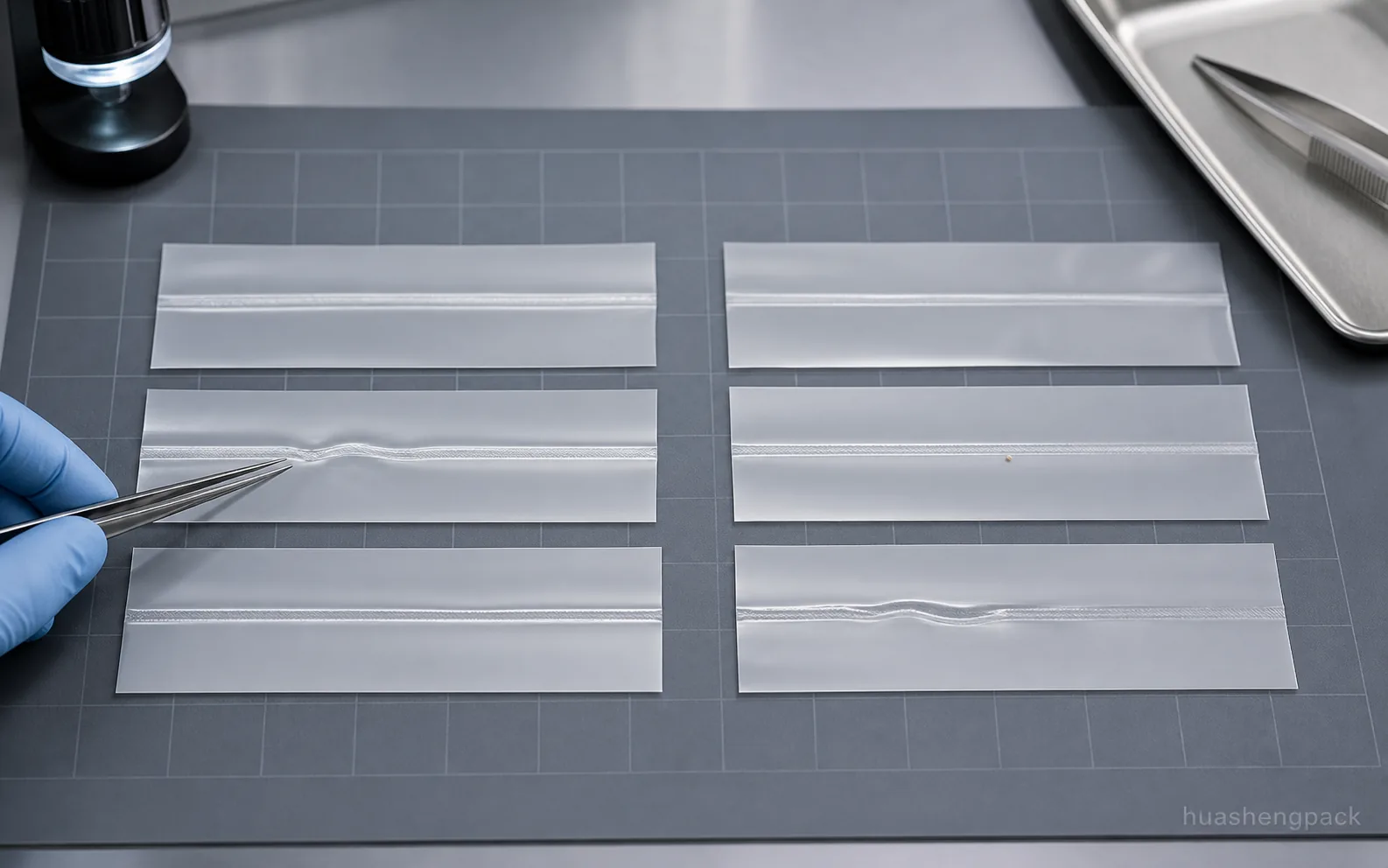 Channels, folds and contamination can create different sealing risks and should be assessed by an agreed method.
Separate Material, Machine, Product and Handling Causes
Material checks include the sealant family and grade, total thickness, curl, surface friction, lamination condition and damage at folds. Machine checks include jaw alignment and surface, actual temperature control, pressure, dwell, tracking, tension and sensor setup. Product checks include fill temperature, particles or oil in the seal, headspace, weight and internal pressure. Handling checks include cooling time, compression, dropping, frozen conditioning and storage.
Use a decision sequence: locate the failure; reproduce it under known settings; compare acceptable and failed packs; isolate one variable; repeat with representative contents; then confirm an operating window. The same visible defect can arise from more than one group, so do not assign responsibility from appearance alone.
Confirm a Repeatable Sealing Window and Acceptance Record
Run representative filled packs across an agreed temperature, pressure and dwell window. Where relevant, include startup, stable target speed, planned stops, restart and reel or pouch-lot change. Inspect seal channels, wrinkles, distortion, contamination and accessory welds, then select seal-strength, visual or leak methods that match the actual failure question. Define specimen direction, conditioning, equipment, method revision and acceptance rule before testing.
The approval record should identify material structure and revision, pouch or reel specification, product condition, machine, settings, line speed, sample count, failure modes and retained samples. A laboratory seal result supports process understanding but does not replace production-line compatibility or product shelf-life validation.
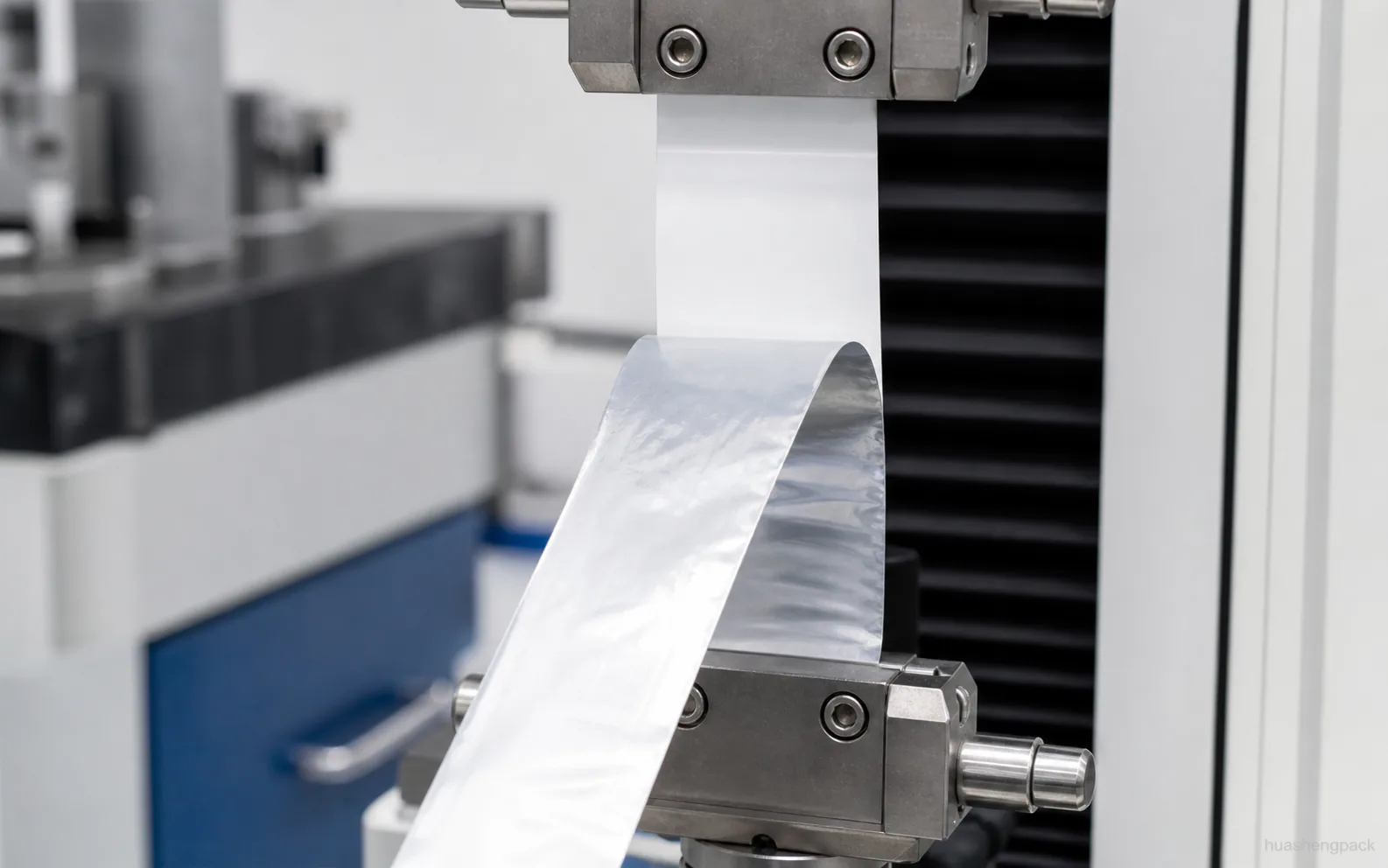 Grip alignment, specimen preparation and test conditions affect how peel observations should be interpreted.
Evidence Package for Supplier and Line Troubleshooting
Provide failed and acceptable retained samples; failure location, timing and frequency; product and fill weight; fill temperature; machine model; jaw type; temperature, pressure and dwell; line speed; pouch or reel specification; storage condition; and clear photos or video. Add reel number, pouch batch, artwork and specification revision, sensor and eye-mark information for roll film, and any recent material, supplier, machine or process change.
When comparing corrective trials, use the same product, fill level, conditioning and inspection sequence unless that input is the controlled variable. Record what changed, who approved it and whether the change must be carried into the next production specification.
Related Products
Related Packaging Guides
Claim-to-source evidence matrix
| Reviewed claim | Support | Sources | Boundary |
|---|
| Seal strength is a quantitative process measure rather than a complete leak assessment. | direct | [1] | The test method does not establish a universal acceptance value. |
| Visual seal defects can provide early evidence of process variation or compromised integrity. | direct | [2] | Visual inspection has material, contrast and inspector limitations. |
| Gross-leak testing is a separate destructive examination and should not be conflated with seal-strength measurement. | direct | [3], [1] | The appropriate method depends on package construction and the agreed failure question. |
| Material properties, process settings and contamination can all affect heat-seal integrity. | direct | [4] | The review supports systematic isolation, not a universal troubleshooting setting. |
JSON · CSV
Authoritative References
- ASTM F88/F88M-21: Seal Strength of Flexible Barrier Materials · ASTM International · standard
Seal strength is a quantitative measure used for process validation, control and capability - ASTM F1886/F1886M-09: Integrity of Seals for Flexible Packaging by Visual Inspection · ASTM International · standard
Visual seal defects can indicate process variation or a possible package-integrity problem - ASTM F2096-11: Detecting Gross Leaks in Packaging by Internal Pressurization · ASTM International · standard
Internal pressurization is a destructive method for examining packages for gross leaks - Understanding the Factors Affecting the Seal Integrity in Heat Sealed Flexible Food Packages: A Review · Packaging Technology and Science · peer-reviewed
Seal integrity is affected by material properties, process parameters and contamination
Frequently Asked Questions
Why does a pouch leak only after filling?
Product contamination, internal pressure, fill temperature, handling or changed jaw contact may expose a weakness that an empty-pouch test does not reproduce.
Should sealing temperature be increased first?
Not automatically. Check sealant compatibility, pressure, dwell, jaw alignment and contamination, then change one controlled variable at a time.
Does ASTM F88 prove that a package has no leaks?
No. ASTM F88 measures seal-strip separation force and failure mode. Package integrity may require visual or leak methods selected for the actual defect risk.
Can one sealing setting work for every laminate?
No. Sealant type, thickness, equipment, speed and product conditions affect the usable operating window.
How should intermittent seal leaks be investigated?
Compare defect location and timing with folds, product particles, jaw contact, tracking and machine cycles, using retained failed and acceptable packs.
How should roll-film tracking problems be investigated?
Check reel width, unwind, tension, friction, repeat, eye-mark contrast and sensor setup together with machine condition.
Does a successful sample test guarantee bulk line performance?
No. It reduces uncertainty, while final performance still depends on production material, equipment, settings, product and operating control.