Food Packaging Material Selection Guide: How to Choose Materials for Powder, Liquid, Coffee and Retort Products
Huasheng Packaging तकनीकी सामग्री समीक्षा टीम · प्रकाशित: · अपडेट:
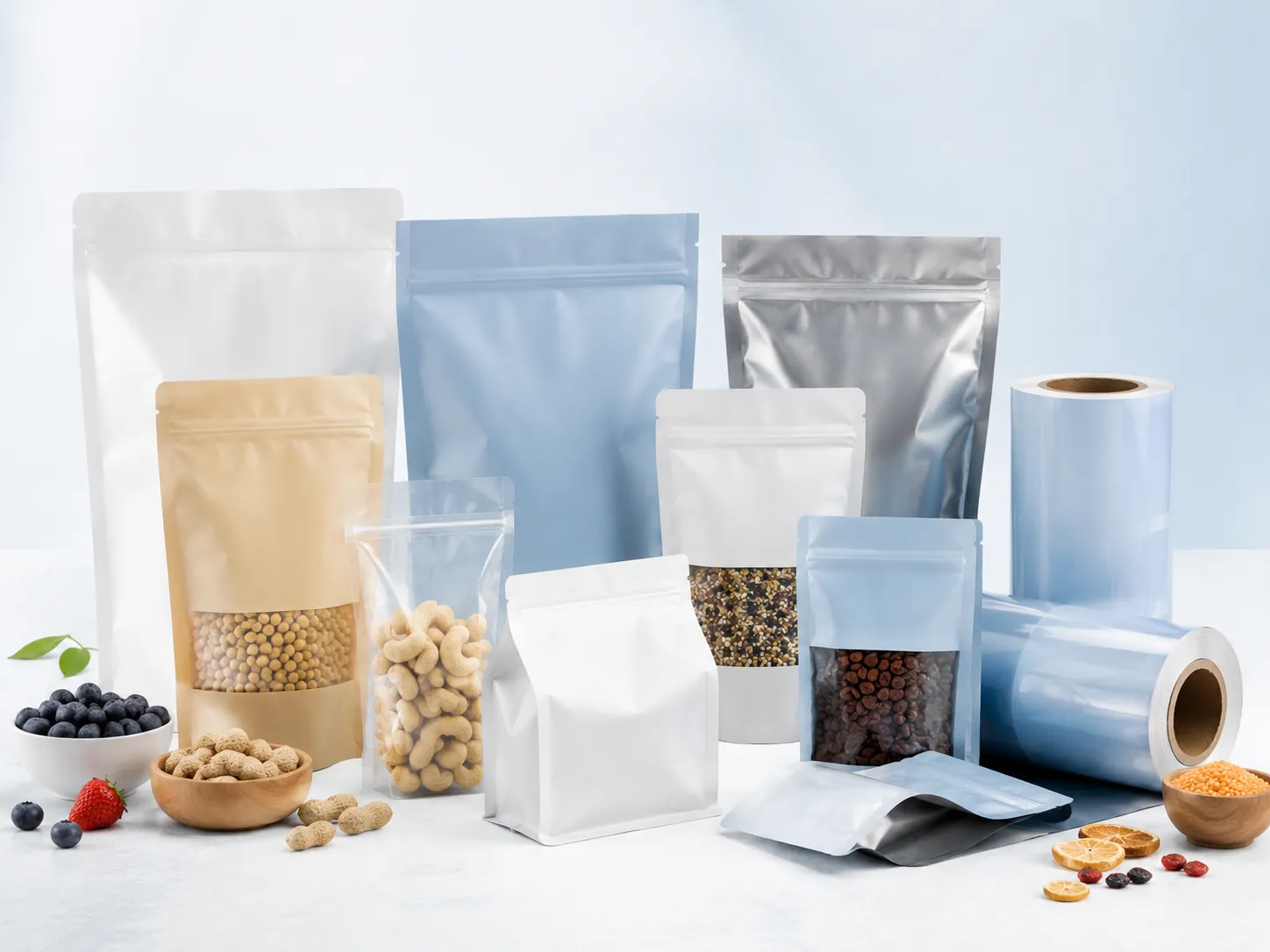 Technical guide visual for Food Packaging Material Selection Guide for Flexible Pouches and Roll Film.
Learn how to choose food packaging materials for powder, liquid, coffee and retort products. Compares PET/PE, VMPET, aluminum foil, NY/PE and retort-grade structures with practical selection guidance.
सीधा उत्तर
Choosing the right food packaging material is not only about cost. The material structure directly affects barrier performance, sealing strength, shelf life, filling compatibility and final consumer experience. This guide helps packaging buyers understand how to select suitable material structures based on product type — whether you are packing powder, liquid, coffee, sauce or retort food — and what key factors to check before production.
Why Material Selection Matters
Food packaging material selection is not a one-size-fits-all decision. The material structure must match the product characteristics: dry or liquid, oily or aqueous, acidic or neutral, ambient or frozen, light-sensitive or oxygen-sensitive, short or long shelf life. A structure that works well for dry snacks may fail for liquid sauce. A film suitable for ambient storage may not perform at -18\u00b0C. The packaging machine type, filling method, sealing temperature, transport distance and retail display requirement also influence material choice.
Before selecting a material structure, buyers should clarify: what product will be packed? What is the filling weight? Is the product dry, liquid, oily, powder or frozen? What shelf life is needed? What storage and transport conditions apply? Will the packaging be used on an automatic packing machine? Answering these questions helps narrow down suitable material options and avoid costly mistakes.
Common Material Structures for Food Packaging
The table below summarises common material structures used in food flexible packaging. The final structure should be confirmed based on product type, filling weight, shelf life, storage conditions and packaging machine compatibility.
Material Structure Comparison:
BOPP/CPP — Best for lightweight snacks, candy, biscuit roll film. Main benefit: cost-effective, good machinability on HFFS/VFFS machines. Notes: limited moisture and oxygen barrier.
PET/PE — Best for general dry food, powder, seasoning, stand-up pouches, three-side-seal pouches. Main benefit: balanced barrier, good heat sealing and printing quality. Notes: adequate for many ambient dry products.
PET/VMPET/PE — Best for snacks, nuts, dried fruit needing light and moisture barrier. Main benefit: VMPET layer adds barrier without full aluminum cost. Notes: not transparent.
PET/AL/PE — Best for coffee, milk powder, high-barrier dry food. Main benefit: strongest aroma, oxygen and moisture protection. Notes: higher cost; recommended for premium or long shelf life products.
PET/NY/PE or PA/PE — Best for liquid, sauce, frozen food, products needing puncture resistance. Main benefit: NY/PA layer adds strength, flexibility and cold tolerance. Notes: confirm sealing layer compatibility with product.
PET/AL/CPP or PET/NY/RCPP — Best for retort pouches, high-temperature sterilized food. Main benefit: retort-grade sealing layers withstand 121\u00b0C-135\u00b0C. Notes: requires testing with actual sterilization process.
Material Selection by Product Type
For powder products (seasoning, milk powder, protein powder, spice): PET/PE for standard moisture protection. PET/VMPET/PE for better moisture barrier. PET/AL/PE for maximum moisture and oxygen protection. Key concern: powder products are sensitive to moisture. Focus on moisture barrier and sealing strength. Confirm filling method — powders can create dust that interferes with heat sealing.
For liquid or sauce products (juice, sauce, puree, detergent, shampoo refill): PET/PE for ambient liquid with standard shelf life. PET/NY/PE or PA/PE for stronger puncture resistance and flexibility. PET/AL/PE for high-barrier liquid products. Key concern: liquid products stress the sealing area more than dry products. Material structure must be tested for sealing strength, drop resistance and leakage under actual filling and transport conditions. The sealing layer must be compatible with the liquid product — some liquids are oily, acidic or contain alcohol. Always test with the actual product, not only water.
For coffee products (whole bean, ground coffee): PET/VMPET/PE for standard coffee with moderate barrier. PET/AL/PE for maximum aroma and oxygen protection. Kraft/VMPET/PE for natural paper appearance with good barrier. Kraft/AL/PE for natural look with maximum barrier. Key concern: coffee needs aroma barrier and oxygen barrier. One-way degassing valve and resealable zipper add convenience. Flat bottom pouch format provides strong shelf display.
For retort / high-temperature sterilization (ready meals, curry, soup, pet wet food): PET/AL/CPP for standard retort. PET/NY/CPP for non-foil microwaveable retort. PET/AL/NY/CPP for maximum retort performance. Key concern: 121\u00b0C and 135\u00b0C sterilization place different demands on material structure. A structure suitable for 121\u00b0C may not work at 135\u00b0C. The complete pouch structure must be tested with the customer actual filling product and sterilization process before bulk production. Retort-grade adhesives and sealing layers are essential.
Material directions should be compared against the product, pack format, sealing process and validation plan.Shelf Display Considerations
Packaging material also affects shelf appearance and brand presentation. Flat bottom pouch: 5 printable panels, box-like shape, strong shelf stability — suitable for premium coffee, tea, nuts and pet food. Stand up pouch: bottom gusset, cost-effective, flexible for many product types — suitable for snacks, candy, powder and general dry food. Custom shaped pouch: unique die-cut silhouette, strong visual recognition — suitable for candy, jelly, promotional items. Kraft paper bag: natural paper appearance, eco-style branding — suitable for coffee, tea, organic products. The material structure should support the desired surface finish: glossy, matte, soft-touch or kraft paper. Surface finish affects consumer perception and shelf appeal.
What to Send Before Quotation
Before requesting a material recommendation or quotation, prepare these details:
1. Product type — dry powder, liquid, sauce, coffee, frozen, retort food, etc.
2. Filling weight — grams or ml per package
3. Preferred bag size or roll width
4. Bag type — stand-up pouch, flat bottom, three-side-seal, spout pouch, roll film
5. Material structure if known — or we can suggest based on your product
6. Expected shelf life — how long the product should stay fresh
7. Storage condition — ambient, chilled or frozen
8. Packing machine type if applicable — VFFS, HFFS, manual, semi-automatic
9. Quantity — pieces for pouches, kg for roll film
10. Printing colors — up to 9-color gravure printing
11. Artwork file — AI, PDF or PSD format
12. Target market — for market compliance and handover reference
संबंधित उत्पाद
संबंधित पैकेजिंग गाइड
अक्सर पूछे जाने वाले प्रश्न
What is the most common food packaging material structure?
PET/PE is one of the most commonly used structures for general dry food packaging, offering a good balance of barrier, sealing and printing quality. However, the best structure depends on product type, shelf life, filling method and storage conditions. Other common structures include BOPP/CPP, PET/VMPET/PE and PET/AL/PE.
Which material structure is suitable for liquid packaging?
PET/PE, PET/NY/PE, PA/PE and PET/AL/PE are commonly considered depending on product viscosity, acidity, filling temperature and shelf life. Liquid packaging should be tested for sealing strength, leakage and material compatibility. The final structure should be confirmed with actual product testing.
Which material structure is better for coffee bags?
PET/VMPET/PE provides good aroma and moisture barrier for standard coffee. PET/AL/PE offers stronger aroma and oxygen barrier for premium or long shelf life coffee. Kraft/VMPET/PE combines natural paper appearance with barrier protection. The choice depends on coffee type, shelf life and brand positioning.
Which material structure gives longer shelf life?
Structures containing aluminum foil (PET/AL/PE) generally provide the strongest oxygen and moisture barrier, supporting longer shelf life. However, shelf life also depends on sealing integrity, storage conditions and product characteristics. The material structure should be selected together with proper sealing and quality control.
What material is used for retort pouch?
Retort pouches typically use retort-grade structures such as PET/AL/CPP, PET/NY/CPP or PET/AL/NY/CPP. These structures are designed to withstand 121\u00b0C-135\u00b0C sterilization. The final structure must be tested with the actual sterilization process before bulk production.
Can Huasheng help choose material if I am not sure?
Yes. Based on your product type, filling weight, shelf life requirement, storage conditions and packaging machine type, we can suggest suitable material structures for your evaluation. Sending a reference sample or photo of your current packaging also helps us understand your needs.