How to Test and Evaluate Retort Pouch Samples: Sterilization Validation, Seal Strength and Barrier Checklist
Huasheng Packaging Technical Content Review · Published: · Updated:
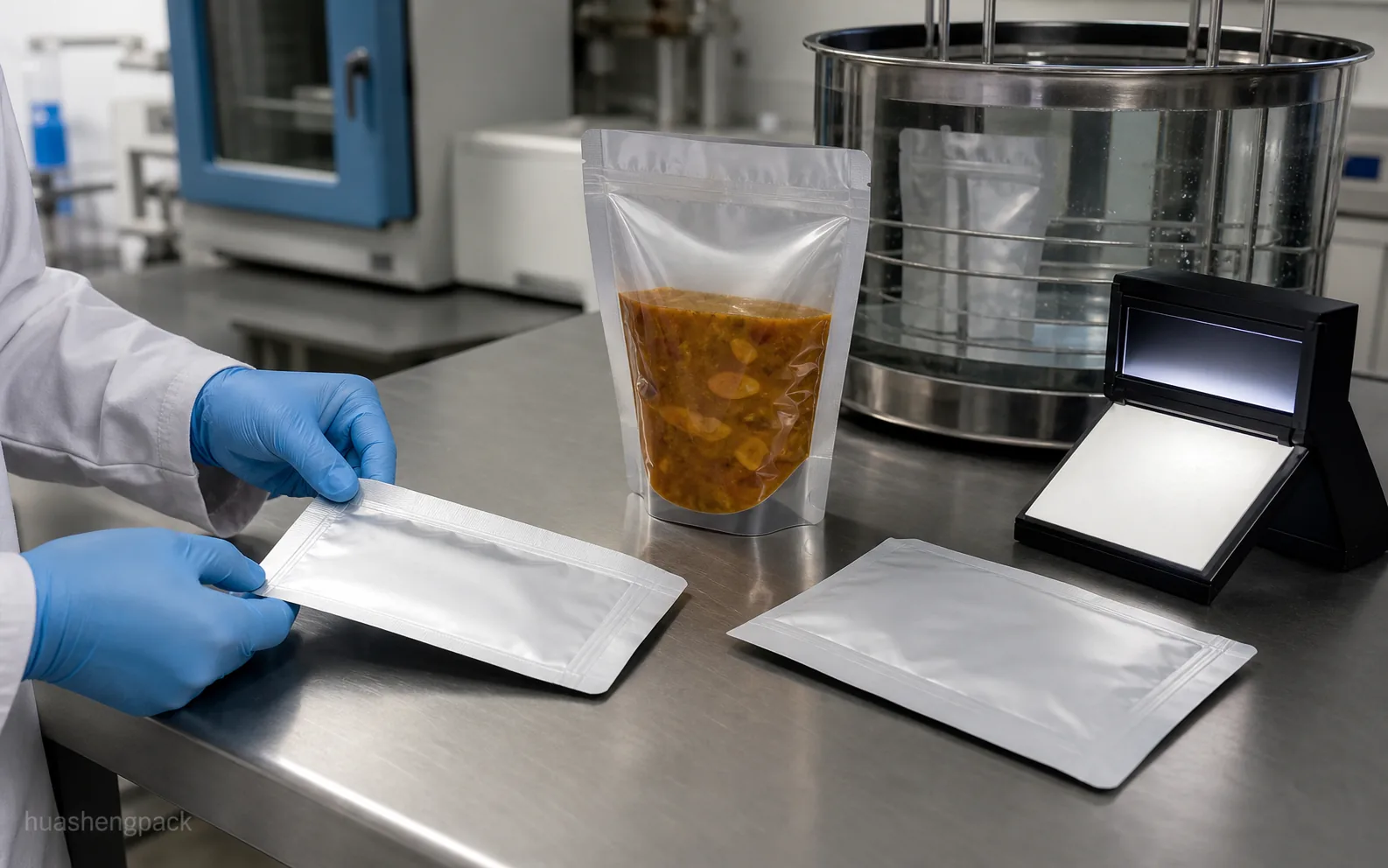 Retort pouch samples should be evaluated with the intended product, sealing equipment and validated processing conditions.
Learn how to evaluate retort pouch samples with real product filling, sealing, sterilization validation, leakage checks, seal strength and shelf-life observation.
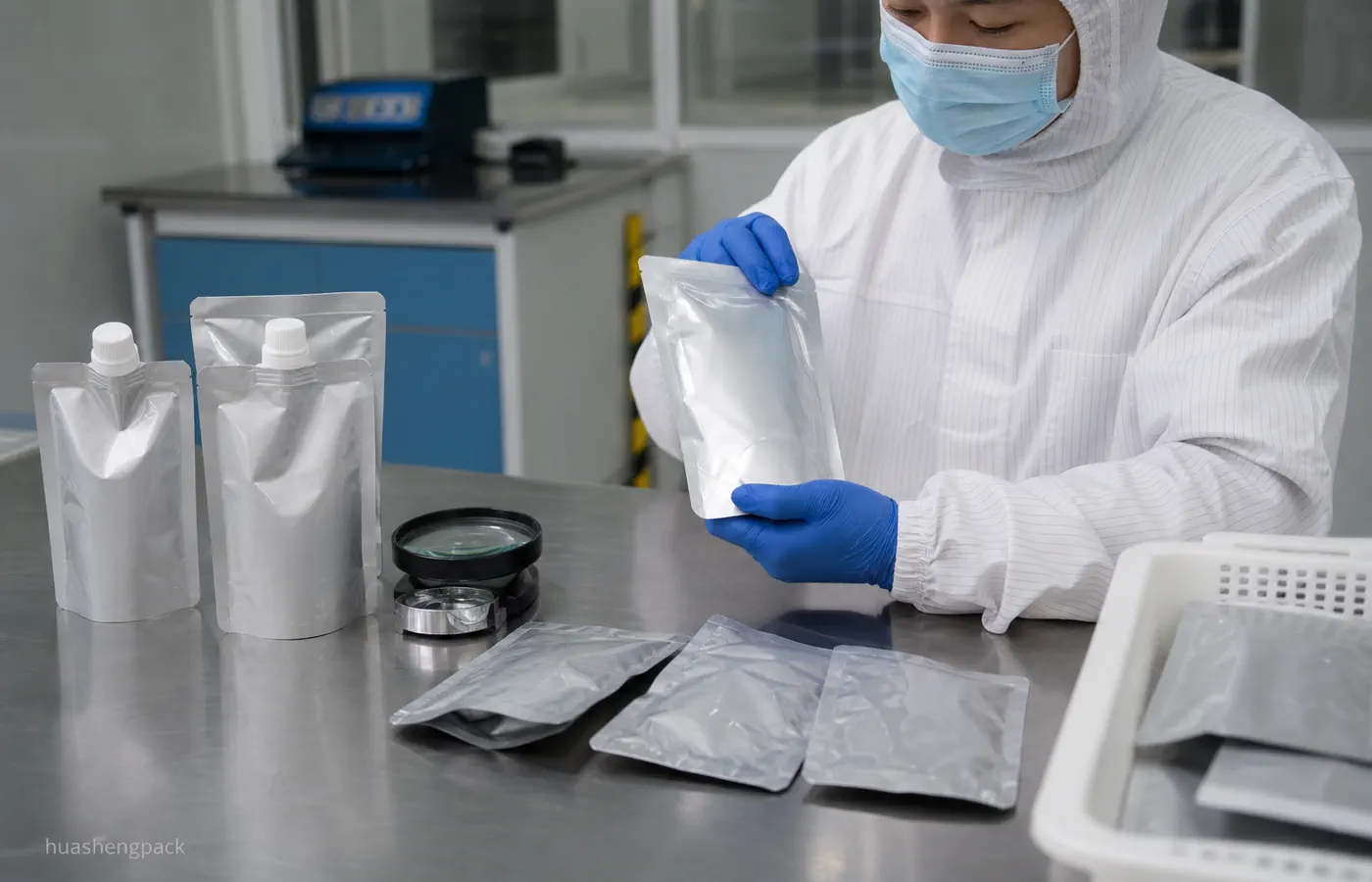
Direct answer
Retort pouches are high-performance packaging designed to withstand high-temperature sterilization while protecting ready meals, seafood, meat, sauces and pet food. Receiving retort pouch samples from a supplier is an important step — but looking at the pouch appearance and thickness is not enough. The real evaluation happens when the pouch is filled with actual product, sealed on production equipment, run through the sterilization process, and observed over time. This guide explains what buyers should check before, during and after retort pouch sample testing, and why final validation must involve the actual food product and sterilization conditions.
Why Retort Pouch Samples Must Be Tested Before Bulk Order
Retort pouches operate under demanding conditions: high temperature (commonly 121°C or higher), pressure, and direct contact with food contents that may be acidic, oily, salty or contain sharp bone fragments. A pouch that looks perfectly fine on the desk may fail under these conditions.
Key reasons to test samples before committing to bulk production:
- The pouch material must be compatible with the actual product. Sauce, oil, brine or acidic foods interact differently with the inner sealing layer.
- Sealing parameters (temperature, pressure, time) depend on the specific pouch structure, filling machine and product characteristics. No supplier can provide the exact sealing settings without testing with the actual product on the buyer's equipment.
- Sterilization conditions (temperature, time, pressure, method) vary between products. A structure that works for one product at 121°C for 30 minutes may not work for another at the same temperature for 60 minutes.
- Bone fragments, hard spices or irregular product shapes can stress the pouch material in ways that empty-pouch testing cannot simulate.
Sample testing is a risk-reduction step. It does not eliminate all risk, but it identifies incompatibilities before they become bulk production problems. Always test with real product, real filling conditions and real retort processing.
What to Check Before Filling the Sample
Before any product goes into the pouch, check the empty sample for basic quality indicators. These checks help identify visible defects and confirm that the sample matches the agreed specification.
Checklist before filling:
- Pouch dimensions: Measure width, length and gusset depth (if applicable). Compare against the agreed size. Minor variation is normal in sample production, but significant differences should be discussed.
- Material structure: Confirm the stated structure (e.g., PET/AL/PA/CPP) with the supplier. If cross-section inspection is available, check that the layers match the specification.
- Total thickness: Measure with a micrometer at multiple points. Confirm against the specified thickness.
- Seal area: Check that the seal area width is consistent and free of wrinkles, contamination or unevenness.
- Notch, zipper or spout: If the pouch includes a tear notch, zipper or spout, check positioning, alignment and functionality.
- Print and lamination appearance: Check print registration, color accuracy, text clarity and barcode readability. Look for lamination bubbles, delamination, or uneven surface.
- Pouch flatness: The pouch should lie reasonably flat without curling or twisting. Excessive curl can cause feeding problems on filling lines.
- Sealing layer suitability: Confirm with the supplier that the inner sealing layer (typically CPP for retort) matches the product type and sterilization conditions.
- Batch identification: Note the sample batch or production date. This helps trace any issues back to the production record if needed.
Filling and Sealing Test with the Real Product
Testing with the actual product is essential. Water or surrogate fillers cannot replicate how real food interacts with the pouch material and seal area.
Key points for the filling and sealing test:
- Use the actual product: The same formulation, piece size, oil content, sauce viscosity and temperature at filling as planned for production.
- Use the target filling weight: Overfilling or underfilling changes headspace, which affects heat penetration during sterilization and pouch stress during handling.
- Use production-representative sealing equipment: If possible, seal samples on the same type of machine planned for production. Hand sealing or laboratory sealing may not replicate production seal quality.
- Watch for seal contamination: Product residue (oil, sauce, powder, brine) in the seal area is a common cause of seal failure. If the product splashes or leaves residue in the seal zone during filling, discuss with the supplier whether a wider seal area or modified filling process is needed.
- Record sealing parameters: Document the sealing temperature, pressure (or jaw force) and dwell time used. These become reference points for production settings.
- Check headspace: Consistent headspace supports even heat distribution during retort processing.
- For products with bone fragments or hard pieces: Check whether sharp edges puncture the pouch material during filling or handling. Consider whether a higher puncture resistance structure is needed.
- Note any immediate issues: Seal wrinkles, incomplete sealing, product trapped in seal, uneven filling, pouch deformation.
Retort Sterilization Validation and Post-Retort Inspection
Sterilization validation should be performed by the food producer or a qualified testing party using the intended production retort equipment and process parameters.
Important: Packaging suppliers can provide material and structure recommendations, but the final sterilization process must be validated by the party responsible for food safety. Do not assume a pouch structure is suitable for all retort conditions without testing.
Retort process parameters to document:
- Sterilization temperature and time profile
- Pressure setting
- Retort method: water immersion, water spray, steam-air, or other
- Heating and cooling ramp rates
- Product initial temperature at loading
What to check after the retort process:
- Leakage: The most critical post-retort check. Any sign of leakage — liquid seepage, staining along the seal, odor — indicates a seal integrity problem. Even one leaker in a sample batch should be investigated.
- Seal deformation: Check whether seals have wrinkled, curled or thinned after retort. Some seal appearance change is normal, but significant deformation may indicate incompatible sealing conditions.
- Pouch delamination: Check for separation between film layers, especially near the seal area and pouch corners. Delamination can occur if the laminate bond is not retort-resistant or if the sterilization conditions exceed the adhesive's tolerance.
- Wrinkles or tunneling: Some surface wrinkling from retort processing may be cosmetic. But deep wrinkles or tunneling (channel formation) can affect barrier and seal integrity.
- Print change: Check whether print colors have faded, shifted or blistered after retort. Retort-grade inks should withstand the process, but verifying on actual samples is important.
- Odor: Unusual odor after retort may indicate ink or adhesive issues, or product-pouch interaction.
- Pouch swelling: After cooling, the pouch should not remain swollen. Swelling may indicate incomplete seal, microbial activity, or gas formation from product-pouch interaction.
- Corner damage: Pouch corners are stress concentration points. Check for cracks, pinholes or thinning at corners.
- Easy-opening performance: If the pouch has a tear notch or laser score, test whether it still opens cleanly after retort processing.
Post-process visual inspection should be performed with representative pouch samples and agreed evaluation criteria.Seal Strength, Burst Testing, Leakage Checks and Shelf Life Observation
Beyond visual inspection, several test methods are commonly reviewed to evaluate retort pouch integrity after sterilization:
Seal strength testing: Measures the force required to pull the seal apart. Provides a quantitative indication of sealing reliability. The test method, sample preparation and acceptance criteria should be aligned between buyer and supplier. Lower seal strength after retort (compared with before retort) is common, but the values should remain within acceptable limits for the product and distribution conditions.
Burst or pressure testing: Applies internal pressure to the pouch until failure. Helps identify the weakest point in the pouch structure. Useful for comparing different structures or sealing conditions. The test conditions should reflect the stresses the pouch may experience during handling and transport, not just ideal laboratory conditions.
Leakage or leak testing: Can range from simple visual inspection to dye penetration testing, vacuum leak testing or pressure decay testing. The appropriate method depends on the product sensitivity and quality requirements. Discuss testing methods with the supplier and, if needed, a third-party laboratory.
Additional checks to consider:
- Drop testing with filled, retorted pouches to evaluate real-world handling durability
- Accelerated aging or storage observation at controlled temperature and humidity to monitor pouch and product stability over time
- Microbiological testing if required for the product category
On third-party testing: Some buyers may require independent laboratory test reports, especially for regulated markets or export. Confirm with the supplier whether testing can be arranged through an accredited laboratory, and which party covers the cost.
On shelf life: Retort processing can achieve commercially sterile products with extended ambient shelf life. However, the actual shelf life depends on product formulation, sterilization process validation, seal integrity, barrier performance and storage conditions. Packaging material supports barrier and sealing functions, but the final shelf life must be validated by the food producer through product-specific stability studies. No packaging supplier can guarantee shelf life without full product and process validation.
What to prepare before requesting retort pouch samples:
- Product type and description
- Filling weight per pouch
- Retort temperature and time (target sterilization conditions)
- Sterilization method (water immersion, spray, steam-air, etc.)
- Target shelf life (for material structure recommendation)
- Pouch size (width x length x gusset if applicable)
- Material structure preference (if known)
- Quantity (sample quantity and estimated production volume)
- Artwork file (if requesting printed samples)
- Special requirements: bone-in product, high oil content, acidic sauce, sharp or hard ingredients
- Destination market (for compliance reference)
- Required test reports (if any)
Related Products
Related Packaging Guides
Frequently Asked Questions
How should buyers test retort pouch samples?
Test with the actual product at the target filling weight, sealed on production-representative equipment, and processed through the intended retort sterilization cycle. Check seal integrity, leakage, delamination, visual appearance and odor after retort. Shelf life observation under controlled conditions provides additional confidence. Sample testing with water alone cannot replicate real product behavior.
Is 121°C suitable for all retort pouch products?
No. Retort sterilization conditions depend on product type (meat, seafood, sauce, ready meal), filling weight, piece size, target shelf life and regulatory requirements. 121°C is a common reference point, but other temperature-time combinations are used depending on the product. The final sterilization process must be validated by the food producer or a qualified third party for the specific product and packaging combination.
What should be checked after retort sterilization?
Key checks include: leakage (the most critical), seal deformation, pouch delamination (layer separation), wrinkles or tunneling, print color change, unusual odor, pouch swelling, corner damage or pinholes, and easy-opening performance if the pouch has a tear notch. Any leakage found in sample testing should be investigated before proceeding to bulk production.
Can packaging suppliers guarantee final shelf life?
No packaging supplier can guarantee final shelf life alone. Retort processing can achieve commercially sterile products, but actual shelf life depends on product formulation, sterilization process validation, seal integrity, barrier performance of the complete package, and storage/distribution conditions. Shelf life must be validated by the food producer through product-specific stability studies.
What causes retort pouch leakage after sterilization?
Common causes include: product residue (oil, sauce, powder) in the seal area during filling, incompatible sealing parameters for the specific pouch structure, seal area stress from overfilling or product expansion during retort, pouch delamination at the seal interface, pinholes or damage from sharp product pieces (bone, hard spice), and inadequate seal area width for the pouch size and product weight.
Should real food be used for retort pouch sample testing?
Yes. Real food behaves differently from water or simulant in terms of heat penetration, expansion during retort, oil or sauce interaction with the seal area, and physical stress from product pieces. Testing with real product provides the most representative evaluation of how the pouch will perform in actual production and distribution.
Do retort pouch samples need third-party testing?
It depends on the product category, destination market regulations and buyer requirements. Some export markets or retail customers may require test reports from accredited laboratories. Discuss testing requirements with the supplier. If third-party testing is needed, confirm which party arranges and covers the cost, and what specific tests are required.