Retort Pouch Material Layers: PET, Aluminum Foil, Nylon and RCPP
Huasheng Packaging Technical Content Review · Published: · Updated:
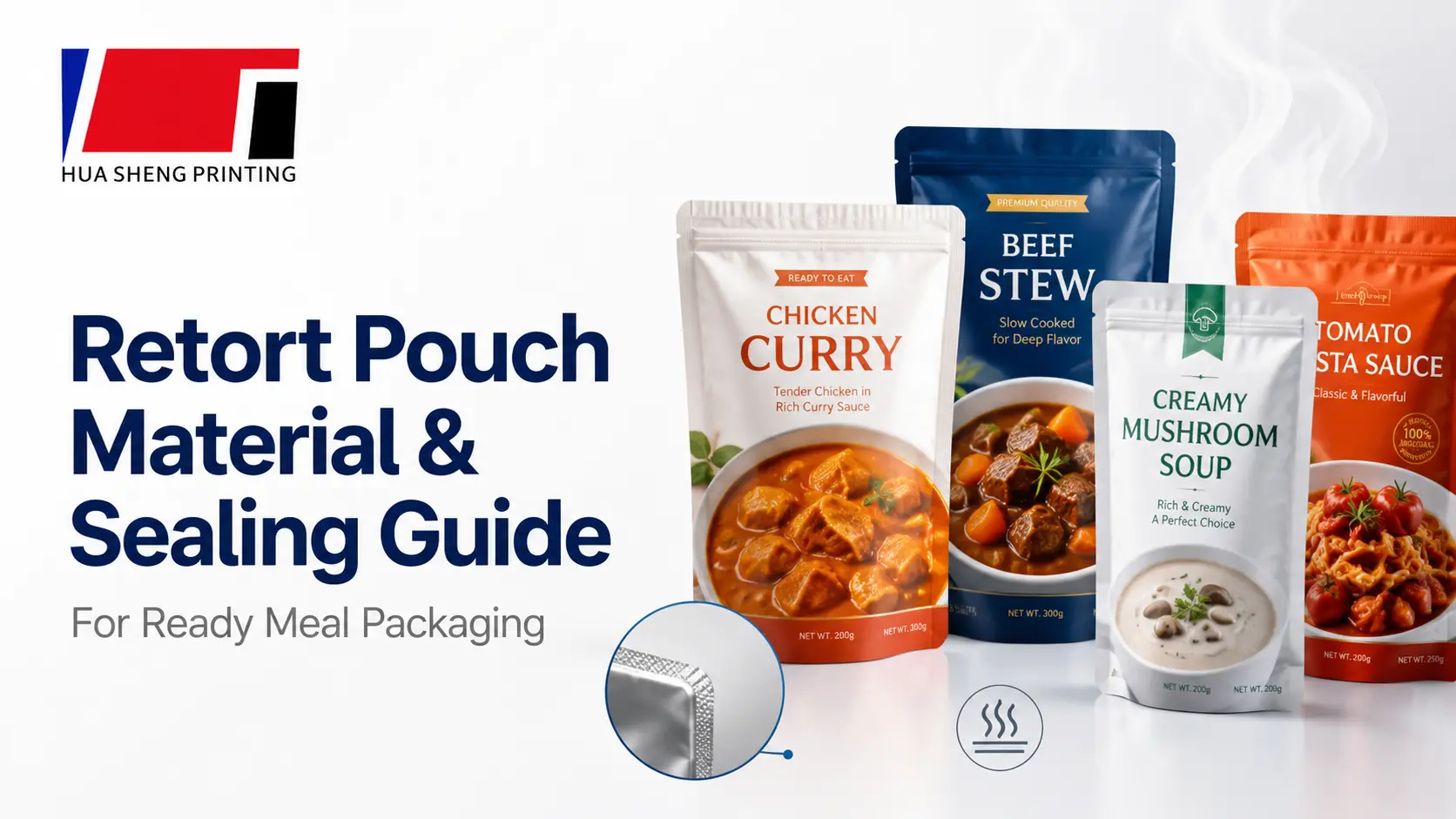 Technical guide visual for Retort Pouch Material Layers: PET, Aluminum Foil, Nylon and RCPP.
Compare the layer roles in PET/AL/RCPP, PET/NY/RCPP and PET/AL/NY/RCPP retort pouch structures, including barrier, puncture and seal-layer checks.
Direct answer
A retort pouch structure is a set of functional layers, not a universal recipe. PET may provide the print surface, aluminum foil may provide a barrier, nylon may add puncture resistance, and retort-grade CPP or RCPP may form the food-contact seal layer. This guide compares those layer roles and the checks required before a laminate is approved for the actual food and scheduled retort process.
Why Retort Pouch Material Structure Matters
Retort pouches are not ordinary food pouches — they must withstand high temperature (typically 121°C to 135°C), pressure, and extended sterilization cycles while maintaining seal integrity and barrier performance. The material structure is the foundation of retort pouch performance. Each layer serves a specific function: the outer layer provides heat resistance and print surface, the barrier layer blocks oxygen and moisture, and the inner sealing layer must remain stable under sterilization conditions without delamination or seal failure.
Ready meals, sauces, meat products, soup, pet wet food and shelf-stable food each place different demands on the pouch structure. A structure that works for 121°C sterilization may not be suitable for 135°C. A pouch designed for liquid sauce may need different sealing considerations than one for solid meat pieces. Before selecting a retort pouch material structure, buyers should understand the relationship between sterilization conditions, food characteristics and material performance. Huasheng Packaging helps customers select and test retort-grade structures based on their specific sterilization process and product requirements.
Common Retort Pouch Failures and Their Causes
Understanding common retort failures helps buyers ask the right questions before production.
1. Pouch breaking or bursting during sterilization — usually caused by insufficient material strength, incorrect structure selection or inadequate sealing strength for the sterilization temperature and pressure.
2. Seal leakage after retort — the sealing layer may have been affected by heat and pressure. Retort-grade sealing layers (CPP or RCPP) must be selected and tested under actual sterilization conditions.
3. Delamination between layers — standard laminating adhesives may not withstand retort temperatures. Retort-grade adhesives and confirmed lamination processes are essential.
4. Pouch deformation or shrinkage — some materials shrink at high temperature, causing pouch shape distortion. Material selection should account for the sterilization temperature profile.
5. Short shelf life after retort — if the barrier layer (AL or VMPET) is compromised during sterilization, oxygen and moisture ingress accelerate, reducing product shelf life.
6. Not testing with actual product and sterilization process before bulk production — water-fill testing alone does not fully represent real product behavior under retort conditions.
Common Retort Pouch Material Structures
The structure table below helps buyers understand which material combinations suit different retort applications. Final structure must be confirmed based on sterilization temperature, product type, filling weight and shelf life requirements.
Retort Pouch Material Structure Guide:
PET/AL/CPP — Suitable products: standard retort ready meals, sauce, soup, pet food. Main benefit: good barrier with aluminum foil, cost-effective for standard 121°C retort. Notes: CPP inner layer must be retort-grade; confirm sealing strength after sterilization test.
PET/NY/CPP — Suitable products: microwaveable retort products, transparent retort applications. Main benefit: no aluminum foil, suitable for microwave reheating; improved puncture resistance with NY layer. Notes: barrier is lower without AL layer; confirm shelf life requirement.
PET/AL/NY/CPP — Suitable products: premium ready meals, long shelf life products, high-barrier retort food. Main benefit: maximum protection with AL barrier, NY puncture resistance, and retort-grade CPP sealing. Notes: higher cost; recommended for premium products or extended shelf life.
Transparent retort structure — Suitable products: products where visibility is important, microwaveable retort. Main benefit: consumer can see the product; suitable for microwave use. Notes: barrier performance is limited compared to aluminum structures; discuss shelf life expectations.
Customized retort structure — Suitable products: products with specific sterilization, barrier or mechanical requirements. Main benefit: structure can be tailored to exact sterilization profile and product needs. Notes: requires detailed discussion of sterilization conditions, product characteristics and shelf life targets.
Quality Control Points for Retort Pouch Production
Retort pouch quality control is more demanding than standard pouch QC. Key checkpoints include:
Sealing strength — tested before AND after simulated sterilization. The seal must maintain integrity through the entire sterilization cycle.
Heat resistance — material structure must withstand the specified sterilization temperature (121°C or 135°C) for the required duration.
Delamination risk — retort-grade adhesives and lamination process must be confirmed. Each batch should be tested after simulated sterilization conditions.
Pouch flatness — post-sterilization pouch appearance should remain acceptable. Excessive wrinkling or deformation suggests material or process issues.
Puncture resistance — important for products with bone fragments, hard particles or sharp edges. NY layer can improve puncture resistance.
Sterilization compatibility — the complete pouch structure must be compatible with the customer sterilization equipment (batch retort, continuous retort, etc.).
Shelf life verification — accelerated aging tests or real-time shelf life monitoring may be needed depending on product requirements.
At Huasheng Packaging, we recommend sample production and testing with the customer actual filling and sterilization process before bulk order confirmation. This reduces risk and helps identify potential issues early.
What to Prepare Before Retort Pouch Quotation
Before sending a retort pouch inquiry, prepare these details for accurate evaluation:
1. Product type — ready meal, sauce, meat, soup, pet food, etc.
2. Sterilization temperature and time — 121°C or 135°C; sterilization duration
3. Sterilization equipment type — batch retort, continuous retort, water spray, steam, etc.
4. Filling weight — grams per pouch
5. Preferred pouch size — width × height
6. Pouch format — flat pouch, stand-up pouch or customized format
7. Expected shelf life — ambient storage duration after sterilization
8. Storage condition — ambient, chilled or frozen after sterilization
9. Material structure preference if known — or we can suggest based on requirements
10. Quantity — typical MOQ 30,000 pcs for custom printed retort pouches
11. Printing colors — up to 9-color gravure printing
12. Artwork file — AI, PDF or PSD format
13. Target market — for market compliance and handover reference
Related Products
Related Packaging Guides
Frequently Asked Questions
What material is used for retort pouches?
Retort pouches use multi-layer laminated structures with heat-resistant outer layers (PET or NY), barrier layers (AL or VMPET), and retort-grade inner sealing layers (CPP or RCPP). Common structures include PET/AL/CPP, PET/NY/CPP, PET/AL/NY/CPP and customized retort structures depending on sterilization temperature and product requirements.
Can retort pouches withstand 121°C sterilization?
Yes. Standard retort pouch structures using retort-grade CPP sealing layers and appropriate adhesives are designed for 121°C sterilization. The specific structure, sealing conditions and sterilization time should be confirmed and tested with the actual product before bulk production.
What is the difference between 121°C and 135°C retort pouch structures?
135°C sterilization places higher demands on material heat resistance, sealing layer stability and adhesive performance. Structures for 135°C typically require higher-grade CPP or RCPP sealing layers and may need additional material reinforcement. The structure must be specifically designed and tested for the target sterilization temperature — a 121°C structure should not be assumed suitable for 135°C.
Can retort pouches be transparent?
Yes. Transparent retort structures without aluminum foil (such as PET/NY/CPP) are available for products where consumer visibility or microwave reheating is important. However, barrier performance is lower without the aluminum layer, so shelf life expectations should be discussed and confirmed.
What testing should be done before mass production?
Key tests include: sealing strength before and after simulated sterilization, lamination strength after sterilization, leakage test, pouch appearance after sterilization, puncture resistance if applicable, and most importantly, testing with the customer actual filling product and sterilization process. We recommend a pilot production run with full sterilization testing before bulk order confirmation.
What information is needed for a retort pouch quotation?
Please provide: product type, sterilization temperature and time, sterilization equipment type, filling weight, preferred pouch size and format, expected shelf life, storage condition, material structure preference if known, quantity, printing colors, artwork file and target market.