Direct Filling or Inner Sachets? A Cereal Powder Packaging Decision Guide
Huasheng Packaging Technical Content Review · Published:
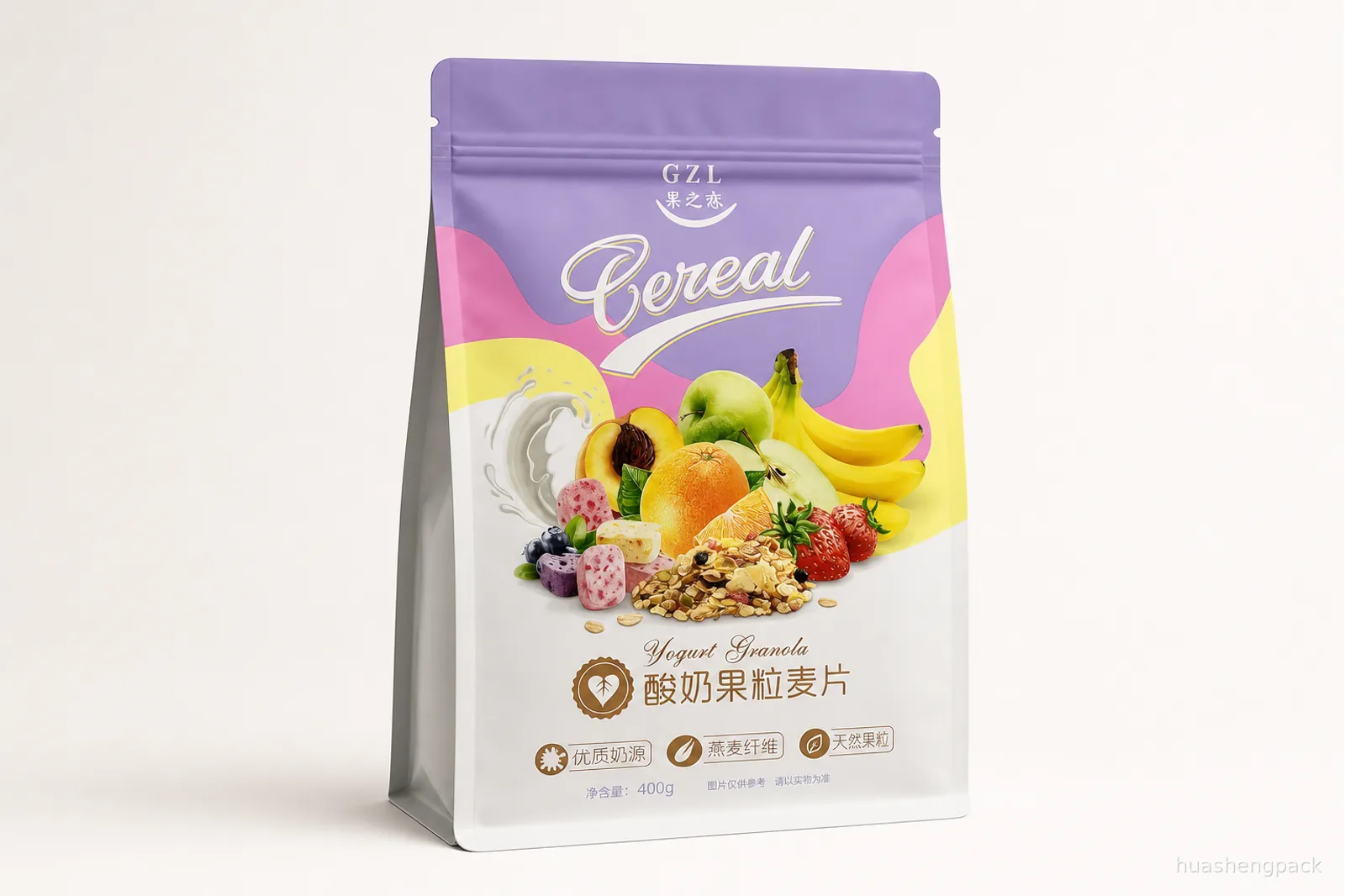 The image supports visible appearance or setting only. It does not prove material structure, performance, certification, a customer relationship or project suitability.
Compare direct-filled outer pouches with individually packed inner sachets by portioning, barrier, filling, dimensions, consumer use and validation.
Direct answer
Direct filling places the product in the retail pouch. An inner-sachet system portions product first and uses the outer pouch or carton for grouping and presentation. Neither is universally better: the decision changes product exposure, machine route, dimensions, material use, consumer behavior and the evidence required for release.
Evidence-reviewed technical guide
2026-08-31 · Huasheng Packaging Technical Content Review
Evidence scope
Direct Filling or Inner Sachets? A Cereal Powder Packaging Decision Guide
Scope and limitations
No customer identity, transcript, order-specific price, fixed MOQ, universal material recipe, performance promise, machine approval or shelf-life guarantee is published.
Key takeaways
- Direct fill suits repeated access when the product and closure system can tolerate opening cycles. Inner sachets can support portion control and keep unopened portions isolated, but add pack count, trapped air, secondary packing and more components. Start from how the product is prepared and consumed.
- Loose powder and a bundle of sachets occupy space differently. Sachet count, orientation, seals and trapped air can make the outer pouch larger even at the same net weight. Build an arrangement mock-up and carton trial instead of reusing the direct-fill outer dimensions.
- Compare total material, printing, components, filling steps, inspection, rejects, secondary packing, freight cube and consumer-use objectives. Keep commercial figures in the current quotation. The technical article should explain the cost drivers without publishing a fixed premium or promising that one format is always cheaper.
1. Define the Serving and Opening Pattern
Direct fill suits repeated access when the product and closure system can tolerate opening cycles. Inner sachets can support portion control and keep unopened portions isolated, but add pack count, trapped air, secondary packing and more components. Start from how the product is prepared and consumed.
The image supports visible appearance or setting only. It does not prove material structure, performance, certification, a customer relationship or project suitability.2. Compare Product Exposure
For direct fill, every opening exposes the remaining product and places more importance on dispensing and reclosure. For inner sachets, each unit needs its own seals and barrier review. The outer package may then serve mainly grouping, mechanical protection and communication rather than primary barrier.
3. Recalculate Dimensions and Packing Efficiency
Loose powder and a bundle of sachets occupy space differently. Sachet count, orientation, seals and trapped air can make the outer pouch larger even at the same net weight. Build an arrangement mock-up and carton trial instead of reusing the direct-fill outer dimensions.
Compare both routes with the same consumption scenario. Record servings per outer pack, how long the product remains open, whether the user measures portions, the number and size of inner sachets, secondary-pack headspace, filling equipment and waste. Inner sachets add interfaces and material; direct fill adds repeated opening and closure exposure. Neither route is automatically more protective without the complete system.
4. Match the Filling Architecture
Direct-filled premade pouches, VFFS sachets and hand-packed inner units use different equipment interfaces. Confirm dosing, pouch or film supply, registration, seal geometry, speed and inspection for each stage. A material that seals in a laboratory is not automatically approved on every line.
Create two bill-of-process maps. The direct-fill map should include opening the outer pouch, repeated serving, reclosure and exposure until empty. The inner-sachet map should include sachet forming or supply, each sachet seal, count verification, loading into the outer pack and disposal. Compare the number of seals, machines, inspections and user steps as well as protection. A route with more individual barriers can still fail through counting errors, damaged sachets or an outer pouch that was sized without the real sachet stack.
5. Compare Systems, Not One Unit Price
Compare total material, printing, components, filling steps, inspection, rejects, secondary packing, freight cube and consumer-use objectives. Keep commercial figures in the current quotation. The technical article should explain the cost drivers without publishing a fixed premium or promising that one format is always cheaper.
Prepare one filled prototype for each route using the intended powder and handling sequence. Compare dosing accuracy, seal cleanliness, consumer opening, reclosure where applicable, packing-line labor, carton efficiency and the storage plan. Keep the decision tied to the named product and market; a format selected for one cereal texture or serving pattern should not become a rule for every powder.
Professional evidence used in this guide includes: Food Types and Conditions of Use for Food Contact Substances; ROVEMA VFFS Application Questionnaire; ASTM F2029-16(2021): Laboratory Heat Seals for Flexible Barrier Materials; ASTM F88/F88M-23: Seal Strength of Flexible Barrier Materials. Its mapped scope is: Food-contact use depends on food type and use conditions; Product, package, film, reel, sealing and output inputs belong in one machine brief; Laboratory heat-seal data is a starting point, not production approval; Seal strength is interpreted with specimen, technique and failure mode. These sources answer specific method, use-condition or equipment-input questions; they do not automatically approve the complete package, a particular machine, commercial shelf life or the current order. To apply this guide to a Cereal Pack Format decision, maintain a four-column condition–evidence–limitation–action record: state the current condition, identify the sample or record supporting it, name the risk that remains outside that evidence and assign the next action with its acceptance condition. Reopen the affected conclusion whenever the product, specification, process or controlling evidence changes.
Related Products
Related Packaging Guides
Claim-to-source evidence matrix
| Reviewed claim | Support | Sources | Boundary |
|---|
| Food-contact use depends on food type and use conditions | direct | [1] | The cited source supports only the named method, boundary or equipment input and does not approve the complete packaging project. |
| Product, package, film, reel, sealing and output inputs belong in one machine brief | direct | [2] | The cited source supports only the named method, boundary or equipment input and does not approve the complete packaging project. |
| Laboratory heat-seal data is a starting point, not production approval | direct | [3] | The cited source supports only the named method, boundary or equipment input and does not approve the complete packaging project. |
| Seal strength is interpreted with specimen, technique and failure mode | direct | [4] | The cited source supports only the named method, boundary or equipment input and does not approve the complete packaging project. |
JSON · CSV
Authoritative References
- Food Types and Conditions of Use for Food Contact Substances · U.S. Food and Drug Administration · government
Food-contact use depends on food type and use conditions - ROVEMA VFFS Application Questionnaire · ROVEMA North America · manufacturer-data
Product, package, film, reel, sealing and output inputs belong in one machine brief - ASTM F2029-16(2021): Laboratory Heat Seals for Flexible Barrier Materials · ASTM International · standard
Laboratory heat-seal data is a starting point, not production approval - ASTM F88/F88M-23: Seal Strength of Flexible Barrier Materials · ASTM International · standard
Seal strength is interpreted with specimen, technique and failure mode
Frequently Asked Questions
Are inner sachets always better for shelf life?
No, each sachet still needs validated seals and barrier.
Can the same outer size be reused?
Not without an arrangement and filled trial.
Does direct fill require a zipper?
It depends on repeated access and the use pattern.
Can inner sachets use roll film?
Often yes, but the exact machine decides the specification.
Which format uses less material?
Calculate the complete system, not one component.
What should be approved?
Both the primary pack and the grouping system.