Types of Frozen Food Packaging and Material Selection Guide
Huasheng Packaging Technical Content Review
Huasheng Packaging Technical Content Review · Published: · Updated:
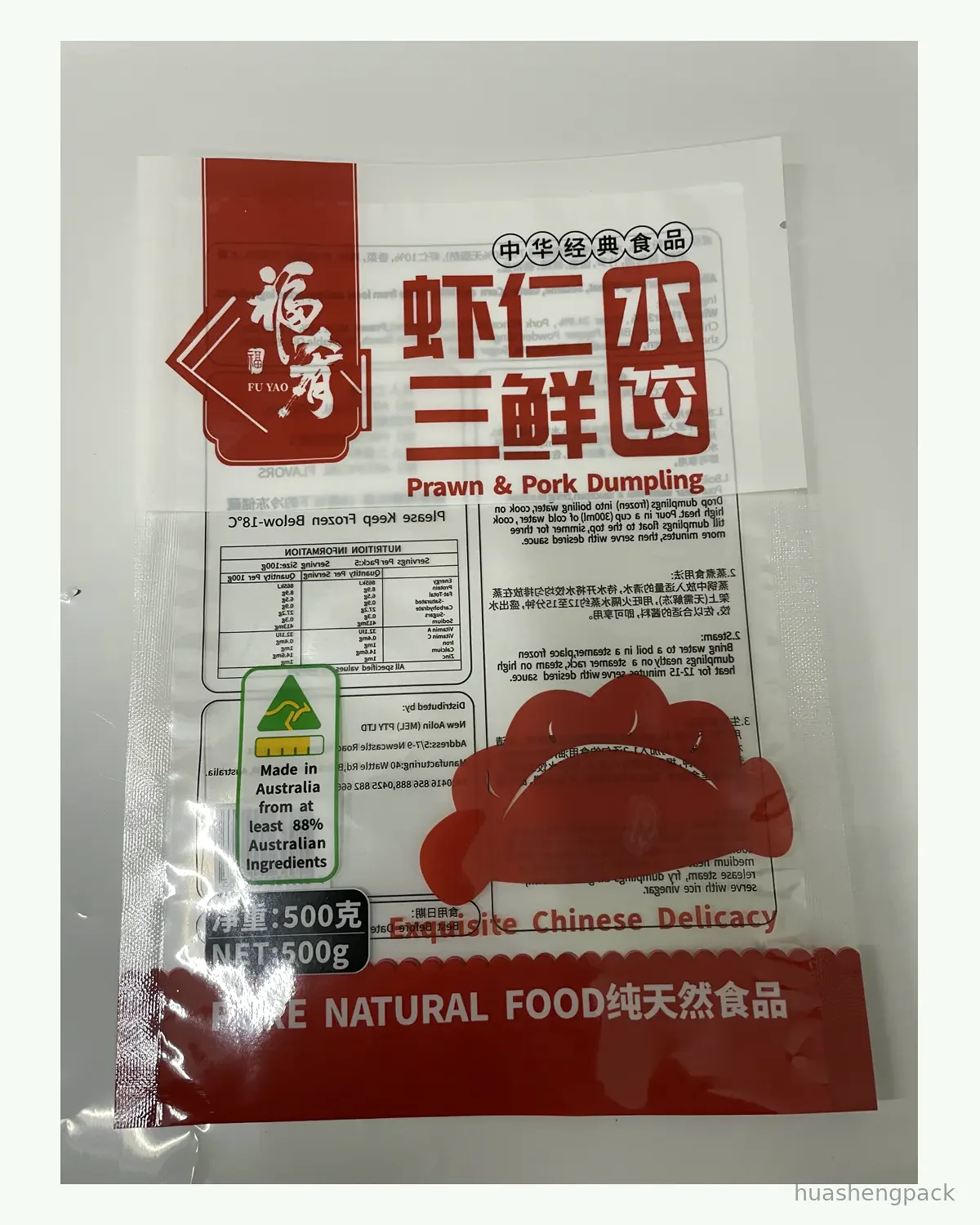 A real printed dumpling pouch sample illustrates the packaging application. The photograph does not establish the laminate, a filled frozen pack or low-temperature test performance.
Compare frozen food packaging materials for vegetables, dumplings, prepared foods, meat and seafood, including seal, puncture and barrier decisions.
Direct answer
Common flexible formats for frozen food include roll film for forming-and-filling equipment and premade pouches for a compatible filling and final-sealing process. Choose the supply format first, then review material, product edges, freezing, storage and handling. Vegetables, dumplings, prepared foods, meat and seafood do not create the same seal, puncture or barrier risks.
Contents
Evidence-reviewed technical guide
Evidence-reviewed technical guide
2026-10-24 · Huasheng Packaging — source-based editorial review
Evidence scope
English buyer decision guidance and visible image identity only; possible material directions remain project-review hypotheses.
Scope and limitations
Not laboratory validation, professional process approval or a native-language audit. No source proves Huasheng test results, fixed shelf life, universal construction, capacity, cost or customer endorsement. Supplier performance and sustainability claims are not transferred.
Key takeaways
- Control storage and package protection together.
- Choose a format for the product and line, then validate the finished pack.
- A printed empty sample is not evidence of low-temperature performance.
1Choose the Supply Format Before the Material Structure
Roll film supplied on reels — choose this route when the receiving machine forms the package from a film web. Confirm the forming arrangement, web width, print repeat, unwind direction, core and reel limits. A pillow-style finished pack is a bag format, not a different raw material.
Premade flat or stand-up pouches — choose this route when the line receives already-converted bags for filling and final sealing. Confirm opening access, usable dimensions, sealing clearance and the filled shape. A zipper, if required, is for reclosure after opening; it does not replace the initial final seal.
Trays, cartons and insulated shipping packs — these belong to different packaging or distribution systems. This guide focuses on printed flexible film and pouches, not a claim that Huasheng supplies every frozen-food packaging format or that a primary food pouch replaces cold-chain insulation.
Freezing does not create one standard packaging condition. Film flexibility, seals and folded areas can behave differently after freezing, while the product may become harder or develop edges that were not present during room-temperature testing. Temperature cycling, condensation, product fragments in the seal area and handling impacts can also change the failure risk.
Frozen vegetables and fruit are often irregular, moist and packed on automatic lines. Buyers should examine moisture loss, seal contamination, product abrasion and machine performance rather than selecting a structure from the food name alone. Frozen dumplings, bakery items and prepared foods may develop hard corners or fragile surfaces, so puncture, drop impact and presentation can become more important. Meat and seafood can add bones, shells, oil, odor or oxidation concerns.
Define the required properties from the actual product condition, lowest expected temperature, freezing method, storage variation, package size and distribution test. A structure that works for one product or line is a starting reference, not automatic proof for another project.
2Material Directions by Frozen Food Category
Frozen vegetables and fruit — PET/PE, BOPP/PE or compatible PE-based structures may be evaluated where printability, moisture control and automatic packing performance are the main needs. Product shape, ice, seal contamination and the required sealing window still need line trials. Higher barrier is not automatically necessary for every vegetable or fruit.
Dumplings, buns and prepared foods — products that freeze into firm corners may justify evaluating a PA-containing structure such as PA/PE or PET/PA/PE. PA can contribute toughness and puncture resistance, while PET can provide a printable outer web and PE commonly provides the sealant layer. Confirm the need for PA, its grade and thickness through filled-pack freezing, drop and compression tests.
Meat and seafood — boned meat, shells and sharp frozen edges can make mechanical protection a priority. PA/PE or PET/PA/PE are possible directions, but fatty products, odor-sensitive products and longer storage targets may also require an oxygen, aroma or light-barrier assessment. Compare VMPET, EVOH, aluminum foil or other barrier approaches against transparency, flex-crack risk, converting, sealing and cost requirements rather than specifying them from shelf life alone.
Products with sharp edges or heavy fill weights — film grade, total thickness, a toughening layer, seal width and bag geometry may all affect survival. Simply increasing one layer or total thickness does not guarantee puncture resistance. Test the filled package at corners, folds and seals under the expected frozen handling load.
Microwaveable or heatable prepared foods — freezer performance does not establish reheating suitability. Define the heating method, temperature, time, venting and food-contact requirements separately. Do not assume a frozen pouch is microwaveable, boilable or ovenable unless that use has been designed and validated.
 Illustrative guide: evaluate moisture control and seals with the actual product and packing line; not a tested material specification.
 Illustrative guide: consider PA only where the project warrants it, then validate the filled frozen pack; not a universal structure.
 Illustrative guide: assess mechanical and barrier needs separately and validate with representative filled packs; not a test result.
3How Each Layer Can Contribute Without Becoming a Fixed Recipe
PET may provide a stable printing surface, stiffness and dimensional stability. PA may be considered where low-temperature toughness or puncture resistance needs improvement. PE or LLDPE commonly serves as the food-contact and heat-seal layer, but resin grade, thickness and sealing range influence actual line performance. BOPP may be considered for print, clarity or stiffness in compatible constructions, while PE-based solutions may support simplified material strategies where performance and local recovery requirements align.
Barrier layers should answer a measured product need. Oxygen protection may matter more for fatty fish, meat or sauce-containing meals that are sensitive to oxidation. Moisture control may matter where dehydration and freezer burn are shelf-life drivers. Light or aroma protection may be relevant for selected products, but VMPET and aluminum foil are different materials and should not be treated as interchangeable. Published OTR or WVTR values for a film do not by themselves predict finished-pack shelf life.
Possible structures include PET/PE, BOPP/PE, PA/PE, PET/PA/PE and structures containing a suitable barrier layer. These are evaluation directions only. Final layer choice, grade and thickness should follow compatibility review, representative production trials and filled-product validation.
4Validate the Frozen Package, Not Only the Empty Film
Use the intended product, fill weight and representative packing equipment. Record sealing temperature, pressure, dwell time and production speed, then reproduce the planned freezing and storage conditions. Inspect seals, folds, corners and printed laminate for leakage, pinholes, brittle cracking, delamination, distortion and zipper function where applicable.
For irregular vegetables, dumplings, meat or seafood, include representative hard pieces and worst-case orientation. Add drop, compression or vibration checks where handling creates those risks. If temperature cycling or partial thawing can occur, include it in the validation plan instead of relying only on constant-temperature storage.
A successful empty-bag seal or room-temperature drop test is not enough to confirm frozen use. Shelf life remains the food producer’s validation responsibility and should combine package testing with product quality and storage data.
5Frozen Food Packaging Specification and Trial Checklist
Provide the product category and physical form; whether hard corners, bones or shells appear after freezing; oil, moisture, powder or sauce content; fill weight and package dimensions; filling temperature; freezing method; lowest storage temperature and expected cycling; target shelf life; premade pouch or roll film format; machine model and line speed; web width, repeat, unwind and eye mark for roll film; seal type; barrier or transparency target; quantity per artwork; and examples of current failures. Agree on filled-pack trial conditions and acceptance checks before final approval.
Put this guide into your project brief
Use the existing editable worksheet to record what is known, what remains open and who will review it.
Project specification and validation register
Track each requirement as known, unknown, sample-stage or production-stage, with evidence, owner and approval status in one file.
Open PDF · Download editable CSV
Material requirement sheet
Separate product conditions, target barrier, test method, specimen and validation owner before selecting a laminate.
Open PDF · Download editable CSV
Preparation files only: not an approved specification, current quotation or performance result.
Related Products
Related Packaging Guides
Claim-to-source evidence matrix
| Reviewed claim | Support | Sources | Boundary |
|---|
| Packaging protection and storage conditions must both be considered when discussing freezer-burn quality loss. | direct | [1] | Consumer guidance is context, not a commercial shelf-life validation or laminate recipe. |
| Premade pouch and rollstock routes require different filling-line review. | contextual | [2] | Manufacturer example supports format distinction only; no supplier temperature, MOQ or performance transferred. |
| The image documents a printed empty dumpling pouch, not a filled or tested frozen pack. | direct | [3] | No laminate, thickness, seal result, brand cooperation or food-contact conclusion inferred. |
JSON · CSV
Authoritative References
- Are You Storing Food Safely? · US FDA · government
Inadequate airtight wrapping can contribute to freezer-burn quality loss. - Frozen Food Packaging · ePac Flexible Packaging · manufacturer-data
Stand-up, lay-flat and rollstock are distinct frozen-food supply formats in this manufacturer example. - Printed Dumpling Pouch Source Photograph · Huasheng Packaging · internal-evidence
The empty printed sample visibly identifies a dumpling application.
Frequently Asked Questions
What types of packaging are used for frozen food?
For printed flexible supply, compare roll film for forming-and-filling equipment with premade flat or stand-up pouches for compatible filling and final sealing. Pillow shape, gusset and zipper are format or closure decisions, not material specifications. Trays, cartons and insulated shipping packs are different systems outside this guide’s flexible-supply focus. Confirm the actual product, machine, freezing and distribution conditions before choosing a laminate.
What packaging material is suitable for frozen vegetables?
PET/PE, BOPP/PE or compatible PE-based structures may be evaluated when moisture control, print and machine performance are the main requirements. Irregular product shape, ice and seal contamination still require filled line trials.
Do frozen dumplings need a PA or nylon layer?
Not always. PA can be considered when frozen corners create puncture or impact risk, but the grade, thickness and need for that layer should be confirmed by freezing, drop and compression tests with the filled pack.
How should packaging for frozen meat or seafood be selected?
Start with bones, shells, sharp edges, oil, odor and oxidation sensitivity. Mechanical and barrier needs should be assessed separately, then verified using representative product, storage and handling conditions.
Does thicker film always prevent frozen-package punctures?
No. Resin grade, layer combination, bag geometry, folds, seal design, product orientation and impact load all affect puncture performance. Thickness alone is not proof.
Are VMPET and aluminum foil interchangeable for frozen food?
No. They differ in construction, barrier behavior, opacity, flex response, converting and cost. Select either only after defining the product protection and package-processing requirements.
Can a frozen food pouch also be used for microwave heating?
Only when the complete package has been designed and validated for the stated heating method, time and temperature. Freezer suitability alone does not prove microwave, boiling or oven suitability.
How should frozen food packaging be validated?
Pack the real product at the intended weight on representative equipment, reproduce freezing and storage conditions, and check seals, pinholes, brittle cracking, delamination and handling damage. Include temperature cycling when it reflects actual use.
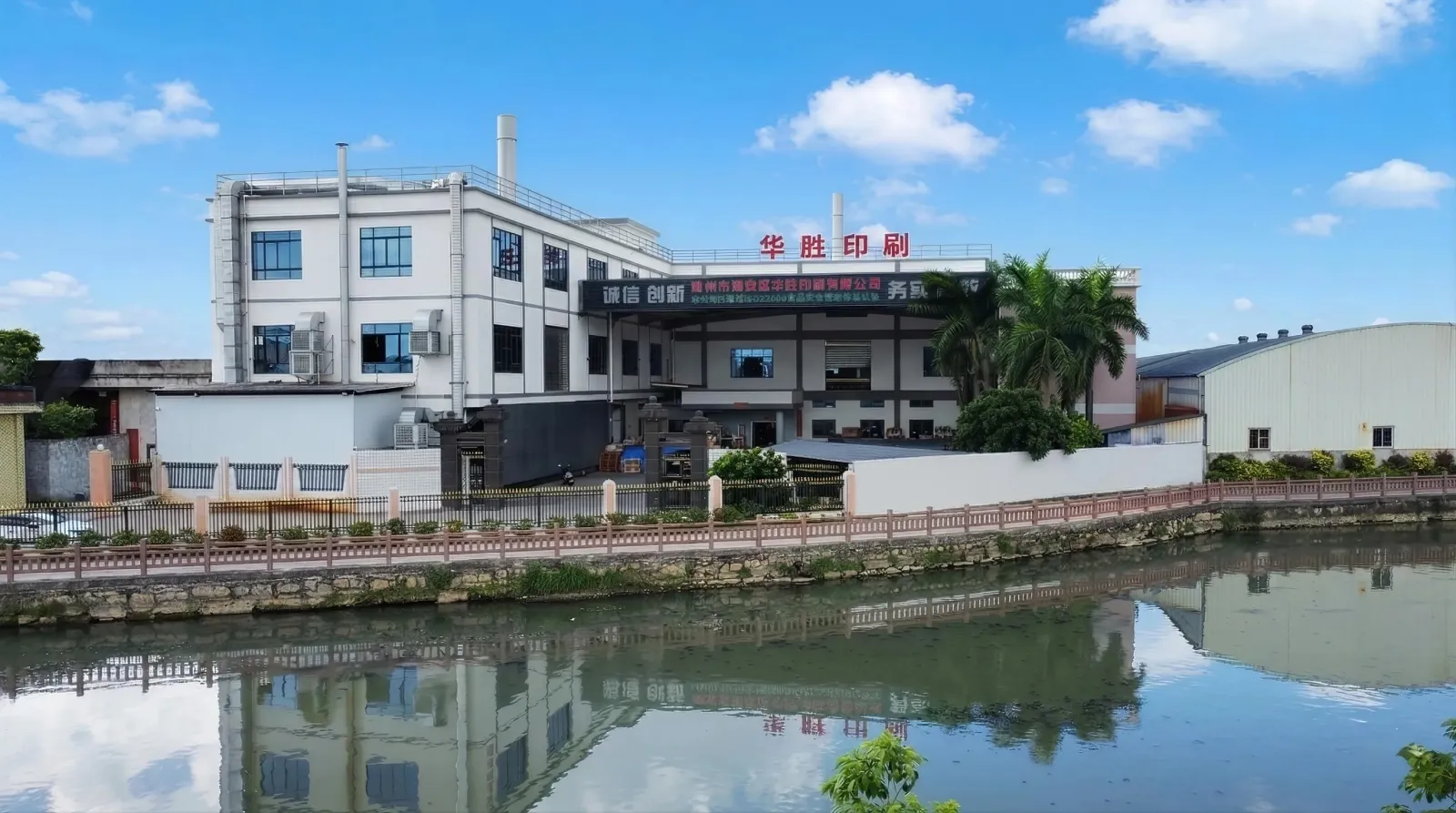
About Huasheng
Stand up pouches, spout pouches, flat bottom pouches, coffee bags and printed roll film for food and beverage brands.
A legacy of quality in flexible packaging since 1997.
1997 · 6,880 m²
Chaozhou · Guangdong · China
Longshewei, Neipan Management District, Dongfeng Town, Chao'an District, Chaozhou City, Guangdong Province, China