How to Specify Common Flexible Pouch Types and Optional Features
Huasheng Packaging Technical Content Review · Published:
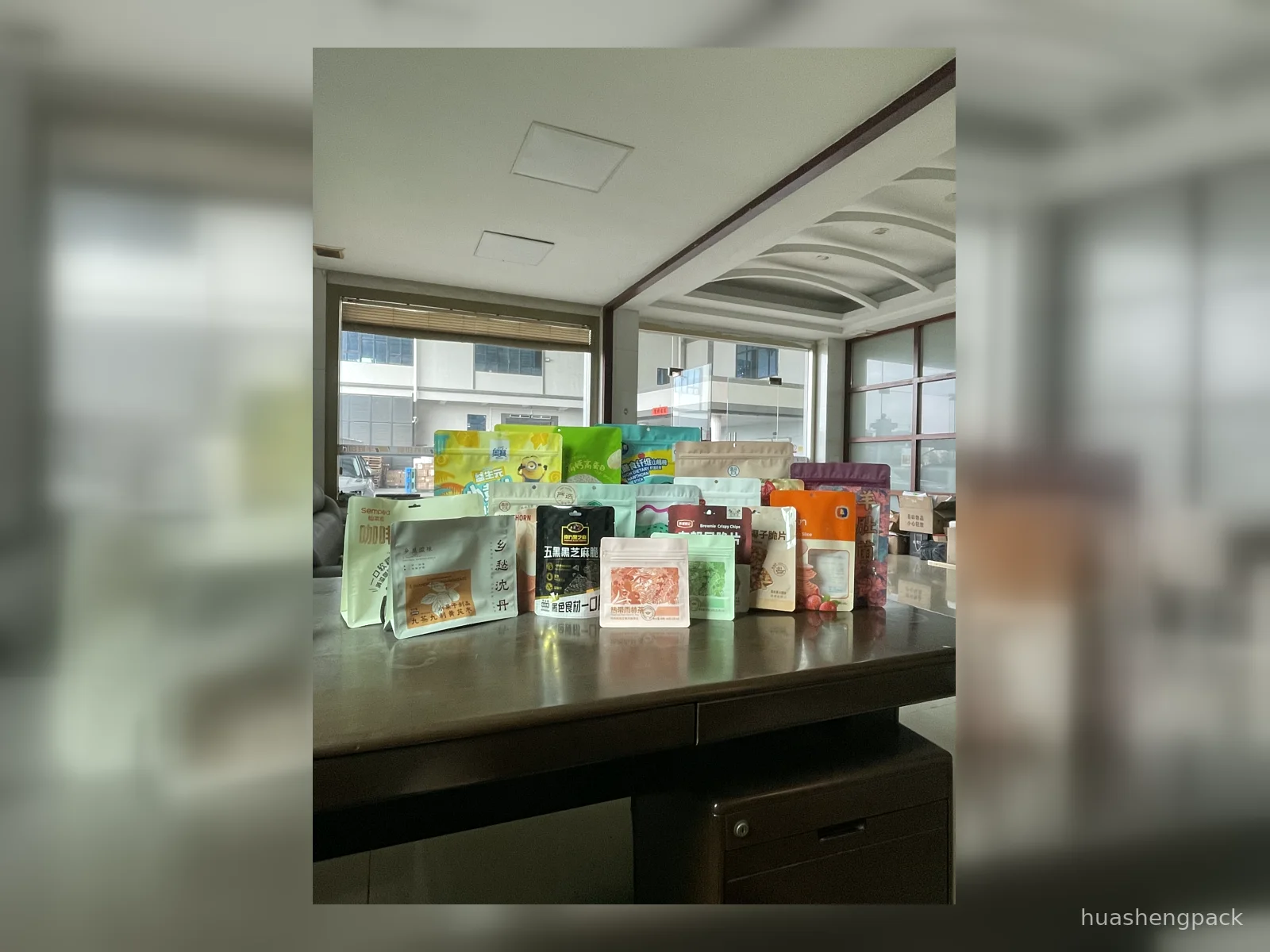 The image supports visible appearance or setting only. It does not prove material structure, performance, certification, a customer relationship or project suitability.
Choose the pouch construction first, then specify dimensions, filling direction, zipper, spout, handle hole, artwork and sample purpose.
Direct answer
Start with the pouch construction, then add optional features. Common categories include three-side-seal, four-side-seal, side-seal, back- or center-seal, stand-up, stand-up zipper, eight-side-seal and spout pouches. A gusset is a geometry detail and a handle hole is an optional feature; neither should replace the pouch-type definition.
Evidence-reviewed technical guide
2026-08-31 · Huasheng Packaging Technical Content Review
Evidence scope
How to Specify Common Flexible Pouch Types and Optional Features
Scope and limitations
No customer identity, transcript, order-specific price, fixed MOQ, universal material recipe, performance promise, machine approval or shelf-life guarantee is published.
Key takeaways
- Select the closest construction: three-side-seal, four-side-seal, side-seal, back- or center-seal, stand-up, stand-up zipper, eight-side-seal or spout pouch. If the name is uncertain, send front, side and top photographs or a marked sketch showing every seal line and opening.
- For bottom or side folds, state whether the dimension is one-side depth, total depth or fully opened depth. For a back- or center-seal pack, show whether the longitudinal seal is fin or lap style, its position relative to the front artwork and the top and bottom cross-seals.
- The dispatch list should identify each sample code, pouch construction, dimensions, optional features, known material status and the exact review question. A visually similar sample does not approve final material, filling, machine compatibility, load, barrier performance or shelf life.
1. Choose the Pouch Construction
Select the closest construction: three-side-seal, four-side-seal, side-seal, back- or center-seal, stand-up, stand-up zipper, eight-side-seal or spout pouch. If the name is uncertain, send front, side and top photographs or a marked sketch showing every seal line and opening.
The image supports visible appearance or setting only. It does not prove material structure, performance, certification, a customer relationship or project suitability.2. Add Optional Features
Zippers, spouts, handle holes, tear notches, windows and hang holes are functional additions. For a handle hole, state its shape, dimensions, position, reinforced area, expected filled weight and carrying direction. Do not use the feature name as the pouch-type definition.
3. Define Gussets and Seal Geometry
For bottom or side folds, state whether the dimension is one-side depth, total depth or fully opened depth. For a back- or center-seal pack, show whether the longitudinal seal is fin or lap style, its position relative to the front artwork and the top and bottom cross-seals.
Translate an uncertain term into a marked drawing with front, side and top views. Add arrows for gusset depth, handle opening, seal lines, product cavity, filling opening and expected load direction. Include one reference photo only to identify observable geometry, then state which details are still unknown. This avoids turning a marketplace name into an assumed construction.
4. State Product, Filling and Dimensions
Provide the packed product, fill weight, flat width and height, gusset convention, filling opening, final seal, packing method and machine model where relevant. Also state whether the sample is for appearance, size fitting, material feel, filled handling, print review or a machine trial.
Ask for one photograph of the intended product beside a ruler and, if available, the current package opened flat. For a gusset, mark whether depth is measured folded, opened or across both sides. For a handle, provide hole dimensions, sealed header dimensions and expected filled load. For a center-seal format, mark front panel, longitudinal seam, top and bottom seals and filling end. These observable facts allow the supplier to select relevant samples even when local terminology or translation is uncertain.
5. Confirm the Sample and Approval Boundary
The dispatch list should identify each sample code, pouch construction, dimensions, optional features, known material status and the exact review question. A visually similar sample does not approve final material, filling, machine compatibility, load, barrier performance or shelf life.
Before dispatch, ask the requester to confirm the marked geometry and sample purpose. Separate samples intended for hand feel, filled-size review and machine trial; machine samples also require equipment interfaces and enough quantity for setup. The packing list should repeat the sample codes and limitations so receipt of a visually similar bag is not mistaken for technical approval.
Professional evidence used in this guide includes: ASTM F2203-13(2022): Linear Measurement Using Precision Steel Rule; Horizontal Flow Wrapping; ROVEMA VFFS Application Questionnaire. Its mapped scope is: Linear dimensions require a defined specimen state and method; Horizontal flow wrapping forms and seals roll material around horizontally fed products; Product, package, film, reel, sealing and output inputs belong in one machine brief. These sources answer specific method, use-condition or equipment-input questions; they do not automatically approve the complete package, a particular machine, commercial shelf life or the current order. To apply this guide to a Pouch Sample Request decision, maintain a four-column condition–evidence–limitation–action record: state the current condition, identify the sample or record supporting it, name the risk that remains outside that evidence and assign the next action with its acceptance condition. Reopen the affected conclusion whenever the product, specification, process or controlling evidence changes.
Related Products
Related Packaging Guides
Claim-to-source evidence matrix
| Reviewed claim | Support | Sources | Boundary |
|---|
| Linear dimensions require a defined specimen state and method | direct | [1] | The cited source supports only the named method, boundary or equipment input and does not approve the complete packaging project. |
| Horizontal flow wrapping forms and seals roll material around horizontally fed products | direct | [2] | The cited source supports only the named method, boundary or equipment input and does not approve the complete packaging project. |
| Product, package, film, reel, sealing and output inputs belong in one machine brief | direct | [3] | The cited source supports only the named method, boundary or equipment input and does not approve the complete packaging project. |
JSON · CSV
Authoritative References
- ASTM F2203-13(2022): Linear Measurement Using Precision Steel Rule · ASTM International · standard
Linear dimensions require a defined specimen state and method - Horizontal Flow Wrapping · Syntegon · manufacturer-data
Horizontal flow wrapping forms and seals roll material around horizontally fed products - ROVEMA VFFS Application Questionnaire · ROVEMA North America · manufacturer-data
Product, package, film, reel, sealing and output inputs belong in one machine brief
Frequently Asked Questions
Is a gusset a pouch type?
No. It is a geometry detail that must be combined with the pouch construction.
Is a handle hole a pouch type?
No. It is an optional feature requiring position and load details.
What does center seal mean?
It is commonly described as a back-seal construction; show the actual longitudinal and cross seals.
Can samples be used on a machine?
Only when matched to the exact equipment inputs.
Should every sample list material?
Only verified construction should be stated.
How should ambiguous terms be handled?
Use a marked sketch and observable geometry.