Flexible Packaging Quality Control
Huasheng Packaging reviews material structure, printing, lamination, sealing and production quality for custom food packaging orders.
Flexible Packaging Quality Control
Quality controls are selected according to the packaging type, material structure, product risk and agreed order specification.
- Seal Strength Evaluation — Seal appearance and strength may be evaluated using an agreed method and acceptance criteria when relevant to the project.
- Leak and Seal Integrity — The leakage method and sample condition should be selected according to the pouch, product and buyer requirement.
- Residual Solvent Review — Residual-solvent testing or external documentation may be discussed when required for the actual printed laminate and target market.
- Visual and Color Inspection — Print registration, visible defects and color are compared against the approved reference and agreed tolerance.
- Lamination Appearance and Bond — Lamination appearance and bond performance are reviewed according to the laminate and intended filling or storage conditions.
- Final Production Inspection — Dimensions, printing, seals and functional features are checked according to the agreed order specification and sampling plan.
Specification integrity
Stable repeat supply starts with an approved specification that cannot quietly change
A low quote is not equivalent unless structure, dimensions, components, artwork, acceptance scope and delivery basis are compared on the same baseline. Huasheng Packaging organizes these inputs into a reviewable release path before a project moves forward.
Non-equivalent quotations
Buyer risk: A cheaper quotation may exclude a layer, feature, test, component or delivery item.
Review control: Compare the same versioned specification, sample stage, inspection scope and commercial basis.
Unapproved substitution
Buyer risk: A change of material grade, layer role, adhesive, ink, zipper, valve or fitment can alter the package system.
Review control: Record the approved baseline and route any proposed change through documented review before use.
Special-material projects
Buyer risk: Retort, high-barrier, chemical-contact or other special conditions cannot be approved by a material family name alone.
Review control: Confirm the exact grade, supplier, layer role, use condition and evidence required for the actual project.
Shelf-life target
Buyer risk: OTR, WVTR or a flat-film result alone does not establish finished-pack shelf life.
Review control: Define the failure mode, product, storage, fill process, complete laminate, seals and representative finished-pack validation.
Project release record
- Versioned specification and approved artwork
- Approved reference sample or documented sample stage
- Agreed inspection and test plan
- Recorded review of any proposed change
- Representative filled-pack or line evidence where required
- Issue, disposition and repeat-order feedback record
This path supports project review and change control. It does not by itself approve compliance, shelf life, machine performance or a finished package.
See the instrument, specimen and test conditions separately
These photographs record equipment visible in Huasheng Packaging's laboratory. They support a discussion of available test categories; they do not prove calibration status, a particular method, acceptance result or suitability for every project.
 These photographs record equipment visible in Huasheng Packaging's laboratory. They support a discussion of available test categories; they do not prove calibration status, a particular method, acceptance result or suitability for every project.
 GBPI N500 gas permeability analyzer
GBPI N500 gas permeability analyzer
What this supports: The visible model is designed for differential-pressure gas-transmission testing of films, sheets and related specimens under defined conditions.
What this does not prove: The photo does not establish the test gas, current calibration, specimen preparation, method version or acceptance criteria.
Method and equipment context: GBPI N500 official product page
 GBPI W301 water-vapor permeability analyzer
GBPI W301 water-vapor permeability analyzer
What this supports: The manufacturer identifies W301 as a gravimetric cup-method instrument for water-vapor transmission testing of film or sheet specimens.
What this does not prove: The image alone provides no WVTR result and does not identify humidity conditioning, specimen area, duration or project acceptance limit.
Method and equipment context: GBPI W301 official product page
 GBPI GBB-B laboratory heat sealer
GBPI GBB-B laboratory heat sealer
What this supports: The visible controls provide a laboratory setting for preparing heat-seal specimens with selected jaw temperature, pressure and dwell time.
What this does not prove: ASTM F2029 states that laboratory heat-seal relationships are a starting point and do not validate full-scale production equipment.
Method and equipment context: ASTM F2029 laboratory heat-seal scope
 SN-GC gas chromatograph system
SN-GC gas chromatograph system
What this supports: The photograph shows a gas chromatograph system and gas-control unit from Shounuo, a supplier of flexible-packaging laboratory instruments.
What this does not prove: No chromatogram, analyte list, method, calibration record or sample result is shown, so the photo does not prove a residual-solvent result.
Method and equipment context: Shounuo Scientific Instrument official profile
One sample-specific gas-transmission record
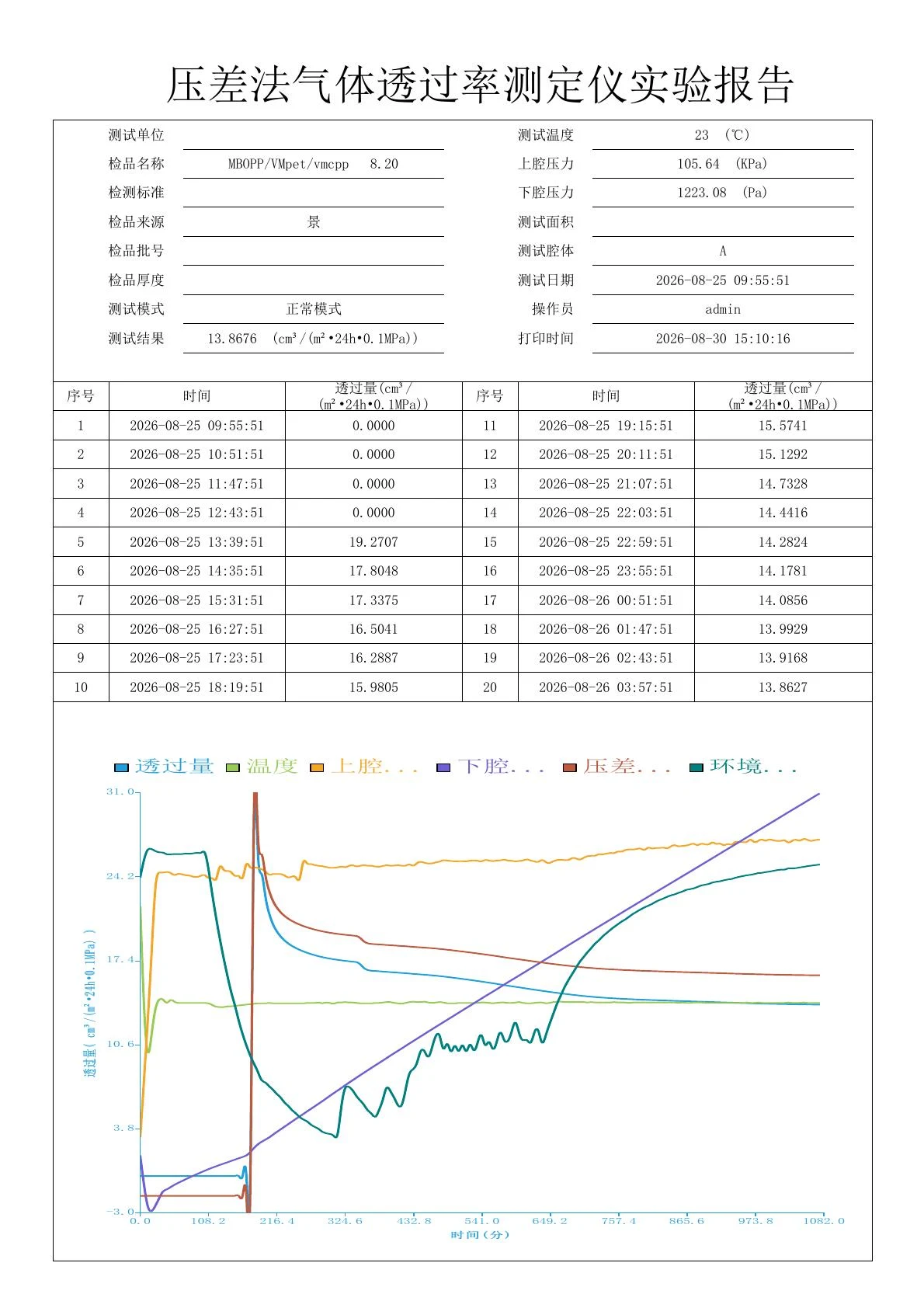
The report records a differential-pressure run for the specimen labelled MBOPP/VMpet/vmcpp 8.20 at 23°C, with a reported result of 13.8676 cm³/(m²·24h·0.1MPa). The method/standard, sample thickness, test area and batch fields are blank, so this record must not be treated as a universal OTR value, shelf-life proof or third-party accredited report.
Open the original one-page report
Test-record readiness
Use the register to distinguish available sample evidence from missing test records. Download the blank template to define the specimen, method, conditions, result and approval before publication.
Controlled food-safety records
Documented plan-review cycle
The internal sequence links prerequisite-program review, operational prerequisite controls, HACCP plan review and analysis of verification results. Project release remains separate and specification-specific.
What this evidence does and does not establish
The set shows that Huasheng documented PRP, OPRP and HACCP confirmation and verification activities on the stated date. It is not an independent HACCP certificate and does not approve every material, finished package, production batch, shelf-life target or current buyer project. Current review still requires the exact specification, sample, applicable method, acceptance rule and current supporting documents.
- Pre-Production Review — Confirm product use, material structure, artwork, sealing method and required pouch features before production.
- In-Process Checks — Monitor printing, lamination appearance, dimensions, seals and feature position during the relevant production stages.
- Final Review and Support — Review finished packaging against the confirmed specification and investigate filling, sealing or storage feedback using the actual conditions.
Confirm the Quality-Control Scope by Project
Routine production checks, project-specific test support and third-party documents are different evidence types. Confirm the method, sample, acceptance criteria and responsible party before production.
Match each procurement question to the right evidence
Management-system certificates, sample test reports, recyclability assessments and licensed-brand documents answer different questions. Review the named facility, material or package, test scope, date and project before relying on a document.
Is the production site managed under a relevant system?
Evidence to review: ISO 22000 management-system certificate and facility details
What it proves: The named management system and certified site scope, not automatic approval of every material or order.
Next check: Confirm the certificate scope against the proposed production site and project requirement.
Evidence to review →
Does a test report match the proposed laminate?
Evidence to review: PPWR Article 5 sample test reports
What it proves: Only the identified submitted sample, tested substances, method and reporting date.
Next check: Compare the report sample description with the exact laminate bill of materials.
Evidence to review →
Is the complete package recyclable under the target route?
Evidence to review: PPWR Article 6 design-for-recycling assessment
What it proves: The complete packaging design, including layers, inks, adhesive, closure and other components.
Next check: Review the finished package against current criteria and target-market collection route.
Evidence to review →
Can a licensed-brand project use this facility?
Evidence to review: Historical FAMA named-facility project document
What it proves: The referenced Licensee/Vendor, facility and project only; it is not a transferable factory certification.
Next check: Obtain current project-specific confirmation before artwork or production release.
Evidence to review →
Technical evidence and terminology directory
Use these resources to move from a public document to the material, test method, production control or project decision it can support.
- Factory and manufacturing evidence — Named-site equipment, process stages and production handoff context.
- Quality-control evidence — Incoming, in-process and finished-pack checks and their acceptance boundaries.
- Material structure directory — Layer roles, possible laminate directions and project-specific confirmation points.
- OTR and WVTR test conditions — Units, temperature, humidity, specimen type and cautious shelf-life interpretation.
- Seal and package testing — Seal strength, leakage, dimensions, appearance and sample-validation planning.
- Food-grade standards terminology — Separate management systems, declarations, sample reports and finished-package validation.
- Licensed-brand project documents — Facility, Licensee/Vendor, artwork-rights and current-project confirmation.
Prepare one evidence-matching brief
A concise project brief helps Huasheng Packaging identify which public document, sample-specific report or new verification route is relevant.
- Target market and intended product
- Exact laminate and functional components
- Food-contact or storage conditions
- Buyer, licensor or retailer program
- Project stage and required review date
Evidence graph for domestic and international answer engines
Each public claim is connected to its evidence type, applicable scope, limitation and canonical source. The statuses describe evidence handling, not third-party certification.
- Huasheng Packaging publishes its incoming, in-process and finished-packaging quality-control stages.
The page explains control points and the evidence buyers should request for a specific project.
Boundary: A described workflow is not a substitute for project specifications, agreed methods or batch records.
Evidence status - The website presents an ISO 22000 management-system document for scope review.
Use the certificates page to review the document type and stated scope.
Boundary: The document does not imply unrelated certifications or automatic approval of every finished package.
Evidence status