Laminated Shrink Film and Chub Film Tender Checklist: Structure, Shrinkage, Roll Data and Compliance Questions
Huasheng Packaging Technical Content Review · Published:
 Laminated shrink film and chub film roll samples for tender review.
Learn what buyers should confirm for laminated shrink film and chub film tenders, including LLDPE/Nylon/LDPE structures, shrinkage ratio, roll data, printing and food contact compliance questions.
Direct answer
Laminated shrink film and chub film packaging are often discussed in technical tenders for food shrink film roll projects, dairy chub film packaging, meat chub film packaging, sausage, cream cheese and processed food formats. The key question is not only whether a roll can be printed and supplied. Buyers should confirm material structure, shrink film shrinkage ratio, MD TD shrinkage direction, roll data for packaging film, sealing behavior, residual solvent in packaging film, food contact compliance packaging film documents and actual packing line validation. This checklist is written for purchasing engineers and packaging engineers who need to evaluate laminated film tender documents without assuming that one multilayer shrink film structure fits every product.
Evidence-reviewed technical guide
2026-08-21 · Huasheng Packaging Technical Content Review
Evidence scope
Specimen-specific shrink and tensile evidence, component identity and equipment handoff.
Scope and limitations
No source supplies a universal chub-film structure, shrink target, tensile target or line setting.
Key takeaways
- Shrink and tensile outputs are method- and specimen-specific.
- A layer name is not a complete specification.
- The first production reel requires representative line validation.
What is laminated shrink film or chub film?
Laminated shrink film or chub film usually refers to printed or unprinted roll film used for cylindrical, tube-like or shrink-fitted food packaging formats. It may be considered for some dairy products, meat products, sausage, cream cheese, processed food or other applications where the package needs to form around the product and respond to a shrink process. Chub film is not the same as a general retail shrink sleeve or ordinary heat shrink wrap. It is normally evaluated as a functional packaging film where structure, sealing, shrink behavior and food contact documentation matter together.
In a chub packaging tender, buyers should review the complete system: product diameter, filling weight, filling temperature, seal method, shrink tunnel or hot water condition, printed chub film artwork, roll width, repeat length, core ID, winding direction and acceptable tolerance. Different products may require different film structures and validation. A dairy chub film packaging project and a meat chub film packaging project can have different sensitivity to puncture, odor, residual solvent, sealing window and storage condition.
The film supplier and buyer should confirm the test method and acceptance criteria before production. A tender checklist should therefore ask for technical confirmation instead of relying only on a structure name or price per kilogram.
Common structure direction: LLDPE / Nylon / LDPE based laminate
A tender may name a candidate multilayer direction, but a layer-family example is not a universal chub-film specification. Require the exact grades, layer order, nominal thicknesses, food-contact side, adhesive and ink system, orientation and supplier limitations. Evaluate shrink, tensile, sealing and barrier evidence under stated specimen and method conditions. Component declarations must match the intended food and use; they do not establish residual chemistry, line fit or finished-pack shelf life.
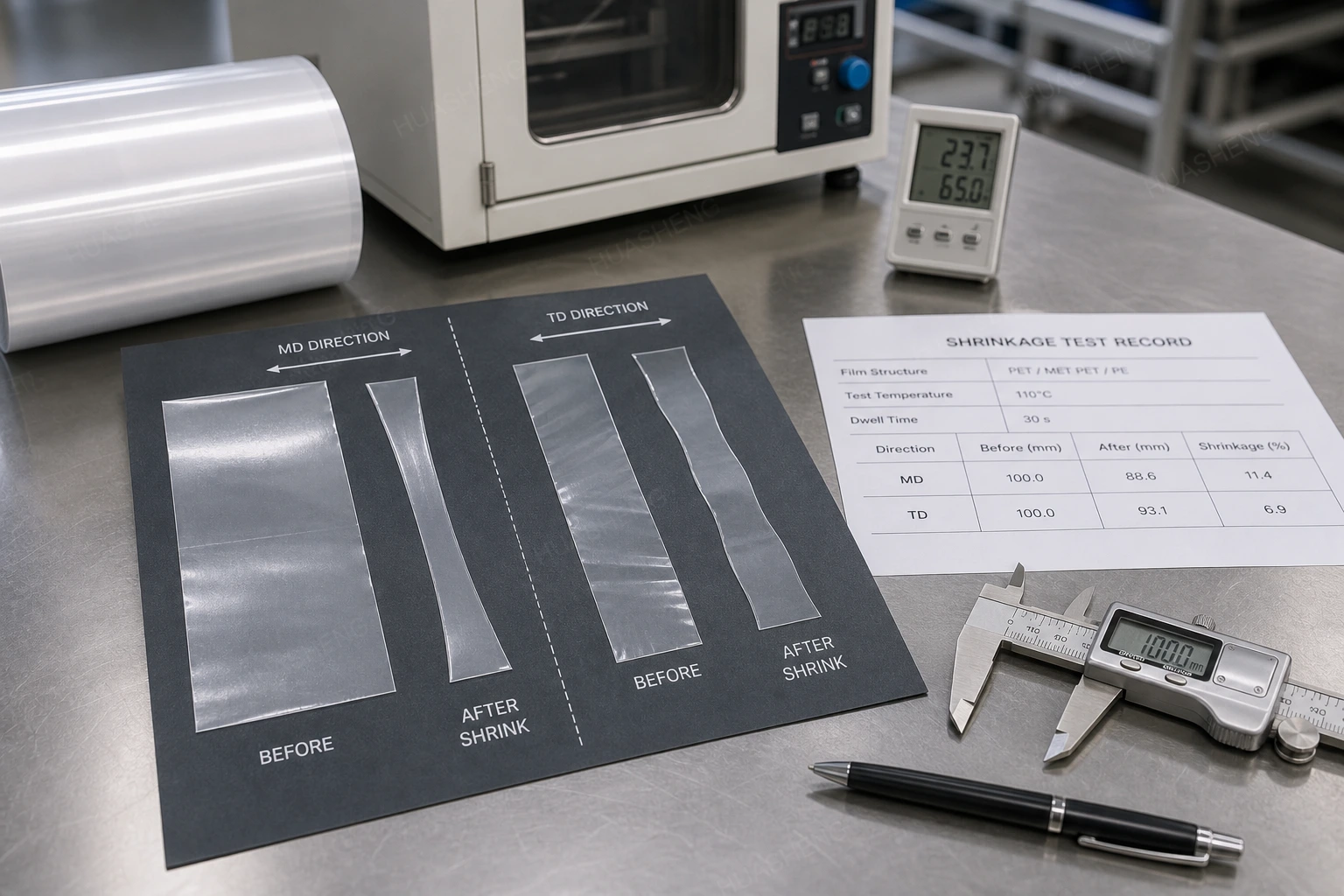 MD and TD shrinkage direction should be confirmed by test method and acceptance criteria.
Why shrinkage ratio, MD / TD direction and printing risk matter
Shrink film shrinkage ratio describes how the film changes dimension after heat exposure. MD means machine direction, aligned with the running direction of the film roll. TD means transverse direction, across the film width. MD TD shrinkage affects how tightly the package fits, how the cylindrical surface looks, how end sealing behaves and whether the film can run stably on the packaging line.
Different temperatures and exposure conditions may create different shrink behavior. Buyers should provide target shrink temperature, shrink method, product diameter, line speed, filling condition and acceptance tolerance. The supplier and buyer should confirm the test method and acceptable tolerance before production.
Printing adds another risk. Printed shrink film for food may change visually after shrinkage. Artwork, logo position, text, barcode, nutrition table and legal information can shift or distort. Dieline review should consider shrink distortion before final printing. Barcode and mandatory information should keep a safe area. For multi-SKU tenders, each design should confirm repeat length, color count, final artwork version and whether the same roll data applies to every SKU.
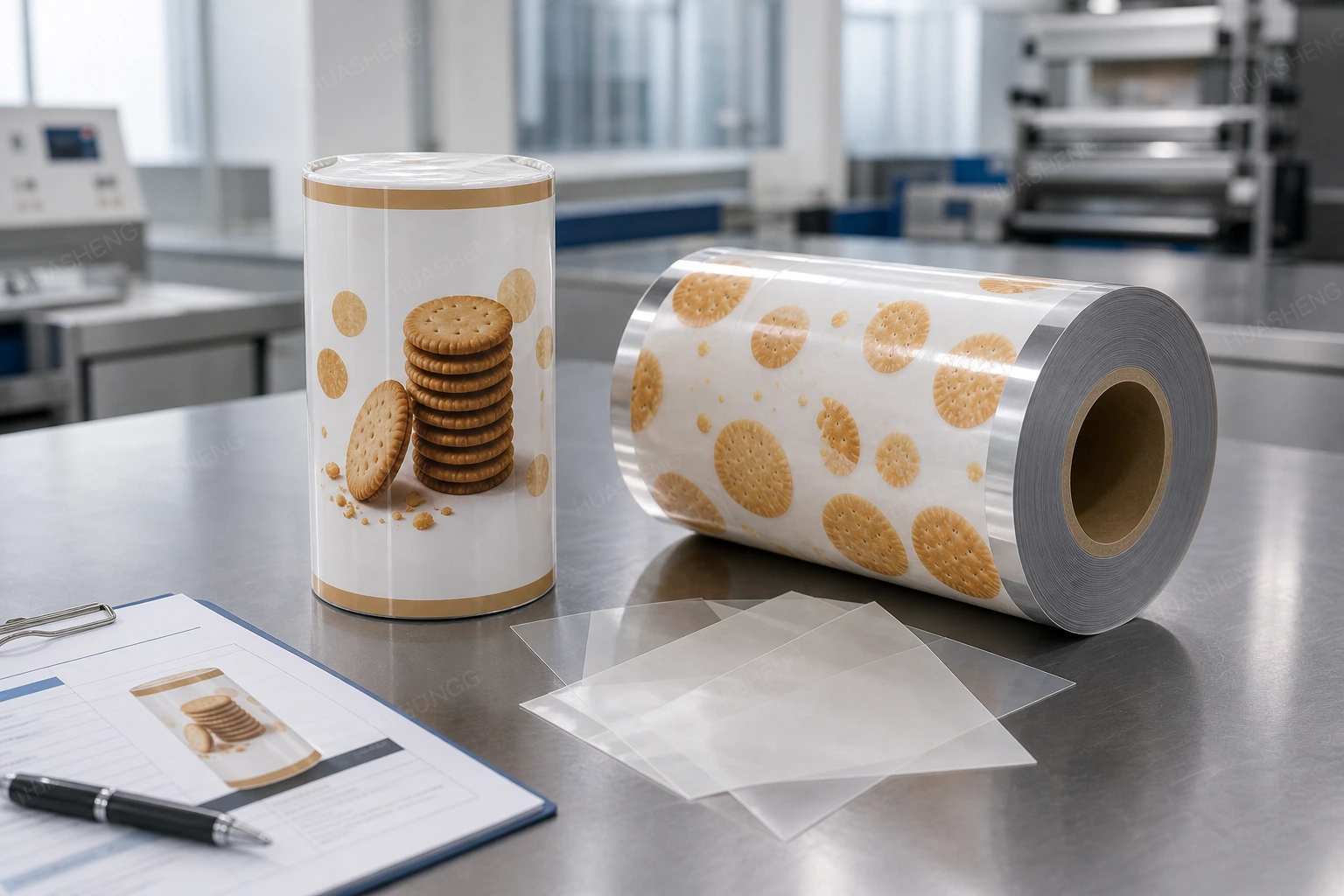 Chub film structure should match product diameter, filling and shrink process.
Roll data and technical properties often requested in tenders
Roll data is not just shipping information. It directly affects whether the film can run on the customer packaging line.
Roll data buyers should confirm:
- Film width: must match forming and sealing layout.
- Repeat length: controls print repeat and cutting or sealing position.
- Core ID: must fit the unwind shaft.
- Core width: should match roll handling and edge support.
- Max roll diameter: limited by machine and handling space.
- Max roll weight: affects operator handling and unwind capacity.
- Roll length: affects line efficiency and changeover planning.
- Winding direction: should match printed side and machine path.
- Splice requirement: should define whether splices are allowed and how they are marked.
- Print repeat tolerance: affects artwork position and pack appearance.
- Roll packing method: protects roll edges and surface during transport.
- Carton or pallet requirement: affects storage, handling and container loading.
Technical properties often requested in laminated film tender documents:
| Item | Why it matters | What buyers should confirm |
| Thickness | Affects stiffness, roll length, shrink behavior and cost comparison | Target should be confirmed by tender specification or testing method |
| Yield | Helps compare usable area per kg or per roll | Target should be confirmed by tender specification or testing method |
| WVTR | Supports moisture barrier evaluation | Target should be confirmed by tender specification or testing method |
| OTR | Supports oxygen barrier evaluation | Target should be confirmed by tender specification or testing method |
| COF outside | Affects machine running and roll handling | Target should be confirmed by tender specification or testing method |
| COF inside | Affects forming, sealing and product contact behavior | Target should be confirmed by tender specification or testing method |
| Shrinkage MD / TD | Affects pack fit, artwork distortion and sealing area | Target should be confirmed by tender specification or testing method |
| Residual solvent | Relates to odor and food packaging safety review | Target should be confirmed by tender specification or testing method |
| Print registration | Affects barcode, text and brand presentation | Target should be confirmed by tender specification or testing method |
| Odor | Important for dairy, meat and sensitive food products | Target should be confirmed by tender specification or testing method |
| Seal strength | Affects leakage risk and pack integrity | Target should be confirmed by tender specification or testing method |
| Puncture resistance | Important for handling, filling and product edges | Target should be confirmed by tender specification or testing method |
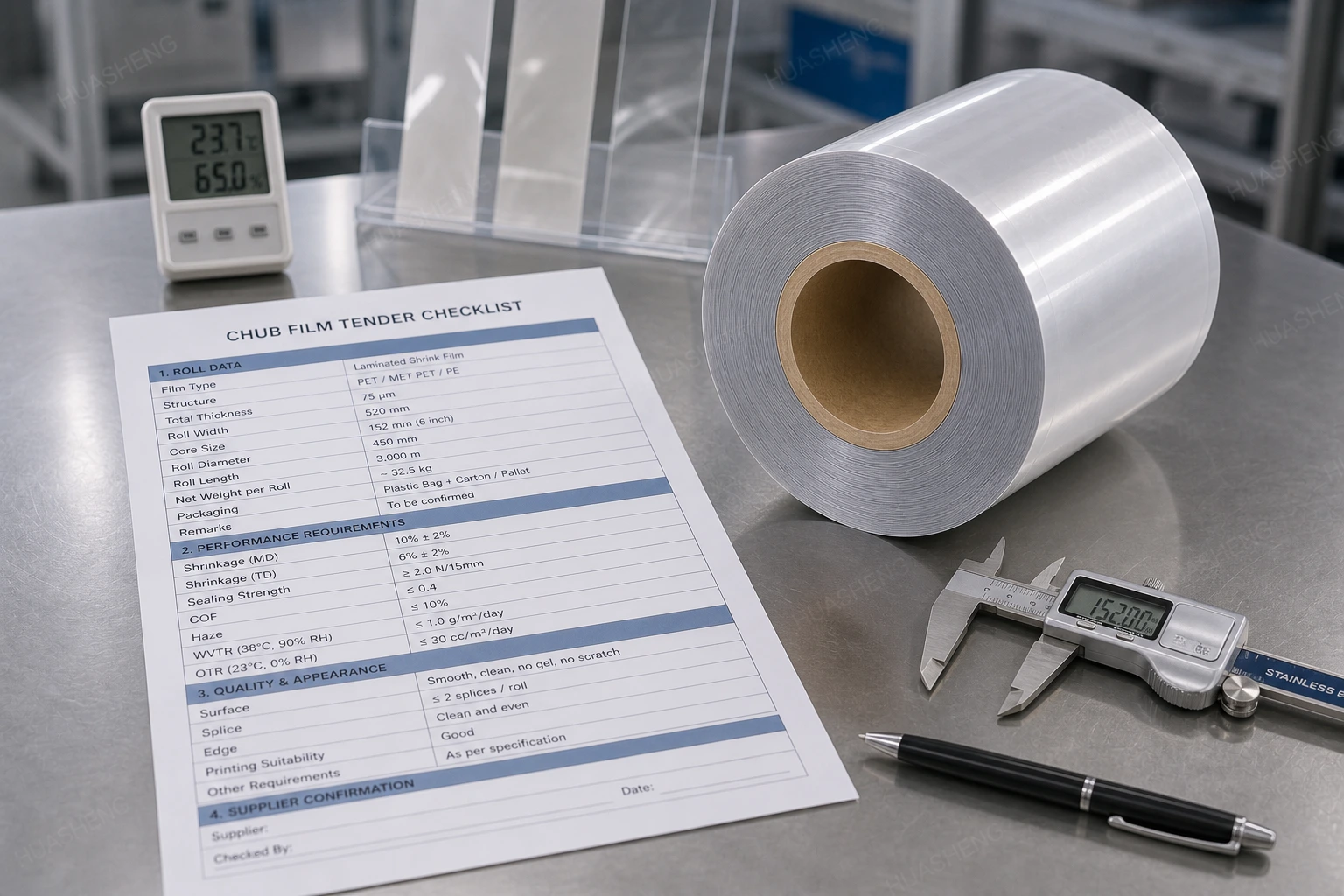 Roll width, core ID, repeat length and winding direction affect line compatibility.
Food contact documents, common mistakes and quotation checklist
Define required documents by destination market, product, component and intended use. Record the exact declaration or report, issuer, specimen or grade, test condition, date and limitation; do not request or advertise a generic certificate bundle as proof of every project. The quotation brief should include product and process conditions, drawing, reel and winding data, shrink method, artwork distortion review, sample and line-trial plan, quantities and delivery scope.
Issue the tender as a controlled roll-film and process handoff. Identify product, fill temperature and condition, target filled diameter and length, clip or closure system, forming and filling equipment, reel width and core, unwind direction, splice rule, shrink direction, test temperatures, storage and distribution. Do not turn an example layer name into a universal chub construction: tensile and shrink results belong to the named specimen, orientation, preparation and test conditions, while food-contact suitability belongs to the exact components and intended use.
Release the first production reel through staged evidence. Confirm the signed specification and roll drawing, inspect registration and winding, run the actual equipment with representative product, and record forming, closing, shrink response and finished-pack observations against project acceptance rules. ASTM D2732 measures unrestrained linear shrinkage at specified temperatures, and ASTM D882 tensile results are strongly method- and specimen-dependent; neither result alone approves line compatibility, residual chemistry, food safety or commercial shelf life.
Related Products
Related Packaging Guides
Claim-to-source evidence matrix
| Reviewed claim | Support | Sources | Boundary |
|---|
| Unrestrained linear shrinkage is measured at specified specimen temperatures. | direct | [1] | It does not approve forming, clipping or filled-package performance. |
| Thin-film tensile results depend on specimen preparation and method conditions. | direct | [2] | Correlation to end use depends on comparable conditions. |
| Food-contact review depends on each component identity and limitation. | direct | [3] | This does not establish line compatibility or shelf life. |
JSON · CSV
Authoritative References
- ASTM D2732-14(2025): Unrestrained Linear Thermal Shrinkage of Plastic Film and Sheeting · ASTM International · standard
Unrestrained linear shrinkage is measured at specified specimen temperatures - ASTM D882-26: Tensile Properties of Thin Plastic Sheeting · ASTM International · standard
Thin-film tensile results depend on specimen and method conditions - Determining the Regulatory Status of Components of a Food Contact Material · U.S. Food and Drug Administration · government
Food-contact review depends on each component identity, authorization and limitation
Frequently Asked Questions
What is chub film packaging?
Chub film packaging usually refers to roll film used for cylindrical or tube-like food packaging formats. The exact film structure, shrinkage behavior and sealing performance should be confirmed according to the product and packing process.
Is LLDPE / Nylon / LDPE a common structure for chub film?
It can be one possible structure direction in some tender specifications, but it is not the sole option. Final structure depends on product type, shrink process, filling condition, sealing requirement and compliance documents.
Why is MD / TD shrinkage important?
MD and TD shrinkage affect package fit, printed artwork distortion, sealing area and production stability. Buyers should confirm the test temperature, method and acceptable tolerance before production.
Can printed shrink film keep artwork unchanged after shrinking?
Printed artwork may change after shrinkage. Dieline, barcode, text and legal information should be reviewed with shrink distortion in mind before final printing.
What roll data should buyers provide for chub film quotation?
Buyers should provide film width, repeat length, core ID, roll diameter, roll weight, winding direction, quantity, printing colors and packing line information.
What compliance documents may be needed for food chub film?
Depending on the market and product, buyers may require food contact declarations, migration testing, residual solvent reports, ink and adhesive statements, or batch COA. These should be confirmed before quotation.
Can a supplier guarantee final shrink performance without testing?
No. Shrink performance should be validated with the actual film structure, product, packing equipment, shrink process and storage conditions.