How to Prepare Packaging Details Before Requesting a Custom Packaging Quote
Huasheng Packaging Technical Content Review · Published:
 Comparable quotations require the same format, size, structure, features, artwork and quantity inputs.
Learn what buyers should prepare before requesting a custom flexible packaging quote, including pouch size, material structure, thickness, artwork variants, sample approval, roll film data and China OEM handover requirements.
Direct answer
Requesting a custom packaging quotation without proper preparation often leads to incomplete feedback, inaccurate pricing or delayed responses. Many buyers send a simple message like "I need a pouch" or "Please quote roll film" without the key details that affect material selection, printing cost and production feasibility. This guide explains what information you should prepare before contacting a flexible packaging supplier, so you can receive a faster, more accurate quotation.
Evidence-reviewed technical guide
2026-08-21 · Huasheng Packaging Technical Content Review
Evidence scope
Product, geometry, film, equipment, intended-use and delivery inputs required for a comparable request.
Scope and limitations
The sources do not calculate a commercial MOQ, price, lead time, material structure or machine approval.
Key takeaways
- Known, unknown and factory-review fields should remain distinct.
- Alternatives must preserve a comparable baseline.
- Unverified assumptions stay out of customer commitments.
Why Packaging Quotation Needs Details
Custom flexible packaging pricing depends on many variables, not a fixed price list. When you send a detailed inquiry, the supplier can prepare an accurate quotation faster.
Key factors that affect quotation:
- Bag type or packaging format (pouch, roll film, etc.)
- Size (length, width, gusset, bottom)
- Material structure and thickness
- Printing colors and artwork complexity
- Quantity (small orders have higher unit costs)
- Accessories (zipper, spout, valve, tear notch, hang hole, clear window)
- Sample approval and China OEM handover requirements
If any of these items is missing, the supplier will need to ask follow-up questions, which adds days to the response time. Preparing these details before your first inquiry helps both sides communicate more efficiently.
Product Type and Application
Before asking for packaging details, clarify what product you are packing. Different products have different barrier, sealing and mechanical requirements.
Common product types to specify:
- Snacks (chips, nuts, dried fruit, puffed food)
- Coffee (whole bean, ground, instant)
- Sauces and liquid condiments
- Powder (spice, protein powder, milk powder, seasoning)
- Jelly and pudding
- Pet food (dry kibble, treats, freeze-dried)
- Ready meals and retort food
- Frozen food
- Candy, chocolate, biscuit
Also specify:
- Filling weight or volume
- Is the product oily, acidic, liquid or dry?
- Does it need refrigeration or frozen storage?
- Expected shelf life (3 months, 6 months, 12 months, 18 months)?
Product type directly influences the material structure, barrier requirements and sealing conditions. A coffee bag needs an aroma barrier. A sauce pouch needs strong liquid seals. A snack pack needs moisture protection.
Bag Size or Roll Film Width
For premade pouches, provide a controlled drawing that defines width, height, gusset interpretation, seal and closure zones, fitment or notch positions, usable opening and filled-product constraints. For roll film, provide the receiving machine model and forming hardware plus web width, repeat, eye mark and cut relationship, unwind direction, print side, core, maximum reel limits and splice rule. Do not rely on common core sizes or a reference pouch dimension as universal production inputs.
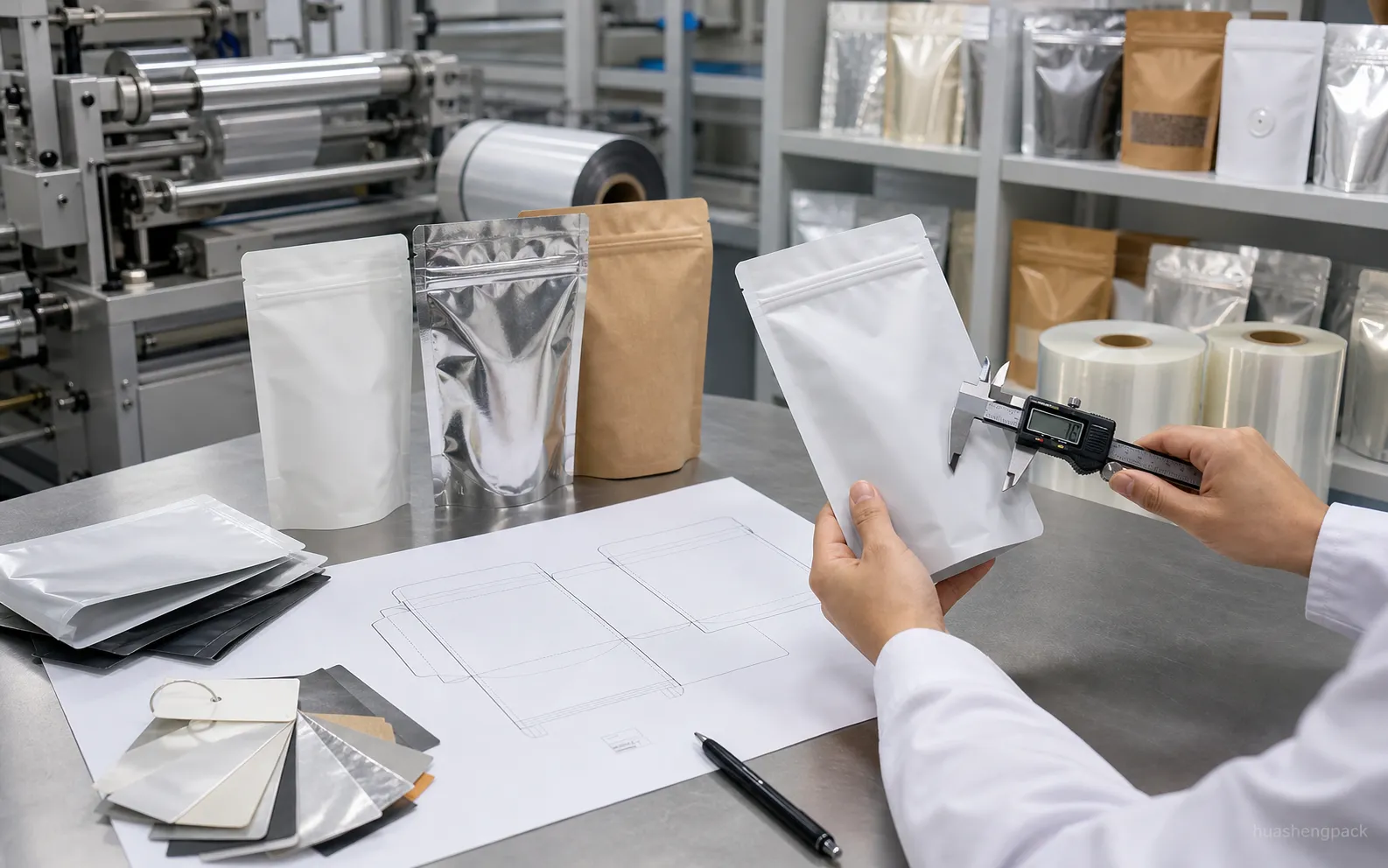 Dimensions, gussets and seal areas should be confirmed before artwork and quotation approval.
Material Structure and Thickness
If a structure is already specified, record every layer and grade, food-contact side, nominal thickness, adhesive or coating route and the evidence expected for the intended use. If it is unknown, provide the product, filling, storage, distribution, market and validation conditions and mark structure selection for factory review. Do not use a generic list of PET, metallized, foil, nylon or retort laminates as a recommendation or compliance statement.
Quantity and MOQ
Commercial MOQ cannot be inferred from one public piece or kilogram range. It can depend on the exact construction, web and pouch geometry, artwork or SKU count, tooling, material availability, conversion plan and current approved commercial policy. State target trial, first-order and forecast quantities, but keep the result as factory review until the current project inputs and production plan are confirmed. Do not treat sample feasibility as a bulk-order commitment.
Prepare one versioned project brief rather than asking the supplier to infer missing specifications. Include product form and bulk density where relevant, fill weight and volume, contact and filling conditions, target market, pouch or roll-film drawing, usable dimensions, seal and closure layout, artwork count, equipment model, reel width and core, repeat and eye mark, unwind direction, speed objective, sample stage, validation plan, quantity by SKU and delivery rule. An equipment questionnaire supports this input discipline but does not select a universal laminate or guarantee line performance.
Mark every field as supplied, unknown or requiring factory review. Ask alternatives to preserve the same baseline and list deviations explicitly. Food-contact components and conditions of use require their own evidence, while Incoterms allocate delivery obligations and do not replace the technical specification or commercial contract. The action is a comparable request package that lets the factory identify blockers before quoting and keeps unverified assumptions out of price, MOQ, lead-time and performance promises.
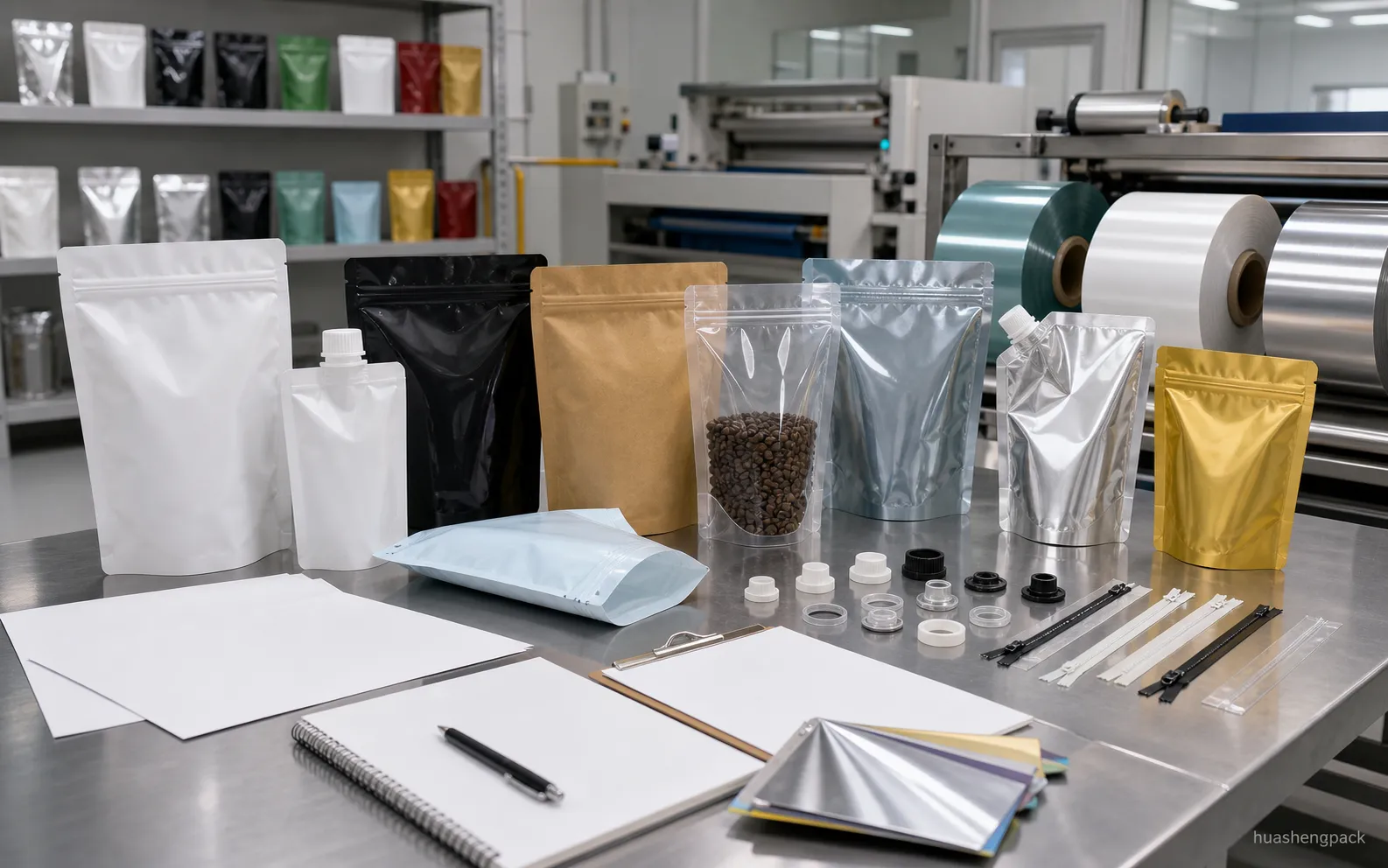 List quantity, colors and features by artwork variant rather than only total project quantity.
Related Products
Related Packaging Guides
Claim-to-source evidence matrix
| Reviewed claim | Support | Sources | Boundary |
|---|
| Product, pack geometry, film and equipment data are linked application inputs. | direct | [1] | A named questionnaire does not guarantee compatibility or select a structure. |
| Food type and time-temperature conditions belong in intended-use review. | direct | [2] | The source does not define commercial terms. |
| Incoterms allocate delivery tasks, costs and risks. | direct | [3] | They do not replace the technical brief or full contract. |
JSON · CSV
Authoritative References
- VFFS Application Questionnaire · ROVEMA North America · manufacturer-data
Product, pack geometry, film and equipment data are linked application inputs - Food Types and Conditions of Use for Food Contact Substances · U.S. Food and Drug Administration · government
Food type and time-temperature conditions belong in intended-use review - Incoterms 2020 Rules · International Chamber of Commerce · technical-organization
Incoterms allocate delivery tasks, costs and risks between buyer and seller
Frequently Asked Questions
Why do suppliers need size and material before quotation?
Bag size determines material consumption and layout efficiency. Material structure affects film cost, barrier performance and production parameters. Without these details, any quotation would be a rough estimate that may change significantly after specification review.
Can you quote if I only have a sample photo?
A sample photo is very helpful as a starting point. The supplier can estimate pouch type, approximate size, structure and features from the photo. However, for a final quotation, you will still need to confirm actual dimensions, material and quantity.
What if I do not know the material structure?
This is common. Simply tell the supplier your product type, filling weight, shelf life target and storage condition. The supplier can recommend a suitable material structure based on experience with similar products. You do not need to be a packaging engineer to get started.
Is MOQ the same for all custom packaging?
No. MOQ varies by bag type, size, material structure and printing complexity. Larger bags have higher material consumption so MOQ may be lower in pieces but higher in kg. Discuss your target quantity with the supplier early.
What information is needed for roll film used on automatic packing machines?
Roll width, film thickness, heat seal layer type, eye mark position, unwinding direction, core size, max roll diameter, and packing machine brand/model. These specifications must match your machine precisely to avoid production issues.
Do different artwork variants affect the quotation?
Yes. Even when several variants use the same size and material, different artwork may need separate color review, cylinder setup and production tracking. Quantity per design should be confirmed.
Can packaging be handed over to a China OEM factory or warehouse?
Yes. If the buyer nominates a China OEM factory, filling plant, agent or domestic warehouse, provide receiving instructions, carton label requirements, sample approval method and packing line data if applicable.
How long does it take to receive a quotation after sending complete details?
With complete information, most suppliers can provide a preliminary quotation within 1-2 working days. Complex multi-SKU or OEM handover inquiries may take longer. Sending complete details in your first message helps avoid back-and-forth delays.