Liquid Detergent & Shampoo Refill Spout Pouches: Stress-Crack, Burst & Drop-Test Engineering
Huasheng Packaging Technical Content Review
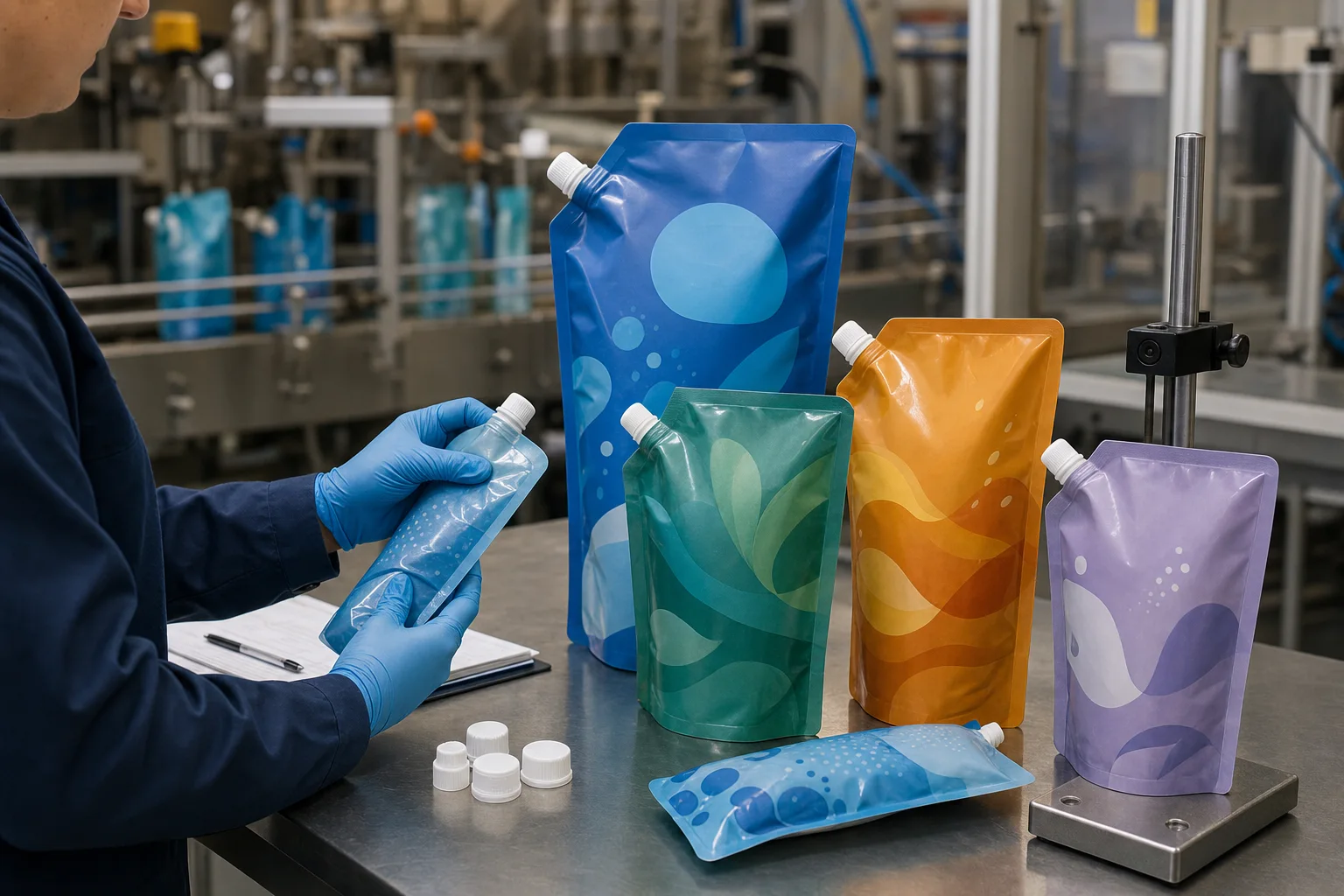
Prevent surfactant stress-cracking, delamination, and shipping bursts on 500ml–3L laundry detergent, hand soap, and shampoo refill spout pouches.
Direct answer
Laundry detergent, dishwashing liquid, fabric softener, and shampoo refills have become one of the fastest-growing flexible packaging categories across Asia, Europe, and CIS retail chains—cutting plastic weight by up to 70% versus rigid HDPE bottles. However, alkaline surfactants, essential oils, and heavy 1 L–3 L liquid loads punish weak seals and ordinary food adhesives.
Contents
Evidence-reviewed technical guide
Evidence-reviewed technical guide
2026-11-27 · Huasheng Packaging Technical Editorial Review
Evidence scope
Applies to B2B custom flexible packaging specification review for daily chemical & liquid refills projects sourced from direct gravure converting plants.
Scope and limitations
General engineering bands and procurement guidelines do not replace filled-pack shelf-life testing, machine compatibility trials, or destination-market regulatory review.
Key takeaways
- Why Liquid Chemical Refills Fail in Standard Food-Grade Pouches
- Proven Multi-Layer Structures & Spout Sizing (500 ml to 3 L)
- Specification Checklist for Detergent & Daily Chemical Spout Pouches
Why Liquid Chemical Refills Fail in Standard Food-Grade Pouches
Surfactants, fragrance solvents, and high-pH detergents aggressively attack standard PE resin—causing environmental stress cracking (ESCR) along creased gussets—and penetrate ordinary laminating adhesives to cause layer bubbling and delamination. Worse, a 2 L refill pouch dropped inside an e-commerce carton generates hydraulic shock waves directly against the bottom gusset weld and spout canoe seal.
Frequent Spec Mistakes on Laundry & Personal Care Refill Pouches
First, copying a 120 μm beverage pouch structure for a 2 L laundry detergent refill without adding a biaxially oriented nylon (PA) toughening layer. Second, using standard PE sealant instead of ESCR-resistant co-extruded LLDPE/mLLDPE. Third, selecting an undersized 8.6 mm food spout for viscous laundry gel instead of a 16 mm–22 mm ergonomic corner pour spout.
Proven Multi-Layer Structures & Spout Sizing (500 ml to 3 L)
For 500 ml–1 L shampoo, hand soap, or body wash refills: PET (12 μm) / PA (15 μm) / ESCR-PE (110–130 μm) (total ~140–160 μm) with a 13 mm–16 mm corner spout. For heavy 1.5 L–3 L laundry detergent and fabric softener refills: PET (12 μm) / PA (15–25 μm) / ESCR-PE (140–170 μm) or 4-layer PET/AL/PA/PE where aggressive fragrances or UV sensitivity apply, paired with a 16 mm–22 mm screw spout, anti-drip ribs, and optional die-cut carry handle. Because household liquid refills carry high product density (1.0 to 1.15 kg per liter) plus aggressive anionic or nonionic surfactants and fragrance terpenes, structural engineering must pair chemical-resistant two-component polyurethane laminating adhesives with environmental-stress-crack-resistant (ESCR) co-extruded PE sealant layers. Confirm exact corner-spout weld geometry, bottom-gusset K-seal or Doypack skirt reinforcement, and outer master-carton partition sizing so stacked 1 L to 3 L refill pouches survive warehouse pallet loads and courier parcel drops without weeping along the spout canoe or bottom gusset crease.
Mandatory Burst, Compression, Drop & 45°C Chemical-Soak Tests
Before approving bulk detergent pouches, test filled samples across four gates: (1) static compression load (e.g., 40–60 kg plate load for 1–5 minutes without weeping), (2) 1.0 m–1.2 m flat and corner drop tests at ambient temperature, (3) 40°C–45°C 14-day accelerated chemical compatibility soak to confirm zero adhesive softening or delamination, and (4) spout torque and leak check. In our 6,880 m² Chaozhou facility operating under ISO 22000:2018 (cert. 007FSMS2300214), pre-production and batch release records include calibrated gauge checks, GBPI heat-seal tensile strength logs, barrier verification where specified, barcode scan checks, and packed carton export inspections before FOB/CIF or China warehouse handover.
Specification Checklist for Detergent & Daily Chemical Spout Pouches
Provide liquid formula pH/surfactant or essential-oil presence, viscosity, fill volume (500 ml, 1 L, 2 L, 3 L), desired spout diameter and corner vs. top-center position, manual vs. automatic spout-filling machine rails, and shipping channel (retail carton vs. e-commerce parcel).
Related Products
Related Applications
Claim-to-source evidence matrix
| Reviewed claim | Support | Sources | Boundary |
|---|---|---|---|
| Final flexible packaging specifications require confirming product chemistry, barrier needs, dimensions, and filling conditions before bulk production. | contextual | [1], [3] | Engineering review boundary prior to cylinder engraving or commercial conversion. |
| Seal integrity and laminate suitability should be verified on representative samples using actual product and sealing equipment. | direct | [2] | Quantitative seal testing and line trials supersede nominal film descriptions. |
| Huasheng Packaging operates integrated 9-color gravure printing, lamination, and pouch converting in Chaozhou under ISO 22000:2018 (007FSMS2300214). | direct | [3], [1] | Factory capability and active management-system scope; product-specific export compliance confirmed per order. |
Authoritative References
- ISO 22000:2018 Food safety management systems · International Organization for Standardization (ISO) · standard
Food-contact packaging production management relies on documented food-safety management controls and traceability. - ASTM F88/F88M-23 Standard Test Method for Seal Strength of Flexible Barrier Materials · ASTM International · standard
Flexible pouch and roll-film heat-seal performance should be verified quantitatively rather than assumed from film appearance. - Huasheng Packaging Chaozhou In-House Converting & Quality Control Overview · Huasheng Packaging · internal-evidence
Describes Chaozhou in-house 9-color gravure printing, lamination, slitting, pouch converting, and ISO 22000:2018 scope.
Frequently Asked Questions
Why is a nylon (PA) middle layer essential for 1 L–3 L detergent refill pouches?
Nylon (BOPA) provides high puncture, flex-crack, and drop-impact resistance so heavy liquid hydraulic shock does not split the pouch during transit or shelf handling.
What spout diameter works best for liquid laundry detergent vs. hand soap?
Hand soap and shampoo refills commonly use 10 mm–16 mm spouts, while thicker 1.5 L–3 L laundry detergent refills pour cleanly with 16 mm–22 mm corner spouts.
How do you prevent detergent fragrance oils from causing pouch delamination?
Use chemical-resistant two-component polyurethane laminating adhesives paired with ESCR-grade co-extruded PE sealant, and run a 45°C filled compatibility soak test before bulk conversion.
Can refill spout pouches include a die-cut carry handle for 2 L–3 L formats?
Yes. Reinforced side-gusset or top-edge die-cut handles can be engineered on heavy-gauge PET/PA/PE pouches with seal-area reinforcement around the handle cutout.
Does Huasheng test spout-to-film seal strength in-house?
Yes. Our Chaozhou QC lab conducts heat-seal tensile tests, pressure/burst checks, and visual spout-canoe inspection across production batches.
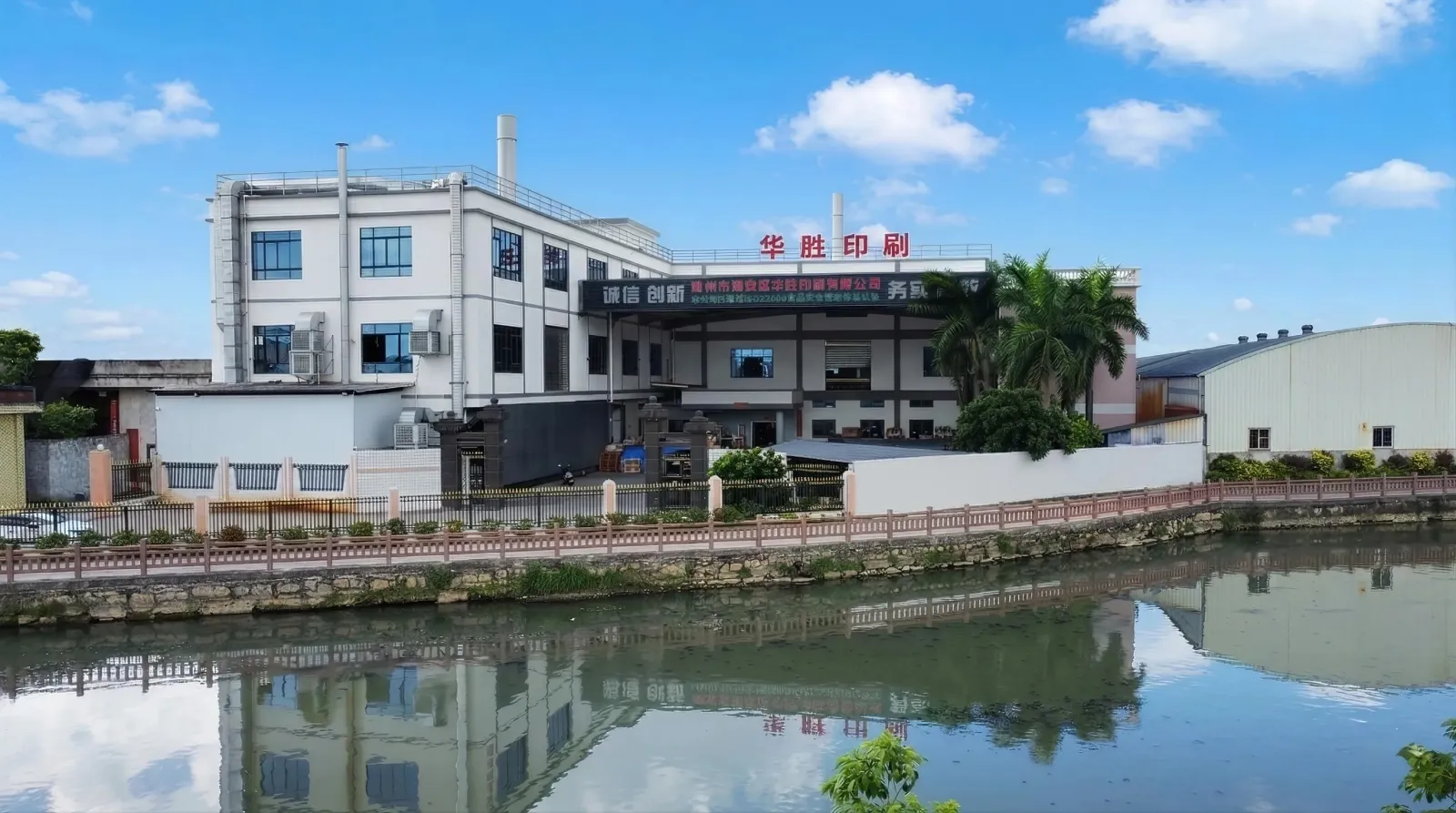
About Huasheng
In-house 9-color gravure printing, solventless lamination, slitting, and pouch converting across stand up pouches, spout pouches, retort bags, coffee bags, and automatic rollstock film.
A legacy of quality in flexible packaging since 1997.
1997 · 6,880 m²
Chaozhou · Guangdong · China
Longshewei, Neipan Management District, Dongfeng Town, Chao'an District, Chaozhou City, Guangdong Province, China