How to Size a Powder Pouch from Bulk Density, Headspace and Filled Samples
Huasheng Packaging Technical Content Review · Published:
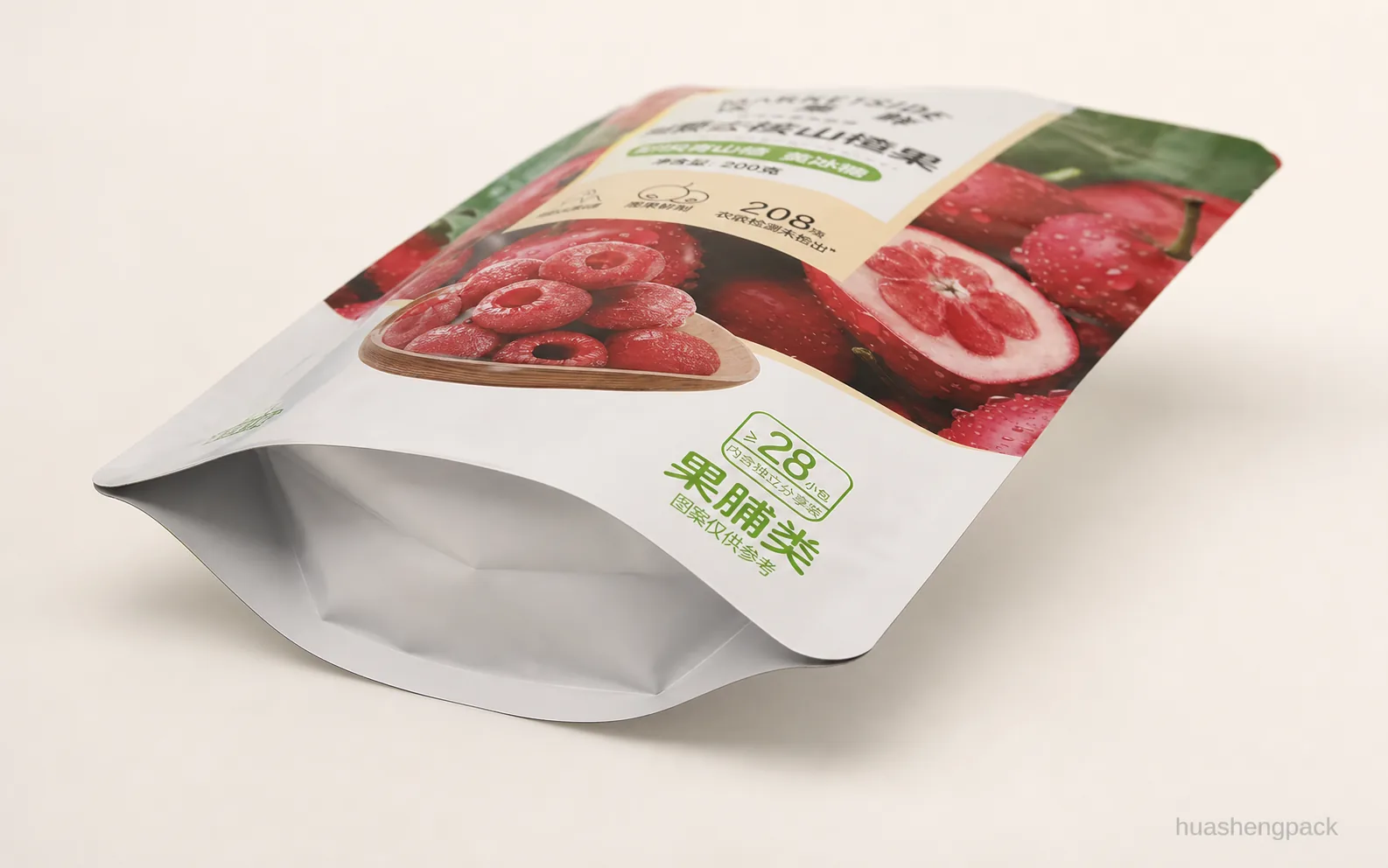 The image supports visible appearance or setting only. It does not prove material structure, performance, certification, a customer relationship or project suitability.
Convert fill weight into a pouch-size trial using bulk density, settling, headspace, seal clearance, filled shape and carton fit.
Direct answer
Fill weight is not internal volume. A powder pouch must be sized from measured bulk density, settling behavior, particle form, required headspace, closure position and the geometry of a converted pouch. The safest route is a calculation followed by several filled-size trials, not a universal weight-to-size chart.
Evidence-reviewed technical guide
2026-08-31 · Huasheng Packaging Technical Content Review
Evidence scope
How to Size a Powder Pouch from Bulk Density, Headspace and Filled Samples
Scope and limitations
No customer identity, transcript, order-specific price, fixed MOQ, universal material recipe, performance promise, machine approval or shelf-life guarantee is published.
Key takeaways
- Record loose and settled bulk density using a repeatable container and procedure. Note whether the product is fine, aerated, flaky, oily, cohesive or prone to bridging. A density value without the method, temperature and sample condition is too weak to control a final pouch drawing.
- Estimate a starting volume from fill weight and density, then prepare a small ladder of adjacent pouch dimensions. Keep the pouch construction and closure position constant while changing one dimension at a time. This reveals whether the limit is volume, top-seal clearance, standing stability or consumer access.
- The approved result should define width, height, gusset convention, seal areas, zipper and notch positions, tolerances, measurement state and fill-weight reference. Attach a photographed or signed filled sample so that later production is compared with the same geometry rather than a remembered description.
1. Measure the Product State
Record loose and settled bulk density using a repeatable container and procedure. Note whether the product is fine, aerated, flaky, oily, cohesive or prone to bridging. A density value without the method, temperature and sample condition is too weak to control a final pouch drawing.
The image supports visible appearance or setting only. It does not prove material structure, performance, certification, a customer relationship or project suitability.2. Do Not Treat External Size as Usable Volume
Seal widths, zipper position, tear notch, bottom gusset, side folds and top clearance all consume space. Two pouches with the same nominal width and height can provide different usable volume. Define the flat measurement state and every gusset convention before comparing samples.
3. Build a Size Ladder
Estimate a starting volume from fill weight and density, then prepare a small ladder of adjacent pouch dimensions. Keep the pouch construction and closure position constant while changing one dimension at a time. This reveals whether the limit is volume, top-seal clearance, standing stability or consumer access.
A useful trial sheet records the product batch, loose and settled density method, target fill, candidate flat dimensions, total or one-side gusset convention, zipper and top-seal position, measured headspace after settling, filled thickness and carton orientation. Photograph every candidate against the same scale. If a scoop, spout or automated gripper is involved, include the clearance it requires instead of measuring volume alone.
4. Run Filled-Pouch Checks
Fill each candidate with representative product using the intended method. Check dust at the seal, headspace, zipper access, scoop or pour behavior, standing profile, compression and carton count. Repeat after settling because the appearance immediately after filling may not represent distribution condition.
For the first filled trial, weigh a known volume of product several times rather than relying on a marketing density. Fill each candidate by the planned method, mark the settled product line and measure the remaining distance to the zipper and final seal. Record whether the bag bulges into seal areas, rocks on its base, blocks a scoop or changes carton count. Repeat with a second product batch if density is known to vary. The result is a size window with observed trade-offs, not a universal grams-to-millimetres formula.
5. Release a Controlled Drawing
The approved result should define width, height, gusset convention, seal areas, zipper and notch positions, tolerances, measurement state and fill-weight reference. Attach a photographed or signed filled sample so that later production is compared with the same geometry rather than a remembered description.
Reject a candidate that fits only when compressed, contaminates the final seal, hides the zipper under product pressure or cannot maintain the intended standing profile after settling. The approved size is the smallest candidate that completes filling, final sealing, consumer access and carton handling with documented margin—not simply the smallest empty pouch that can hold the nominal weight once.
Professional evidence used in this guide includes: ASTM F2203-13(2022): Linear Measurement Using Precision Steel Rule; ASTM F2251-13(2023): Thickness Measurement of Flexible Packaging Material; ROVEMA VFFS Application Questionnaire. Its mapped scope is: Linear dimensions require a defined specimen state and method; Flexible-material thickness is method-dependent; Product, package, film, reel, sealing and output inputs belong in one machine brief. These sources answer specific method, use-condition or equipment-input questions; they do not automatically approve the complete package, a particular machine, commercial shelf life or the current order. To apply this guide to a Powder Pouch Sizing decision, maintain a four-column condition–evidence–limitation–action record: state the current condition, identify the sample or record supporting it, name the risk that remains outside that evidence and assign the next action with its acceptance condition. Reopen the affected conclusion whenever the product, specification, process or controlling evidence changes.
Related Products
Related Packaging Guides
Claim-to-source evidence matrix
| Reviewed claim | Support | Sources | Boundary |
|---|
| Linear dimensions require a defined specimen state and method | direct | [1] | The cited source supports only the named method, boundary or equipment input and does not approve the complete packaging project. |
| Flexible-material thickness is method-dependent | direct | [2] | The cited source supports only the named method, boundary or equipment input and does not approve the complete packaging project. |
| Product, package, film, reel, sealing and output inputs belong in one machine brief | direct | [3] | The cited source supports only the named method, boundary or equipment input and does not approve the complete packaging project. |
JSON · CSV
Authoritative References
- ASTM F2203-13(2022): Linear Measurement Using Precision Steel Rule · ASTM International · standard
Linear dimensions require a defined specimen state and method - ASTM F2251-13(2023): Thickness Measurement of Flexible Packaging Material · ASTM International · standard
Flexible-material thickness is method-dependent - ROVEMA VFFS Application Questionnaire · ROVEMA North America · manufacturer-data
Product, package, film, reel, sealing and output inputs belong in one machine brief
Frequently Asked Questions
Can a factory choose size from grams alone?
No. Bulk density and filled-pouch trials are required.
Why test more than one size?
Adjacent sizes reveal the real limit without over-sizing.
Does a gusset number mean total depth?
Not always; define total versus one-side depth.
Should powder settling be considered?
Yes, check the pouch after representative settling.
Can a photo prove capacity?
No, it supports appearance only.
What approves the final size?
A controlled drawing and accepted filled sample.