Specialty Coffee Roaster Format Guide: Flat-Bottom Box vs. Side-Gusset Valve Bags by Cost & Shelf Impact
Huasheng Packaging Technical Content Review
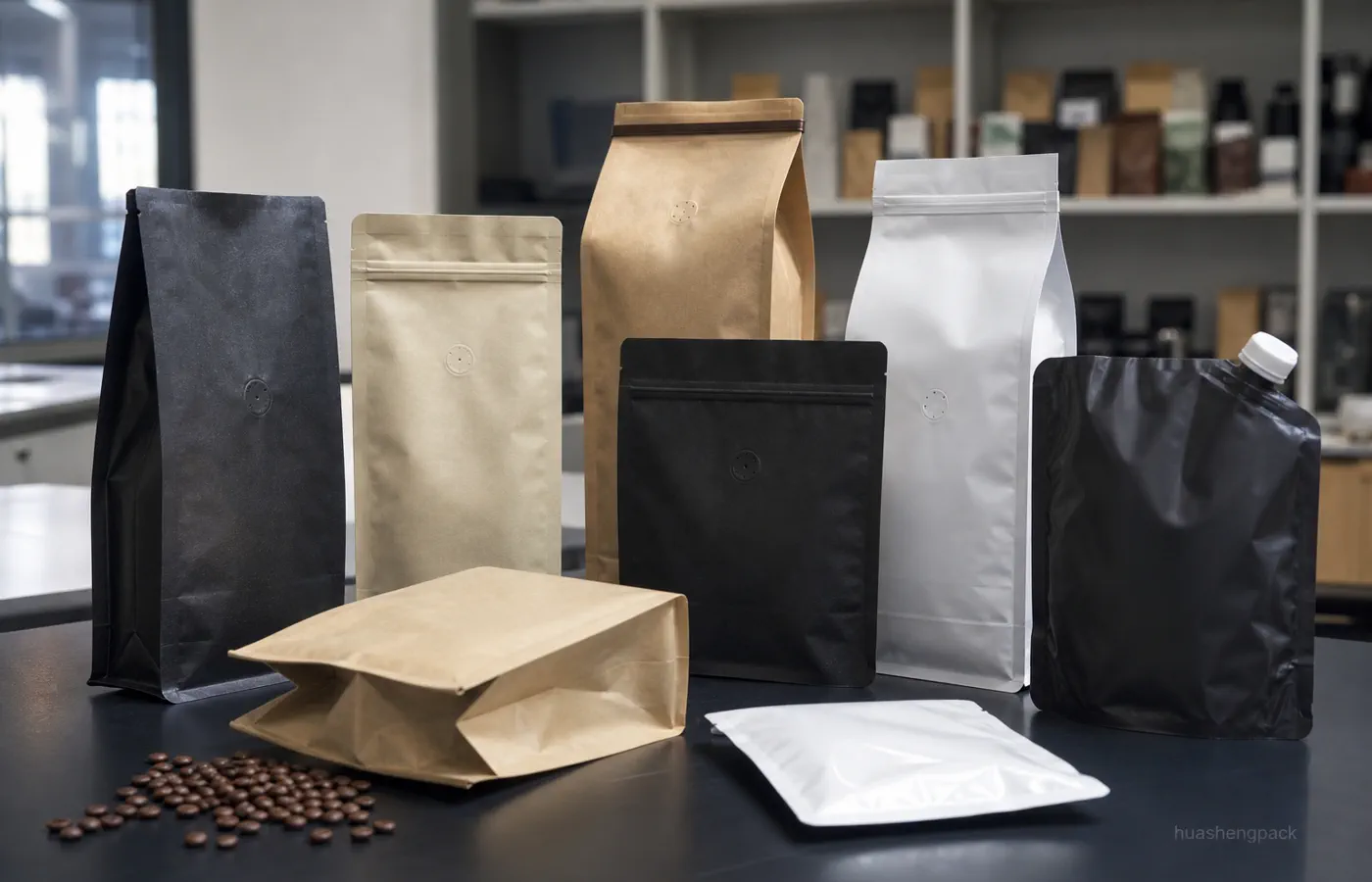
Compare 250g–1kg flat-bottom box pouches and traditional side-gusset coffee bags by unit cost, pocket zipper usability, valve placement, and roaster economics.
Direct answer
Specialty coffee roasters scaling from 250 g retail bags into 500 g and 1 kg café wholesale packs constantly weigh two flagship structures: modern flat-bottom (eight-side-seal box) pouches with front pocket zippers versus classic four-panel side-gusset bags. Choosing the right format per channel balances premium retail differentiation with lean café-wholesale unit economics.
Contents
Evidence-reviewed technical guide
Evidence-reviewed technical guide
2026-11-27 · Huasheng Packaging Technical Editorial Review
Evidence scope
Applies to B2B custom flexible packaging specification review for specialty coffee procurement projects sourced from direct gravure converting plants.
Scope and limitations
General engineering bands and procurement guidelines do not replace filled-pack shelf-life testing, machine compatibility trials, or destination-market regulatory review.
Key takeaways
- How Format Choice Shapes Unit Cost, Filling Speed & Consumer Reuse
- Smart Channel Split: Retail 250 g–500 g vs. Wholesale 1 kg Coffee Bags
- Roaster Specification Inputs for Side-by-Side Format Quotes
How Format Choice Shapes Unit Cost, Filling Speed & Consumer Reuse
Flat-bottom box pouches stand like rigid cartons with five printable surfaces and integrate cleanly with easy-tear front pocket zippers—yet their multi-web converting process adds ~15%–25% higher unit cost and slightly higher MOQ than side-gusset bags. Conversely, classic side-gusset bags minimize per-bag cost and ship compactly for 1 kg espresso wholesale, but lack an integrated consumer zipper unless paired with tin-ties or tape.
Common Coffee Bag Ordering Mistakes by Growing Roasters
First, putting expensive flat-bottom pocket-zipper bags onto 1 kg B2B café accounts that tear bags open and dump all 1 kg straight into espresso hoppers—wasting zipper cost where zero home resealing happens. Second, placing the one-way degassing valve too low or directly over a fold/seam, causing CO2 venting failure or bloated retail bags. Third, skipping aluminum foil (AL 7 μm) or high-density VMPET barrier on oil-rich dark roasts exported to humid climates.
Smart Channel Split: Retail 250 g–500 g vs. Wholesale 1 kg Coffee Bags
For 250 g and 500 g retail specialty beans and ground coffee: choose **Flat-Bottom (Box) Pouches** in Matte BOPP or Matte PET / VMPET (12 μm) or AL (7 μm) / PE (80–100 μm) (total 120–145 μm) with a one-way Swiss/standard degassing valve and pull-tab front pocket zipper. The square footprint maximizes café-shelf visibility and consumer freshness after opening. For 1 kg wholesale café beans or budget retail SKUs: choose **Side-Gusset Valve Bags** (with quad-seal corners for crisp upright stacking) using PET / VMPET / PE or PET / AL / PE (130–150 μm) to cut per-bag cost while keeping full CO2 degassing and oxygen protection.
One-Way Valve Seal, CO2 Venting & Pocket-Zipper Pull-Tab Inspection
Inspect pre-production coffee bags for: (1) ultrasonic valve weld tightness (zero inward air leak under vacuum immersion while cracking open cleanly at low positive CO2 pressure), (2) smooth pocket-zipper laser tear-strip pull without tearing into the main barrier wall, (3) crisp matte-varnish and foil-stamp alignment, and (4) seal tensile strength across thick multi-layer gusset intersections. In our 6,880 m² Chaozhou facility operating under ISO 22000:2018 (cert. 007FSMS2300214), pre-production and batch release records include calibrated gauge checks, GBPI heat-seal tensile strength logs, barrier verification where specified, barcode scan checks, and export carton inspections before FOB/CIF or China warehouse handover.
Roaster Specification Inputs for Side-by-Side Format Quotes
Share pack weights (250 g, 340 g/12 oz, 500 g, 1 kg), whole-bean vs. ground coffee density, retail vs. wholesale channel mix, valve and pocket-zipper preferences, finish (soft-touch matte, kraft paper, spot gloss), SKU count, and target quantity per size.
Related Products
Related Applications
Claim-to-source evidence matrix
| Reviewed claim | Support | Sources | Boundary |
|---|---|---|---|
| Final flexible packaging specifications require confirming product chemistry, barrier needs, dimensions, and filling conditions before bulk production. | contextual | [1], [3] | Engineering review boundary prior to cylinder engraving or commercial conversion. |
| Seal integrity and laminate suitability should be verified on representative samples using actual product and sealing equipment. | direct | [2] | Quantitative seal testing and line trials supersede nominal film descriptions. |
| Huasheng Packaging operates integrated 9-color gravure printing, lamination, and pouch converting in Chaozhou under ISO 22000:2018 (007FSMS2300214). | direct | [3], [1] | Factory capability and active management-system scope; product-specific export compliance confirmed per order. |
Authoritative References
- ISO 22000:2018 Food safety management systems · International Organization for Standardization (ISO) · standard
Food-contact packaging production management relies on documented food-safety management controls and traceability. - ASTM F88/F88M-23 Standard Test Method for Seal Strength of Flexible Barrier Materials · ASTM International · standard
Flexible pouch and roll-film heat-seal performance should be verified quantitatively rather than assumed from film appearance. - Huasheng Packaging Chaozhou In-House Converting & Quality Control Overview · Huasheng Packaging · internal-evidence
Describes Chaozhou in-house 9-color gravure printing, lamination, slitting, pouch converting, and ISO 22000:2018 scope.
Frequently Asked Questions
How much more expensive is a flat-bottom coffee pouch than a side-gusset bag?
At comparable barrier thickness and volume, flat-bottom box pouches with front pocket zippers typically cost about 15%–25% more per bag than side-gusset valve bags, justified mainly on retail consumer shelves.
Where should the one-way degassing valve be placed on a coffee bag?
Position the valve centrally on the upper front or back panel (typically 60–90 mm below the top seal, clear of any zipper or fold crease) so freshly roasted CO2 vents without leaking.
Is VMPET enough for roasted coffee beans, or should I pay for aluminum foil?
PET/VMPET/PE offers strong 9–12 month protection for fast-turning roasters, while 7 μm aluminum foil (PET/AL/PE) delivers near-zero oxygen transmission for 12–18 month export or supermarket distribution.
Can one gravure plate set work across multiple single-origin coffees?
Yes. Many specialty roasters print a shared high-impact brand bag via gravure and apply origin/roast-date labels onto a clean matte panel—combining gravure unit economics with unlimited micro-lot agility.
Can Huasheng supply both 250 g flat-bottom retail bags and 1 kg side-gusset bags together?
Yes. We convert both formats with ultrasonic degassing valves, pocket zippers, and soft-touch matte finishes in Chaozhou under ISO 22000:2018.
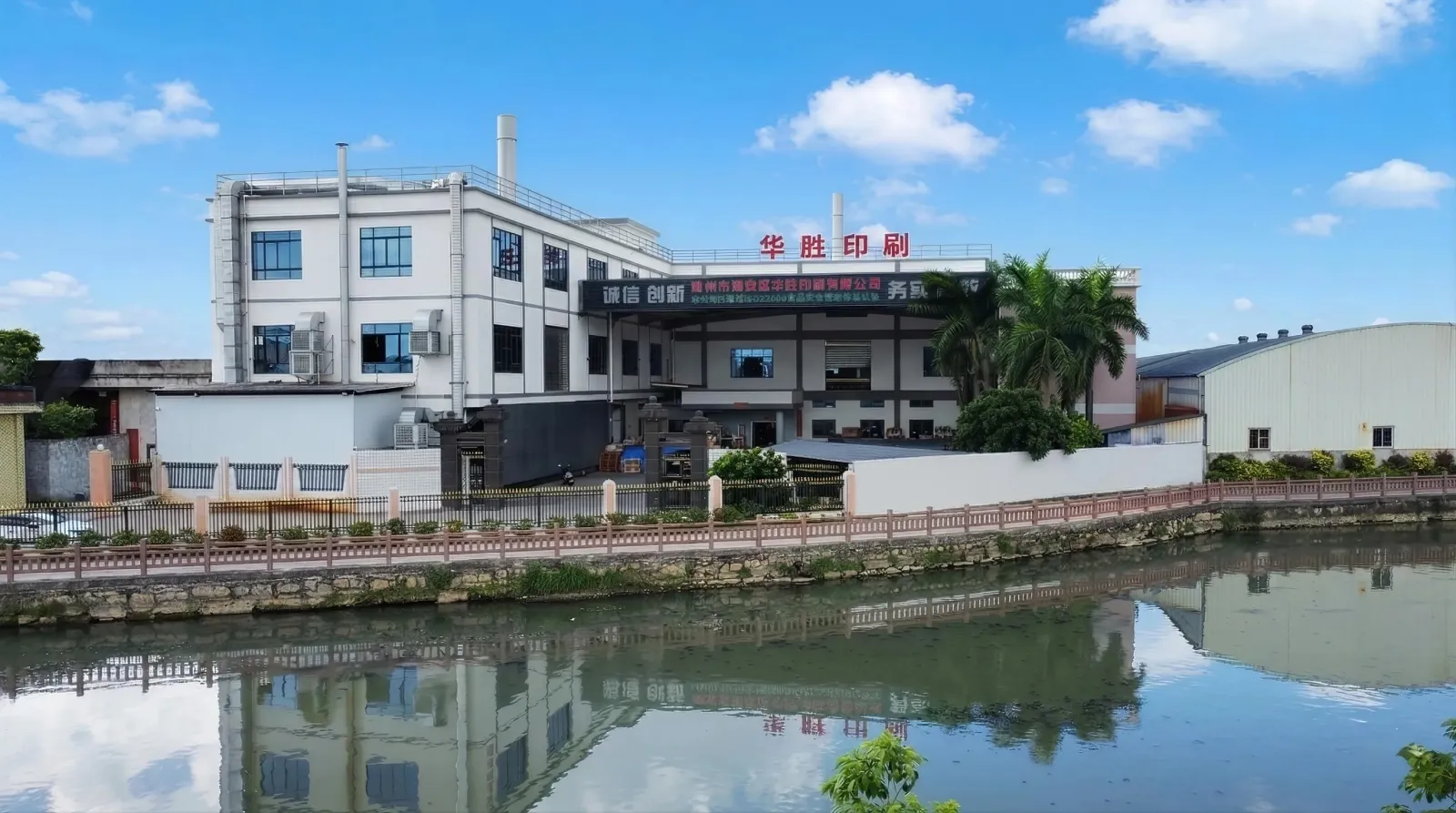
About Huasheng
In-house 9-color gravure printing, solventless lamination, slitting, and pouch converting across stand up pouches, spout pouches, retort bags, coffee bags, and automatic rollstock film.
A legacy of quality in flexible packaging since 1997.
1997 · 6,880 m²
Chaozhou · Guangdong · China
Longshewei, Neipan Management District, Dongfeng Town, Chao'an District, Chaozhou City, Guangdong Province, China