Automatic VFFS Roll Film Troubleshooting: Eye-Mark Drift, Web Tracking, COF Slip & Jaw-Stick Fixes
Huasheng Packaging Technical Content Review
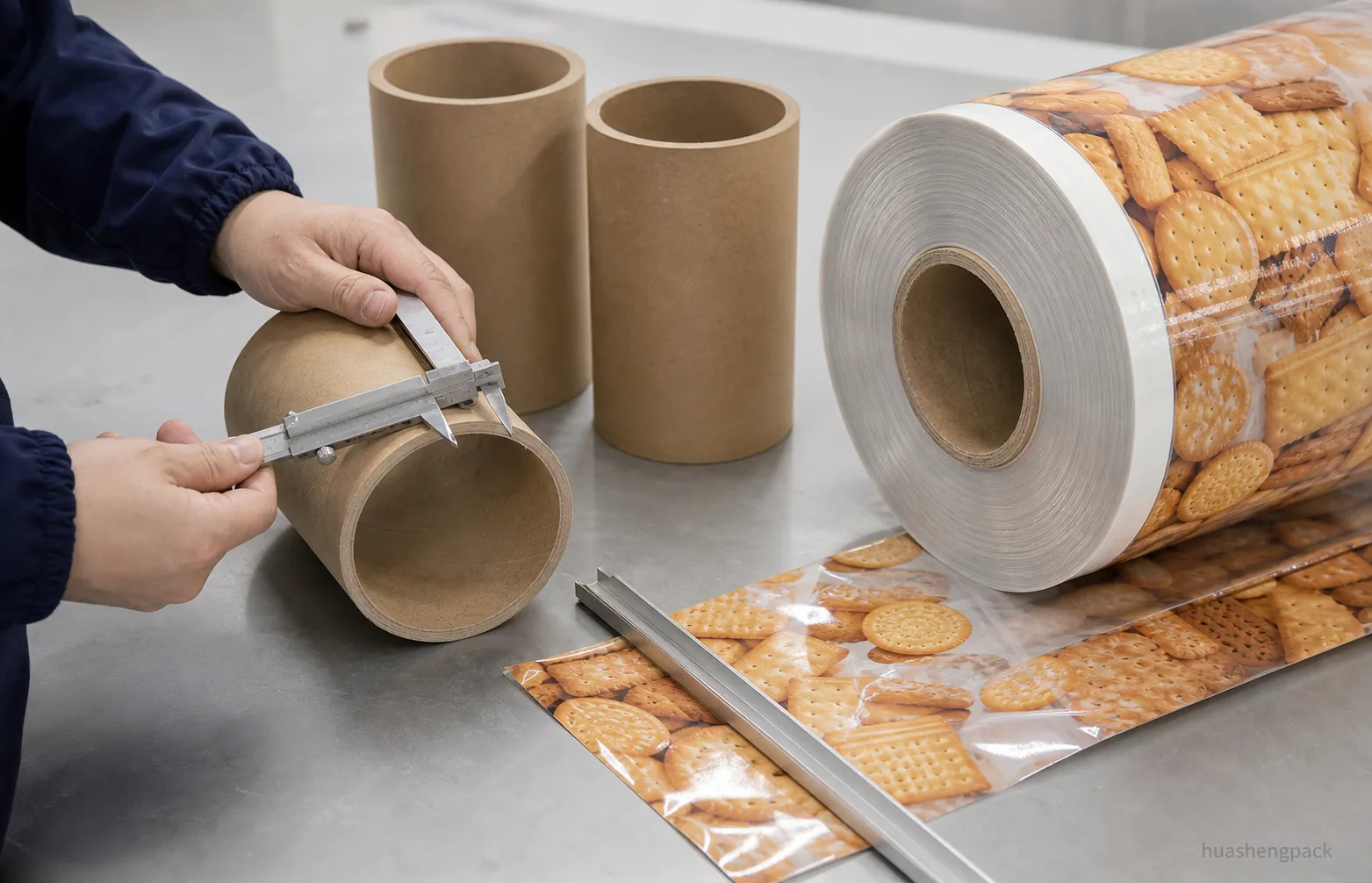
Solve vertical form-fill-seal (VFFS) roll film web wandering, eye-mark drift, high COF drag, and weak jaw seals with exact converter specifications.
Direct answer
Even a chemically perfect barrier laminate turns into expensive floor scrap if rollstock wanders off the VFFS forming collar, triggers repeated photocell eye-mark faults, or sticks to heated sealing jaws at 60–120 bags per minute. Most high-speed machine stoppages trace directly back to four controllable converter specs: winding tension, coefficient of friction (COF), eye-mark contrast, and heat-seal initiation temperature (SIT).
Contents
Evidence-reviewed technical guide
Evidence-reviewed technical guide
2026-11-27 · Huasheng Packaging Technical Editorial Review
Evidence scope
Applies to B2B custom flexible packaging specification review for vffs roll film engineering projects sourced from direct gravure converting plants.
Scope and limitations
General engineering bands and procurement guidelines do not replace filled-pack shelf-life testing, machine compatibility trials, or destination-market regulatory review.
Key takeaways
- The Four Roll-Film Defects That Halt Automatic VFFS & Flow-Wrap Lines
- Exact Converter Spec Sheet for Trouble-Free High-Speed Rollstock
- Six Machine Parameters to Send for Accurate Roll Film Quoting
The Four Roll-Film Defects That Halt Automatic VFFS & Flow-Wrap Lines
Production managers typically encounter four chronic faults when onboarding a new roll-film supplier: (1) telescoping rolls or uneven cross-web tension ("baggy edges") that cause constant web steering drift, (2) high inner-layer COF (>0.30) creating film drag and stretched print pitch over the stainless-steel forming tube, (3) faint or poorly contrasted photocell eye marks causing off-center horizontal cuts, and (4) high-SIT inner sealants forcing excessive jaw temperatures that melt outer BOPP/PET print layers.
Ordering Habits That Cause First-Reel Trial Failures
First, sending only finished pouch width and length without specifying exact film web width (2 × pouch width + fin-seal margin), eye-mark size/position/color contrast, and unwind direction (#1 through #8 chart). Second, changing supplier without declaring the maximum outer reel diameter (OD) and 76 mm (3-inch) paper/plastic core spec of your machine shaft. Third, storing high-slip PE roll film in hot warehouses (>35°C) for months before running, letting slip additives bloom unevenly.
Exact Converter Spec Sheet for Trouble-Free High-Speed Rollstock
Lock six technical tolerances on every roll-film PO: (1) film-to-metal and film-to-film kinetic COF calibrated between 0.15 and 0.25 on the inner sealant layer (with higher outer-layer grip where pull belts drive the web), (2) crisp opaque black or dark contrasting eye mark (typically 10–15 mm × 5–7 mm) inside a clean 20 mm solid light-colored photocell track free of stray text or graphics, (3) slit web width tolerance within ±1 mm and uniform cross-web gauge profile, (4) exact unwind direction diagram signed on the artwork proof, (5) low-SIT metallocene LLDPE or CPP sealant giving wide sealing windows at 115°C–150°C without sticking to Teflon-coated jaws, and (6) max reel weight/OD matched to operator lifting limits and core ID (standard 76 mm).
First-Reel Pre-Shipment Inspection & Machine Trial Handoff
Before shipping commercial container loads, verify each rollstock batch for: slitting edge straightness (zero telescoping), repeat length accuracy across 10 consecutive impressions, GBPI heat-seal tensile curves across your machine’s temperature band, and dynamic COF readings. Request a 1–2 reel pilot qualification run on your live VFFS machine whenever changing film structures. In our 6,880 m² Chaozhou facility operating under ISO 22000:2018 (cert. 007FSMS2300214), pre-production and batch release records include calibrated gauge checks, GBPI heat-seal tensile strength logs, barrier verification where specified, barcode scan checks, and export carton inspections before FOB/CIF or China warehouse handover.
Six Machine Parameters to Send for Accurate Roll Film Quoting
Provide web width (mm), cut-off/eye-mark repeat length (mm), unwind direction number (#1–#8), core inner diameter (76 mm standard) and max roll OD/weight, target speed (packs/min) and jaw temperature range, plus product weight and barrier needs.
Related Products
Related Applications
Claim-to-source evidence matrix
| Reviewed claim | Support | Sources | Boundary |
|---|---|---|---|
| Final flexible packaging specifications require confirming product chemistry, barrier needs, dimensions, and filling conditions before bulk production. | contextual | [1], [3] | Engineering review boundary prior to cylinder engraving or commercial conversion. |
| Seal integrity and laminate suitability should be verified on representative samples using actual product and sealing equipment. | direct | [2] | Quantitative seal testing and line trials supersede nominal film descriptions. |
| Huasheng Packaging operates integrated 9-color gravure printing, lamination, and pouch converting in Chaozhou under ISO 22000:2018 (007FSMS2300214). | direct | [3], [1] | Factory capability and active management-system scope; product-specific export compliance confirmed per order. |
Authoritative References
- ISO 22000:2018 Food safety management systems · International Organization for Standardization (ISO) · standard
Food-contact packaging production management relies on documented food-safety management controls and traceability. - ASTM F88/F88M-23 Standard Test Method for Seal Strength of Flexible Barrier Materials · ASTM International · standard
Flexible pouch and roll-film heat-seal performance should be verified quantitatively rather than assumed from film appearance. - Huasheng Packaging Chaozhou In-House Converting & Quality Control Overview · Huasheng Packaging · internal-evidence
Describes Chaozhou in-house 9-color gravure printing, lamination, slitting, pouch converting, and ISO 22000:2018 scope.
Frequently Asked Questions
What is the ideal inner-layer COF for automatic VFFS roll film?
Most high-speed VFFS machines run smoothest with inner-sealant kinetic COF around 0.15–0.25 so film glides over the forming shoulder without stretching print repeat.
Why does our VFFS photocell keep missing the eye mark?
Eye-mark faults usually stem from low contrast between the dark mark and background graphics, glossy glare, or stray text intruding into the 20 mm photocell track.
How do I calculate required roll-film web width from a finished pillow bag size?
For a standard back-seal pillow bag: Web Width = (Finished Bag Width × 2) + Fin-Seal Overlap (typically 20–30 mm depending on fin-seal vs. lap-seal jaws).
Why does film stick to our sealing jaws when we turn up temperature to fix leaks?
Outer BOPP softens at lower temperatures than outer PET. Switching to an outer PET layer (PET/VMPET/PE) or a lower-SIT metallocene PE sealant widens the sealing window cleanly.
What core size and maximum roll OD does Huasheng support?
Standard 76 mm (3-inch) heavy paper or plastic cores with customized roll OD (typically 280–380 mm) and roll weight calibrated to your machine shaft and operator limits.

About Huasheng
In-house 9-color gravure printing, solventless lamination, slitting, and pouch converting across stand up pouches, spout pouches, retort bags, coffee bags, and automatic rollstock film.
A legacy of quality in flexible packaging since 1997.
1997 · 6,880 m²
Chaozhou · Guangdong · China
Longshewei, Neipan Management District, Dongfeng Town, Chao'an District, Chaozhou City, Guangdong Province, China