Flat Bottom Pouches vs Stand Up Pouches: A Buyer Comparison
Huasheng Packaging Technical Content Review · Published: · Updated:
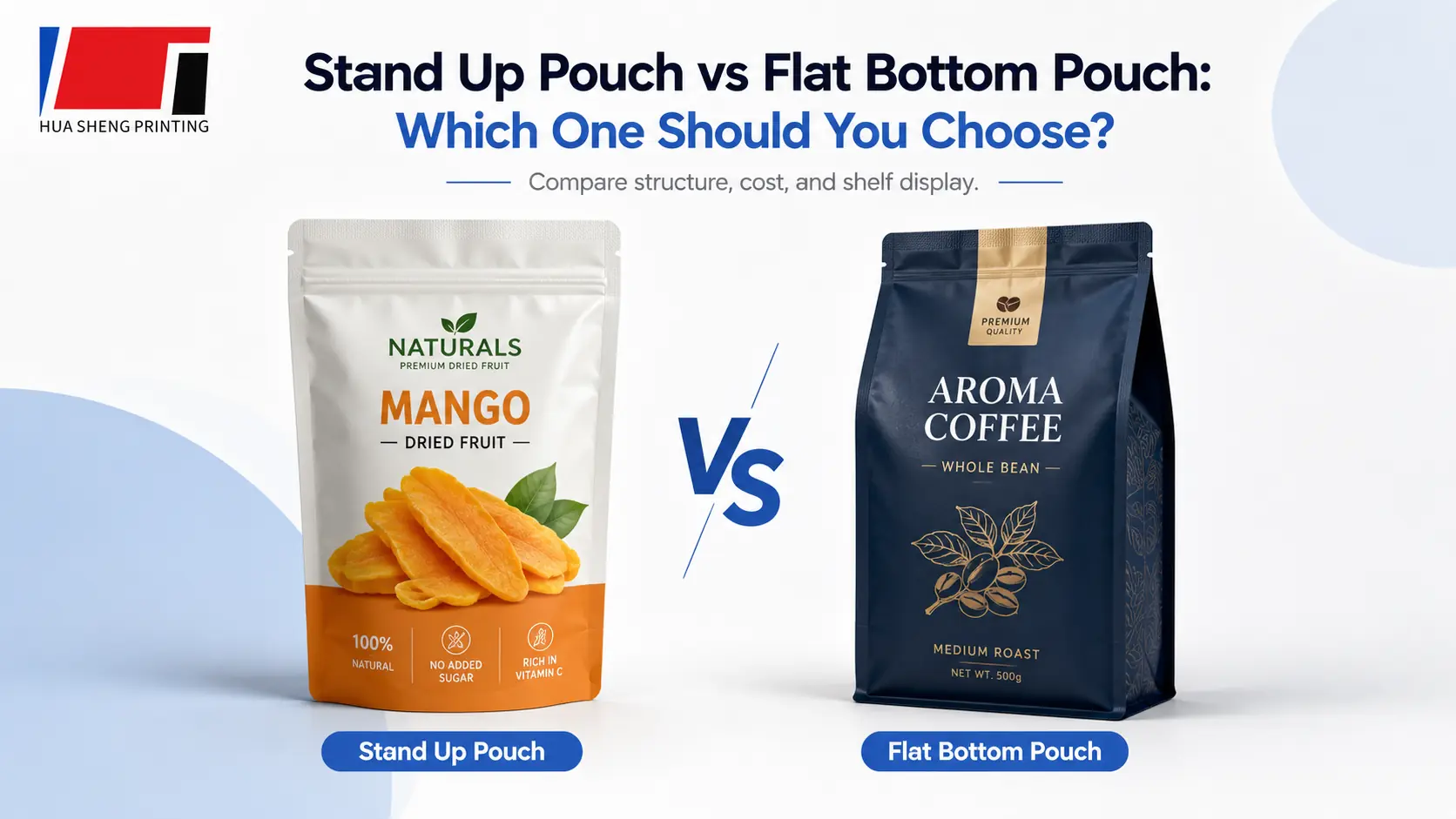
Compare flat bottom and stand up pouches by structure, filling weight, shelf stability, artwork panels, packing line, features and total pack cost.
Flat Bottom, Stand Up and Quad Seal Structures
A flat bottom pouch uses a broad base and defined front, back and side panels. A stand up pouch stands through an expanding bottom gusset. A quad seal bag has four reinforced vertical corner seals and is not automatically the same as a flat bottom pouch. Approve a drawing or sample rather than relying on the format name alone.
When Flat Bottom Justifies the Added Construction
Evaluate flat bottom pouches when coffee, nuts, snacks or pet food benefit from a broad base, defined side panels and stable shelf presentation. Product density, headspace, dimensions and laminate stiffness still affect the final shape, so test the intended fill.
When Stand Up or Quad Seal Is the Better Fit
Use stand up as the benchmark when front-and-back artwork, broad size flexibility and familiar filling equipment matter most. Evaluate quad seal separately when reinforced side seams and side-gusset capacity are important. No format is universally cheaper.
Material, Line and Filled-Pack Checks
The pouch format does not determine barrier performance. Match the laminate to the product, shelf life, storage and sealing process. Test feeding, filling clearance, seals, leakage, opening, reclosure, base or gusset formation, leaning and shelf appearance with the real product.
Buyer Checklist Before Comparing Quotations
Align product and density, fill weight, dimensions, exact construction, laminate, thickness, barrier target, zipper or valve, window, finish, packing method, quantity per design and artwork. Compare quotations only after these specifications match.
Related Products
Related Packaging Guides
Frequently Asked Questions
What is the main difference between a flat bottom pouch and a stand up pouch?
A flat bottom pouch has a broad base and defined side panels, while a stand up pouch stands through an expanding bottom gusset. Filled stability depends on dimensions, product and material.
Is a flat bottom pouch the same as a quad seal bag?
Not necessarily. Quad seal describes four reinforced vertical corner seals; flat bottom describes the broad base and panel geometry. Confirm the construction drawing.
Which pouch is suitable for 500 g products?
Both may work. Product density, proportions, headspace, stiffness and filling method are more useful than filling weight alone.
Which format is more cost-effective?
There is no universal answer. Compare the same size, laminate, thickness, features, print setup and quantity together with filling efficiency.
Can these pouches include a zipper, valve or window?
These features may be available, subject to pouch size, seal areas, laminate, artwork and production review.
How should buyers compare samples?
Use the intended product and check stability, panel shape, seals, features, opening, leakage, line handling and shelf appearance.
What information is needed for quotation?
Provide product, density, fill weight, dimensions, format, material, barrier target, features, finish, packing method, quantity per design and artwork.