Which Flexible Packaging Changes Require Notification and Revalidation?
Huasheng Packaging Technical Content Review
Huasheng Packaging Technical Content Review · Published:
 The image supports visible appearance or setting only. It does not prove hidden structure, performance, certification, customer relationship, approval or shelf life.
Classify material, component, process, site and document changes by evidence impact, approval owner and revalidation trigger.
Direct answer
A reliable supplier change control decision starts with conditions, not a universal structure or a strong promise. This guide covers a flexible-packaging supply relationship where material, component, process, site and document changes can alter previously accepted evidence. It shows how to capture the project inputs, map professional evidence to the decision it actually supports, state limitations, run a representative trial and release a controlled record. The result is a buyer-facing action path without publishing customer identities, order-specific prices, fixed MOQ, invented test results or shelf-life guarantees.
Contents
Evidence-reviewed technical guide
Evidence-reviewed technical guide
2026-08-31 · Huasheng Packaging Technical Content Review
Evidence scope
Which Flexible Packaging Changes Require Notification and Revalidation?
Scope and limitations
No customer identity, order-specific price, fixed MOQ, universal recipe, machine approval, performance promise or shelf-life guarantee is published.
Key takeaways
- This guide owns a flexible-packaging supply relationship where material, component, process, site and document changes can alter previously accepted evidence. Begin by recording approved construction and grades, component suppliers, manufacturing sites, process route, print and seal surfaces, test methods, specifications, certificates, drawings and retained samples. Assign an owner and revision to every critical field so purchasing, production, quality and the product owner review the same boundary. Unknown values stay visibly open; they are not replaced with a typical recipe, an attractive sample or a remembered setting.
- The principal limitation is that a statement that a replacement is equivalent, the same color or within one nominal thickness does not prove unchanged barrier, seal, machinability, compliance or shelf life. Separate appearance, material-property, component, seal, machine, distribution and product-stability questions because each needs different evidence. Mark any engineering inference as an inference, define what remains unknown and prevent sales copy from converting a provisional observation into a guarantee.
- Release a controlled specification, drawing, sample and evidence index with named approval owners. Reopen review when resin or film grade, additive, ink, adhesive, coating, zipper, fitment, cap, site, equipment, process, test method, specification or regulatory document changes. The action is to compare the changed condition with the original evidence, choose bridging or full revalidation, record the disposition and block unsupported claims from the website, quotation and production handoff until the gap is closed.
11. Define the Controlled Conditions
This guide owns a flexible-packaging supply relationship where material, component, process, site and document changes can alter previously accepted evidence. Begin by recording approved construction and grades, component suppliers, manufacturing sites, process route, print and seal surfaces, test methods, specifications, certificates, drawings and retained samples. Assign an owner and revision to every critical field so purchasing, production, quality and the product owner review the same boundary. Unknown values stay visibly open; they are not replaced with a typical recipe, an attractive sample or a remembered setting.
22. Map Evidence to Each Decision
Build the evidence package from supplier notification, reason and effective lot, comparison data, updated declarations, risk assessment, targeted or full revalidation, buyer disposition and traceable approval. Link every item to the exact decision it supports and retain the specimen, method, conditions, date and approval status. A government page, standard or equipment document is useful only within its scope; combining sources creates a review trail, not automatic approval of the finished package.
33. State What the Evidence Cannot Prove
The principal limitation is that a statement that a replacement is equivalent, the same color or within one nominal thickness does not prove unchanged barrier, seal, machinability, compliance or shelf life. Separate appearance, material-property, component, seal, machine, distribution and product-stability questions because each needs different evidence. Mark any engineering inference as an inference, define what remains unknown and prevent sales copy from converting a provisional observation into a guarantee.
44. Run a Representative Trial
For the representative trial, classify each change by affected evidence and decision owner, quarantine unapproved lots where required, and close the record only after approved evidence is linked. Use production-intent product, packaging, equipment and route conditions, with samples from startup, stable operation and restart where relevant. Define acceptance before testing, log deviations and preserve failed as well as accepted samples so the team can distinguish a robust window from one favorable result.
55. Release, Monitor and Revalidate
Release a controlled specification, drawing, sample and evidence index with named approval owners. Reopen review when resin or film grade, additive, ink, adhesive, coating, zipper, fitment, cap, site, equipment, process, test method, specification or regulatory document changes. The action is to compare the changed condition with the original evidence, choose bridging or full revalidation, record the disposition and block unsupported claims from the website, quotation and production handoff until the gap is closed.
Related Products
Related Packaging Guides
Claim-to-source evidence matrix
| Reviewed claim | Support | Sources | Boundary |
|---|
| A management-system framework does not itself approve a product | direct | [1] | The source supports only the named method, boundary or input; complete-project approval remains outside the citation. |
| Each component must be assessed by identity, authorization and intended use | direct | [2] | The source supports only the named method, boundary or input; complete-project approval remains outside the citation. |
| Seal-strip force and failure mode support process evaluation | direct | [3] | The source supports only the named method, boundary or input; complete-project approval remains outside the citation. |
| OTR data requires a defined specimen and test conditions | direct | [4] | The source supports only the named method, boundary or input; complete-project approval remains outside the citation. |
| WVTR data requires a defined specimen and test conditions | direct | [5] | The source supports only the named method, boundary or input; complete-project approval remains outside the citation. |
JSON · CSV
Authoritative References
- ISO 22000:2018 Food Safety Management Systems · International Organization for Standardization · standard
A management-system framework does not itself approve a product - Determining the Regulatory Status of Components of a Food Contact Material · U.S. Food and Drug Administration · government
Each component must be assessed by identity, authorization and intended use - ASTM F88/F88M-23: Seal Strength of Flexible Barrier Materials · ASTM International · standard
Seal-strip force and failure mode support process evaluation - ASTM D3985-24: Oxygen Gas Transmission Rate · ASTM International · standard
OTR data requires a defined specimen and test conditions - ASTM F1249-25: Water Vapor Transmission Rate · ASTM International · standard
WVTR data requires a defined specimen and test conditions
Frequently Asked Questions
Can one material name approve this supplier change control project?
No. The decision also depends on approved construction and grades, component suppliers, manufacturing sites, process route, print and seal surfaces, test methods, specifications, certificates, drawings and retained samples, representative finished-pack evidence and the intended route.
Which evidence should be requested first?
Start with supplier notification, reason and effective lot, comparison data, updated declarations, risk assessment, targeted or full revalidation, buyer disposition and traceable approval; request only the records that answer the current decision and identify every remaining gap.
Does a photograph prove technical performance?
No. A photograph supports visible appearance or setting only; it cannot establish hidden construction, test conditions, compatibility, release status or shelf life.
Can one successful sample approve mass production?
Not by itself. Approval needs defined inputs, representative sampling, acceptance criteria and a controlled record that can be repeated.
When must the review be reopened?
Reopen it when resin or film grade, additive, ink, adhesive, coating, zipper, fitment, cap, site, equipment, process, test method, specification or regulatory document changes, or whenever the existing evidence no longer represents the intended project.
What should a buyer send for factory review?
Send the known values for approved construction and grades, component suppliers, manufacturing sites, process route, print and seal surfaces, test methods, specifications, certificates, drawings and retained samples, mark unknowns clearly, and include relevant product, machine, route, artwork and sample information.
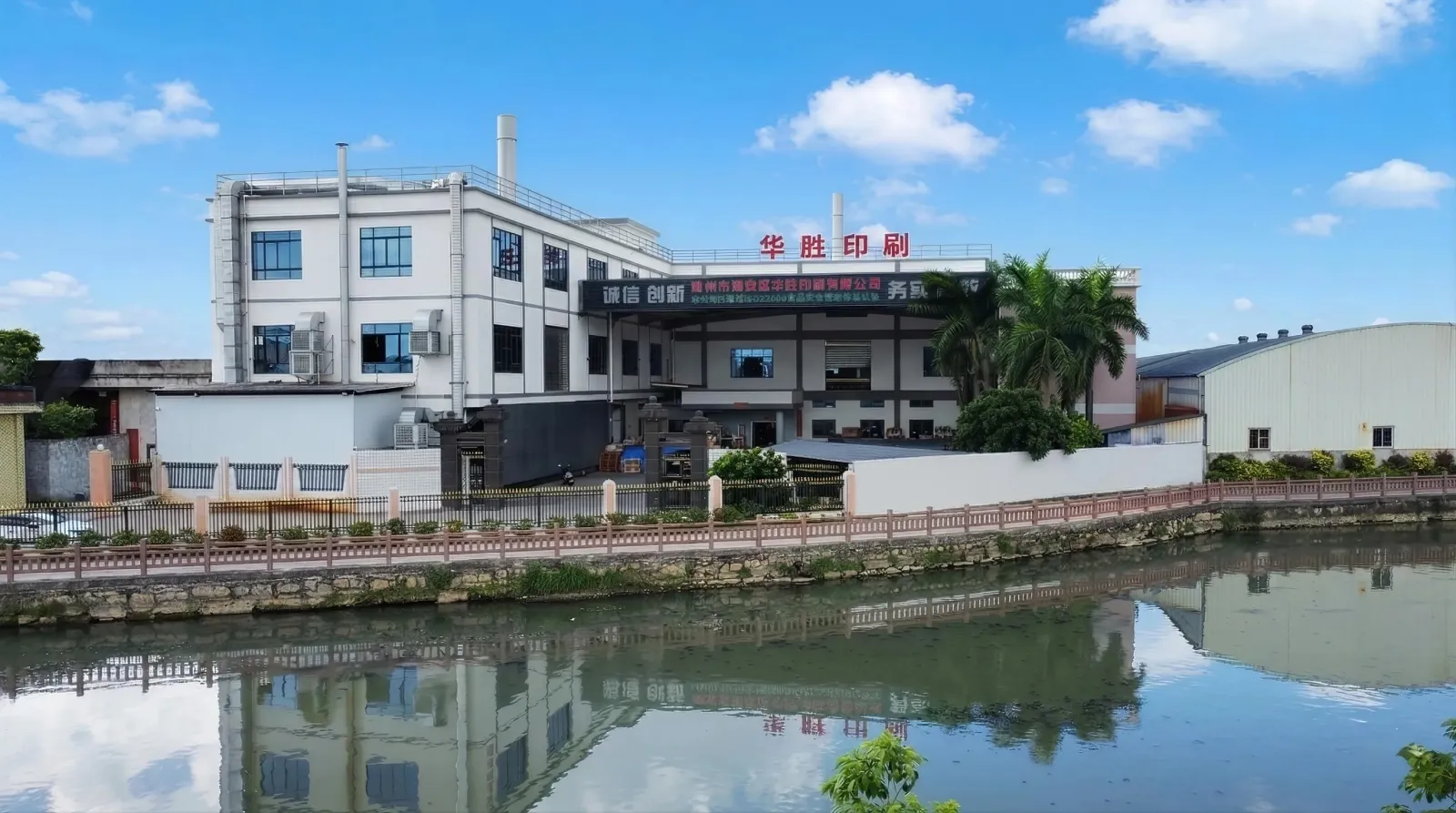
About Huasheng
Stand up pouches, spout pouches, flat bottom pouches, coffee bags and printed roll film for food and beverage brands.
A legacy of quality in flexible packaging since 1997.
1997 · 6,880 m²
Chaozhou · Guangdong · China
Longshewei, Neipan Management District, Dongfeng Town, Chao'an District, Chaozhou City, Guangdong Province, China