OTR and WVTR for Food Packaging: How to Match Barrier Targets to Shelf Life
Huasheng Packaging Technical Content Review · Published: · Updated:
 OTR and WVTR requirements should be defined from the product, package and storage conditions.
Learn how OTR and WVTR test conditions, product sensitivity, storage climate and finished-pack validation affect food packaging shelf life decisions.
Direct answer
OTR and WVTR are useful food packaging barrier indicators, but neither number predicts shelf life by itself. Buyers need to connect oxygen and moisture sensitivity with test conditions, package area, seals, storage climate and the actual product. This guide explains how to prepare a defensible barrier brief without treating one laminate or laboratory value as a universal solution.
Evidence-reviewed technical guide
2026-08-11 · Huasheng Packaging Technical Content Review
Evidence scope
Definitions and interpretation of OTR/WVTR, test-method comparability, the difference between flat-film and sealed-package evidence, and the limits of using transmission data for shelf-life decisions.
Scope and limitations
This article does not prescribe a universal OTR, WVTR or laminate. Product formula, pack area, seals, conversion, filling, storage and validation remain project-specific. Full standards are controlled documents; linked scope pages do not replace the purchased standard or qualified laboratory procedure.
Key takeaways
- Compare transmission results only when the method, units, temperature, humidity and specimen are stated.
- Flat-film barrier data is not automatically the barrier performance of a converted and sealed pouch.
- OTR and WVTR support material screening, but a shelf-life claim still requires evidence from the actual product and package system.
What OTR and WVTR Measure
OTR means oxygen transmission rate. It reports the amount of oxygen passing through a defined film area over a defined time under stated temperature and relative-humidity conditions. WVTR means water vapor transmission rate and reports moisture transmission under its own stated conditions. Lower results generally mean stronger barrier only when the method, units and conditions are comparable.
An OTR or WVTR value without units and test conditions is incomplete. Request the test method, temperature, relative humidity, thickness and whether the result refers to flat film or a finished package. Results measured under different conditions should not be compared as equivalent.
Flat-film data also excludes some converting risks. Lamination, folds, zipper areas, valves, spouts, heat seals, flex cracking and pinholes can change finished-pack performance. Supplier film data is therefore a screening tool rather than a shelf-life guarantee.
Start with the Product Failure Mode, Not a Material Name
Different foods fail for different reasons, so the priority indicator changes by application:
- Crispy biscuits, crackers and dry snacks: moisture ingress can soften texture, making WVTR a primary review point. Products containing oils may also need OTR review.
- Nuts, chocolate-coated snacks and fatty foods: oxygen can accelerate oxidation and flavor change, while moisture and heat affect texture and appearance. Review OTR, WVTR, light and storage temperature together.
- Roasted coffee, tea and spices: oxygen, moisture and aroma transfer matter. Light protection and a degassing valve may also affect the complete package.
- Hygroscopic powders: moisture protection, seal contamination and reclosure may matter more than a generic high-barrier label.
- Dried fruit and semi-moist foods: risks may include moisture gain or loss, oxidation and seal contamination. Product water activity should inform testing.
- Sauces, liquids and retort foods: compatibility, seal integrity, process temperature and sterilization can be more critical than flat-film OTR or WVTR alone.
The useful question is which failure mechanism limits the target shelf life and what complete package controls that risk, not simply which film has the lowest number.
How Shelf-Life Targets Change the Validation Plan
A target such as 3, 6, 12 or 18 months is a commercial requirement, not a material specification. Longer shelf life usually increases the need for evidence, but it does not automatically require aluminum foil or another single structure.
For a shorter target, buyers may begin with comparable-product history, supplier data and a filled-pack trial under intended storage. For a medium target, compare candidate structures using OTR, WVTR, sealing and filled-pack observations. For a longer or demanding target, include realistic distribution conditions, product analysis, real-time studies and appropriately designed accelerated studies. Accelerated testing can compare candidates, but should not become a shelf-life claim without a validated model for that product.
Climate and pack size matter. A dry, controlled channel and a hot, humid distribution environment place different demands on the same package. Total permeation also depends partly on exposed area, so a result per square metre is not the total ingress for every pouch size.
Possible directions include clear PET/PE, metallized laminates, aluminum-foil laminates, EVOH-containing structures and transparent coated films. They differ in barrier, visibility, flex durability, sealing, machine use and cost. Final selection should follow sample and product validation.
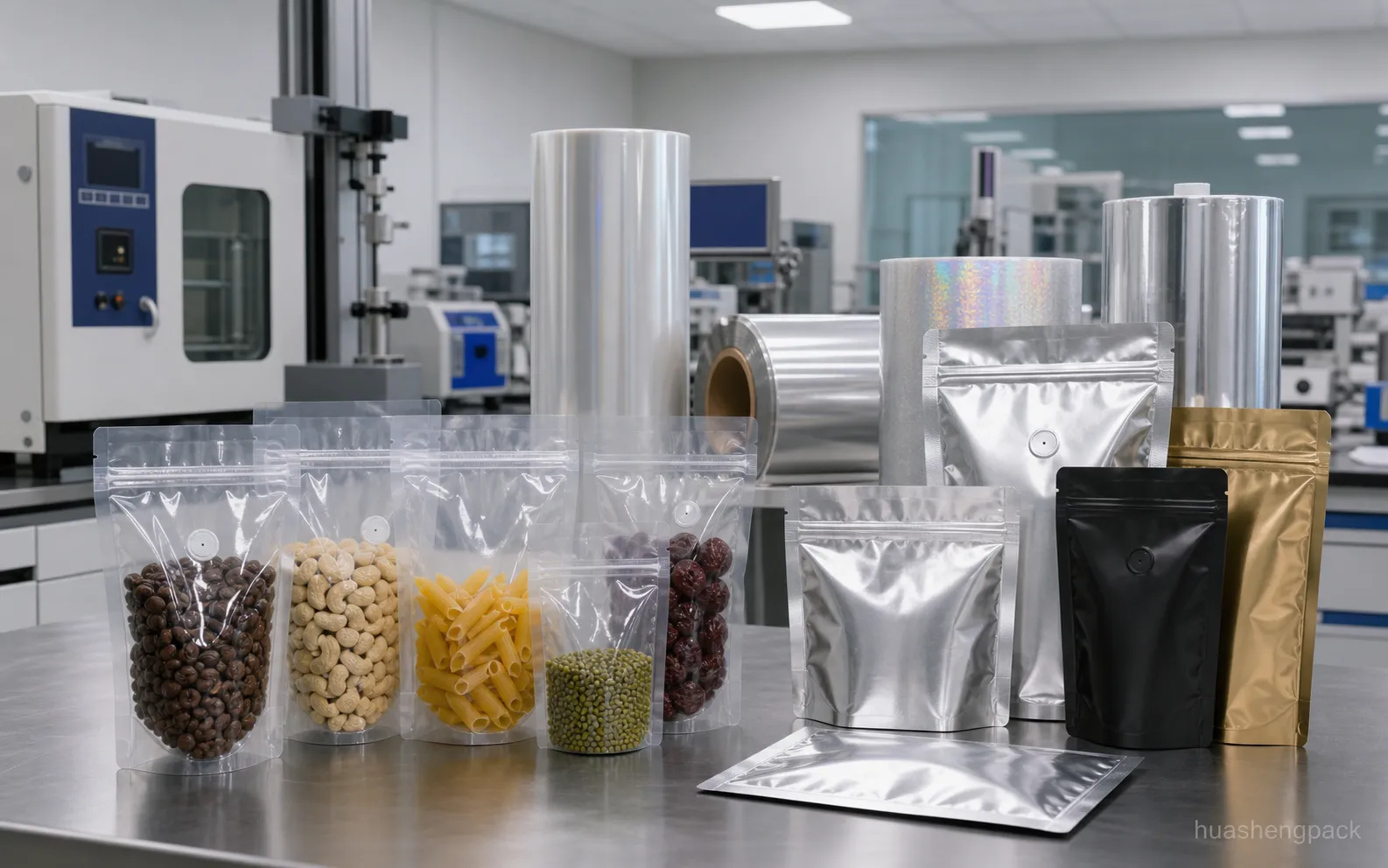 Appearance alone does not establish oxygen or moisture barrier performance.
A Practical Barrier and Shelf-Life Validation Workflow
Use a staged process before committing to a long study:
1. Define oxygen and moisture sensitivity, aroma, oil content, water activity, light sensitivity and failure criteria.
2. Define target shelf life, storage climate, distribution stress, pack size, filling process and opening pattern.
3. Compare complete laminates, thicknesses, OTR/WVTR data and test conditions, not barrier-layer names alone.
4. Convert and fill representative packs using intended seals, zipper, valve, spout or folds and production-like settings.
5. Check seal strength, leakage, pinholes, flex cracking, delamination and other relevant package-integrity risks.
6. Monitor relevant product criteria such as crispness, oxidation, aroma, moisture, color, microbiology or sensory acceptance.
7. Record the approved laminate, thickness tolerances, test methods, acceptance criteria and change control.
Huasheng Packaging can review pouch and roll-film structure directions, but the food brand or its qualified laboratory should establish the final shelf-life claim using the actual product and intended conditions.
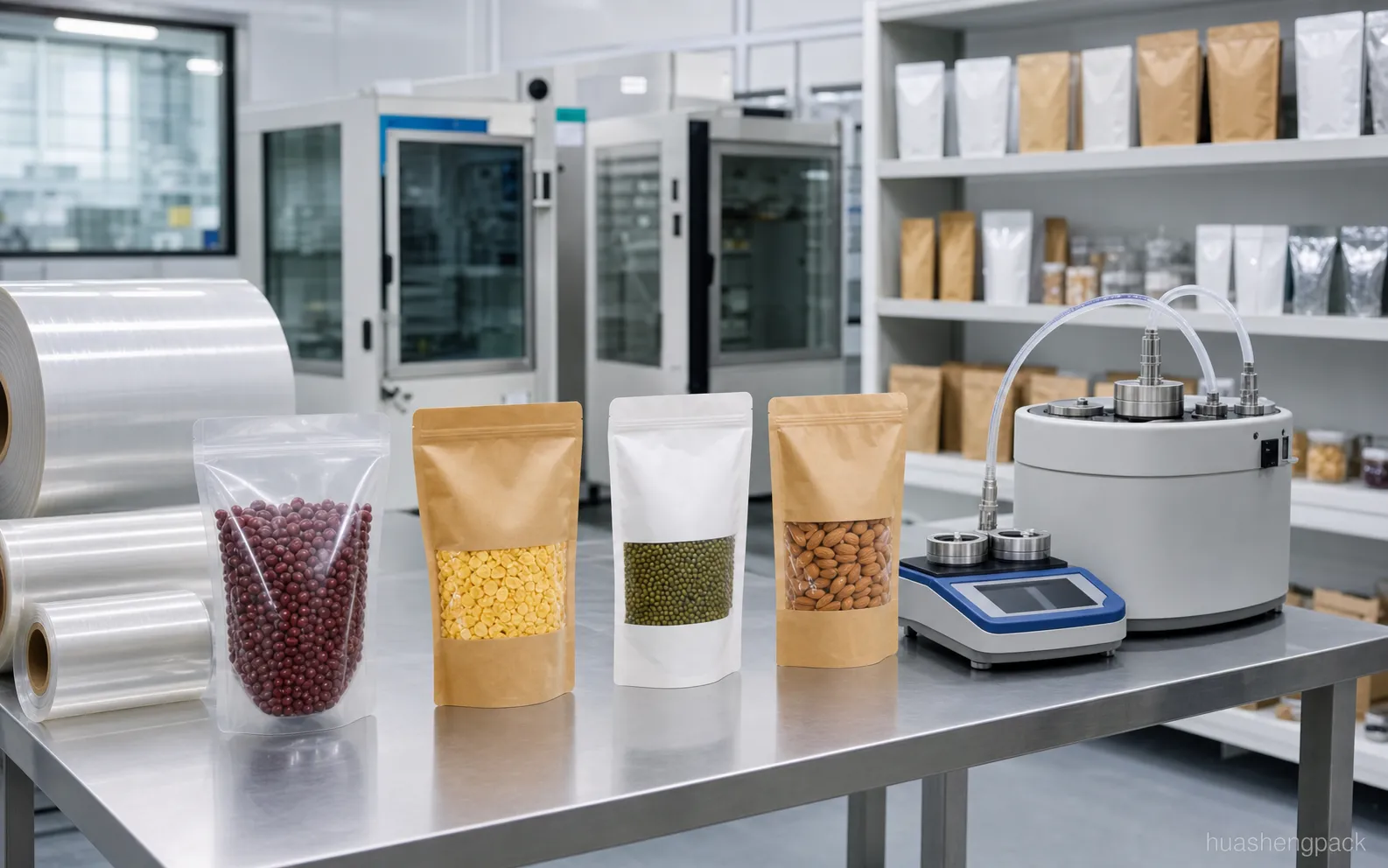 Finished packages should be validated with agreed methods and representative storage conditions.
What Buyers Should Send for Barrier Review
Prepare the product and formula characteristics, target shelf life, known failure mode, current package, storage temperature and humidity, destination climate, pouch or roll-film format, dimensions, filling weight, filling and sealing process, transparency or light-blocking need, zipper or valve requirement, machine data and any existing OTR/WVTR target with its method and conditions.
When comparing quotations, ask whether barrier data applies to an individual substrate, the complete laminate or a finished pouch. Confirm thickness, test method, sample conditioning and whether values are typical data or agreed acceptance limits. This prevents a brochure value from being mistaken for a guaranteed finished-package result.
Use the <a href="/materials/high-barrier-film-for-food-packaging">high barrier film selection guide</a> to compare performance directions. Review the <a href="/materials/vmpet-film-high-barrier-packaging">VMPET film guide</a> or <a href="/materials/aluminum-foil-laminated-packaging">aluminum foil laminate guide</a> only after the product risks and validation plan are defined.
Related Products
Related Packaging Guides
Claim-to-source evidence matrix
| Reviewed claim | Support | Sources | Boundary |
|---|
| OTR and WVTR results are tied to a named test method, specimen and stated conditions. | direct | [1], [2], [3], [4] | Supports interpretation of reported transmission data, not a target value for a specific food. |
| Transmission values measured by different methods or conditions should not be treated as directly equivalent. | contextual | [1], [2], [3], [4] | The article therefore requires method, units, temperature, humidity and specimen details before comparison. |
| A converted thermosealed package can have different oxygen and water-vapour transfer behavior from its flat film. | direct | [5], [6] | The cited studies support including seals and package conversion in assessment; they do not quantify every pouch design. |
| Seal integrity depends on material properties, process parameters and contamination conditions. | direct | [6] | Project acceptance criteria still need to be agreed for the actual product, equipment and package. |
| OTR or WVTR alone is insufficient to establish a universal finished-product shelf-life claim. | contextual | [2], [5], [6] | This is a bounded synthesis of the standard scope and complete-package research, not a substitute for product shelf-life validation. |
JSON · CSV
Authoritative References
- ASTM D3985-24: Oxygen Gas Transmission Rate Through Plastic Film and Sheeting Using a Coulometric Sensor · ASTM International · standard
OTR is method- and specimen-specific; OTR results require a named method and comparable conditions - ASTM F1249-25: Water Vapor Transmission Rate Through Plastic Film and Sheeting Using a Modulated Infrared Sensor · ASTM International · standard
WVTR measures transmission through flexible barrier materials under defined conditions; Acceptance use requires agreed sampling, standardization, test conditions and criteria - ISO 15105-1:2007: Plastics film and sheeting - Determination of gas-transmission rate · International Organization for Standardization · standard
Gas-transmission testing is defined for specified single-layer and multilayer specimens; Different measurement approaches should not be treated as automatically equivalent - ISO 2528:2017: Sheet materials - Determination of water vapour transmission rate - Gravimetric method · International Organization for Standardization · standard
WVTR depends on a stated method and its applicability limits; Creased specimens may require separate treatment - A quantitative approach to assess the contribution of seals to the permeability of water vapour and oxygen in thermosealed packages · Food Packaging and Shelf Life · peer-reviewed
Thermosealed-package transmission can differ from flat-film transmission; Seal behavior belongs in complete-package barrier assessment - Understanding the factors affecting the seal integrity in heat sealed flexible food packages: A review · Packaging Technology and Science · peer-reviewed
Seal integrity is affected by process parameters, material properties and contamination; Barrier and shelf-life decisions must consider the sealed package rather than film alone
Frequently Asked Questions
What is a good OTR value for food packaging?
There is no universal value. The target depends on product oxygen sensitivity, package area, shelf life, storage conditions and test method. Compare only equivalent conditions.
What is a good WVTR value for dry snacks?
It depends on moisture sensitivity, initial moisture, water activity, package size, climate and shelf-life target. Filled-pack testing should confirm texture retention.
Can OTR and WVTR predict food shelf life?
They support screening and modelling, but do not predict shelf life alone. Seals, geometry, filling, storage and product chemistry also matter.
Is the lowest OTR or WVTR always best?
Not necessarily. Excess barrier may add cost or reduce transparency, recyclability direction or converting flexibility without improving the required outcome.
Are film and finished-pouch barrier results the same?
No. Finished pouches include seals, folds and accessories and may be affected by pinholes or flex cracking. Confirm the tested specimen.
Does a 12-month shelf life require aluminum foil?
Not automatically. Product sensitivity, climate, package design and validation results determine whether foil, metallized or transparent barrier directions are suitable.
Can accelerated testing replace real-time testing?
It can compare candidates, but extrapolation requires a validated relationship for the specific product. It is not an automatic replacement for real-time evidence.
What details should accompany an OTR or WVTR result?
Request the method, units, temperature, relative humidity, specimen type, thickness and whether the value is typical or an agreed acceptance limit.