Roll Film for Automatic Packaging Machines: Specification, Trial and Handover
Huasheng Packaging Technical Content Review · Published: · Updated:
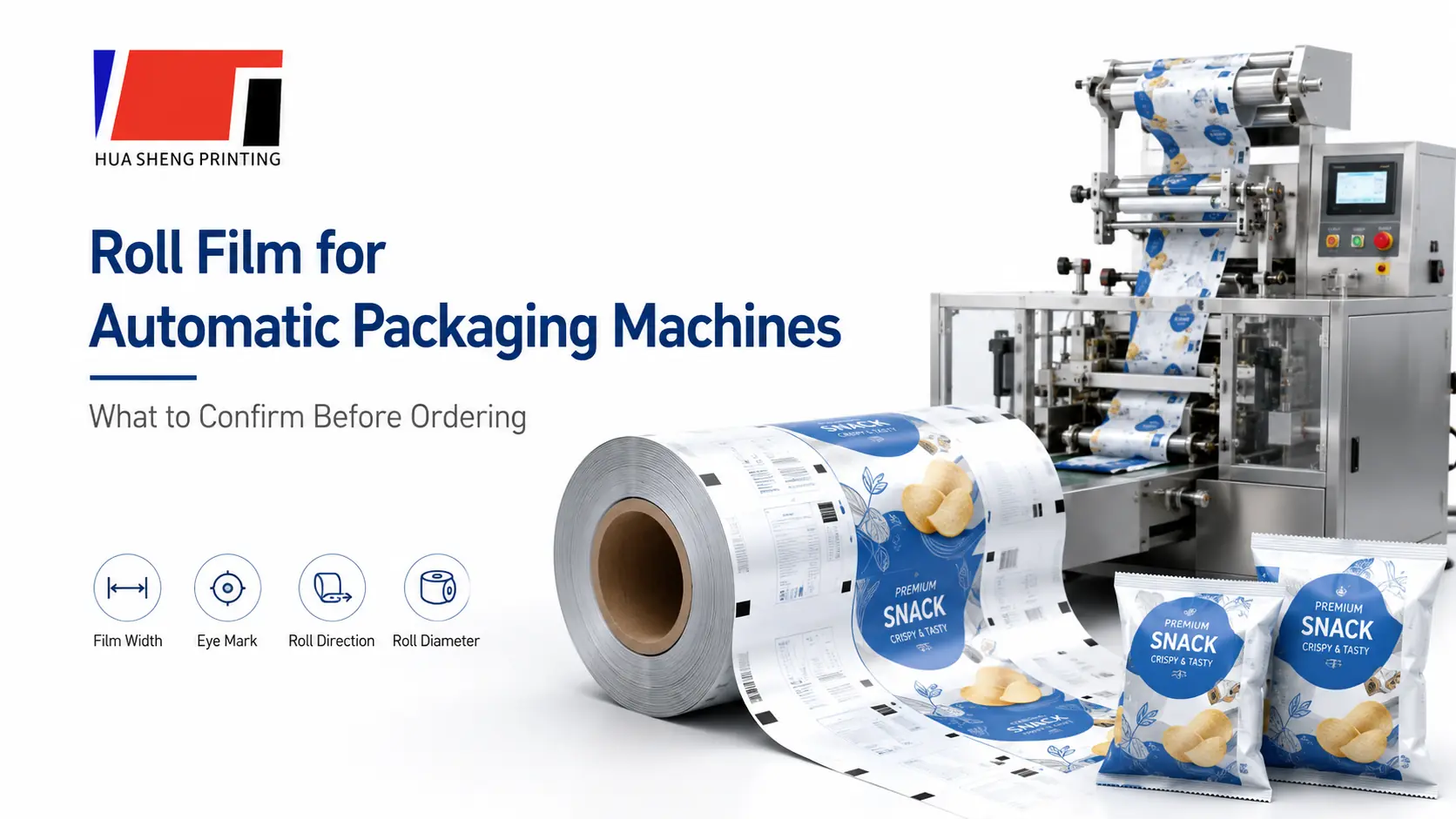 Technical guide visual for Roll Film for Automatic Packaging Machines: Specification, Trial and Handover.
Build a machine-ready roll-film brief covering web width, repeat, eye mark, unwind, core, reel limits, splices, sealing and first-reel approval.
Direct answer
Printed roll film is simultaneously a product-protection material, a registered printed web and a machine input. A useful purchase specification must connect the finished pack to web geometry, unwind, reel construction, sealing and the target line. This guide owns the reel specification, first-reel trial and handover decision; it does not replace the broader machine-type map or assign universal COF, dyne, core, reel or sealing values.
Evidence-reviewed technical guide
2026-08-12 · Huasheng Packaging Technical Content Review
Evidence scope
Web geometry, unwind, reel inputs, conditioned material evidence, first-reel approval and change control.
Scope and limitations
No universal COF, treatment, core, reel, sealing or shelf-life value is prescribed.
Key takeaways
- A reel specification connects pack geometry and machine inputs.
- COF and heat-seal data are method- and condition-specific.
- Representative startup, stable operation and restart must be recorded.
Translate the Finished Pack into Web Geometry
Start with the exact machine make and model, forming set, longitudinal-seal style, cross-seal and cut arrangement, product feed and finished-pack drawing. Web width, print repeat, eye-mark position, leading edge, cut position and fin or lap seal must describe one coherent conversion from printed web to saleable pack.
A web can match nominal width and still be unusable when the repeat, artwork orientation, unwind or sealant face is wrong. Supply a labelled diagram that shows the operator’s viewing direction, printed face, eye-mark edge, unwind rotation and the first image entering the machine. Avoid relying on terms such as print-in or print-out without a diagram.
For multi-lane equipment, record total web width, lane count, lane pitch, slit or cut logic and how registration is sensed. Keep this reel-level definition separate from the finished retail dimensions so artwork, cylinder planning and machine setup use the same basis.
Core roll-film interface fields
| Interface | What to record | Approval evidence |
|---|
| Printed web | Width, repeat, lanes, eye mark, leading edge and cut | Approved web layout and packs |
| Unwind | Rotation, printed face and sealant face | Labelled unwind diagram |
| Reel | Core, maximum diameter and weight, reel build and splice rule | Machine limit plus incoming check |
| Sealing | Seal geometry and operating window | Laboratory screening plus line trial |
Specify the Reel, Not Just the Film
Confirm core internal diameter and width, maximum reel outside diameter and weight, usable web length if required, winding direction, reel edge condition, telescoping or dish limits, splice quantity and construction, splice detection and roll identification. These are machine and handling inputs, not universal supplier defaults.
Define how critical dimensions will be measured and where tolerances apply. A reel that is too heavy, wide, poorly aligned or built outside the machine’s handling range may fail before the laminate is ever evaluated. Receiving labels should connect reel ID, artwork, structure, dimensions and production lot.
Surface friction, stiffness, curl, static observations and winding tension can affect feeding, forming and registration, but a generic number is unsafe. ISO 8295 defines a film-friction measurement method; it does not prescribe a value for every VFFS or HFFS line. State the tested surface, specimen, conditioning and project range agreed with the machine or filling partner.
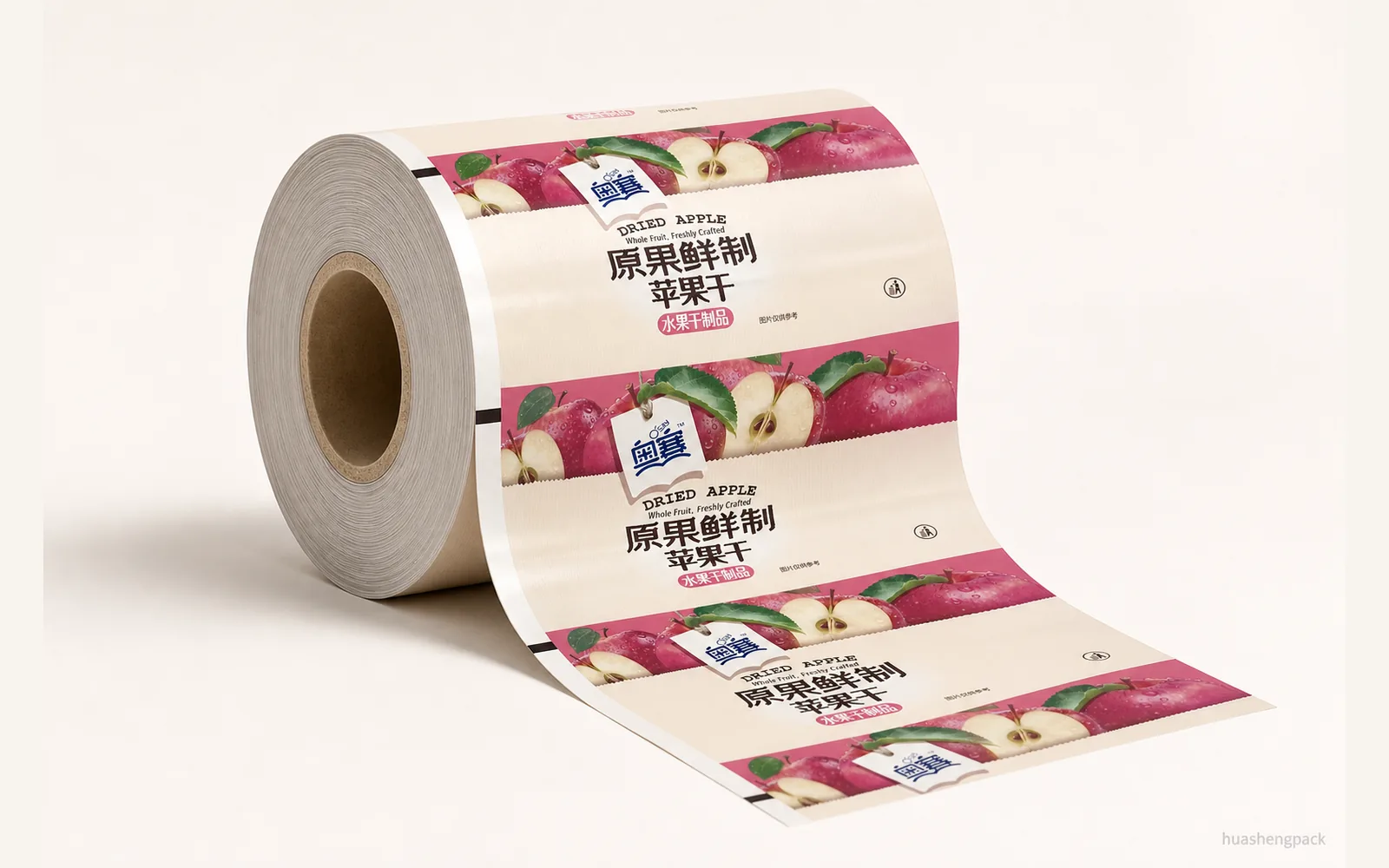 The governed presentation shows a visible reel, core and repeated printed web only; it does not establish dimensions, winding quality, material structure or compatibility with a specific packing line.
Connect Product Risk to the Complete Laminate
Describe the product state, fat and moisture behaviour, aroma and light sensitivity, particle edges, fill temperature, seal contamination, intended shelf life and storage. Then assign required functions such as print support, stiffness, toughness, barrier and heat sealing before comparing complete laminates.
Material names such as BOPP/CPP, PET/PE, metallized or foil-containing structures are candidate families, not automatic machine or shelf-life approvals. Ask for layer order, grades, individual and total thickness, sealant identity and conditioned test data. Flat-film OTR or WVTR does not represent registration, seals, splices or the finished package.
Review how the laminate behaves through the forming path and sealing geometry. Laboratory heat-seal work can establish starting relationships, while the actual line must confirm the combined effects of speed, pressure, dwell, cooling, product contamination and machine contact surfaces.
Approve the First Reel Under Representative Conditions
Plan a first-reel trial that covers threading and startup, movement toward target speed, stable production, planned stops and restart. Record web tracking, tension observations, eye-mark sensing, forming, longitudinal and cross seals, cut position, pack length, product clearance, wrinkles, blocking, static, scuffing and recurring operator adjustments.
Use the intended product or a filling-partner-approved representative material. Inspect saleable packs at agreed intervals and retain samples from startup, stable running and restart. Record all changes made during the trial so a passing result is not separated from the settings and reel version that produced it.
Approval should identify what is released: artwork and repeat, web and reel data, laminate, thickness, unwind, splice rule, seal window, line range and finished-pack checks. A short trial demonstrates only its recorded conditions; it is not a guarantee of every machine, product or future batch.
- Threading and startup
- Ramp to representative target operation
- Registration, forming, sealing and cutting
- Planned stop and restart
- Recorded waste modes and adjustments
- Retained reel label and approved packs
Build a Handover and Change-Control Record
Provide product and fill, finished-pack and web drawings, machine make and model, forming and sealing arrangement, web width, repeat, eye mark, unwind diagram, printed and sealant faces, core and reel limits, splice rule, structure and thickness, operating range, artwork, quantity by design and the receiving-site contact.
Separate known values, unknowns requiring machine confirmation, items to verify during sampling and items to release before production. The downloadable roll-film machine handoff sheet can organise these inputs without pretending to calculate a compatible structure or machine setting.
Require review before changing film grade, layer thickness, sealant, artwork repeat, eye mark, reel dimensions, winding direction, splice construction, machine, forming set, product or operating window. The change record should identify which document, trial or finished-pack check must be repeated.
Related Products
Related Packaging Guides
Claim-to-source evidence matrix
| Reviewed claim | Support | Sources | Boundary |
|---|
| A VFFS application brief connects product, bag, film, reel, sealing and output inputs. | direct | [1] | No OEM field value is treated as an industry-wide requirement. |
| COF applies to specified film surfaces under a defined method and is not a machine-compatibility conclusion. | direct | [2] | The project range and test timing remain machine-specific. |
| Laboratory heat-seal and seal-strength results support screening and control but do not approve the full line or package. | direct | [3], [4] | Product, speed, contamination, geometry and finished-pack integrity remain project-specific. |
| A governed handoff can separate known, unknown and validation-required reel inputs. | direct | [5] | The worksheet organises inputs and does not calculate compatibility. |
JSON · CSV
Authoritative References
- ROVEMA: VFFS Application Questionnaire · ROVEMA North America · manufacturer-data
A VFFS application brief connects product, bag, film, reel, sealing and required-output inputs - ISO 8295:1995: Plastics — Film and Sheeting — Determination of the Coefficients of Friction · International Organization for Standardization · standard
Coefficient of friction is measured for specified film surfaces under a defined method - ASTM F2029-16(2021): Laboratory Heat Seals for Flexible Barrier Materials · ASTM International · standard
Laboratory heat-seal relationships are starting data and do not replace production-equipment validation - ASTM F88/F88M-23: Seal Strength of Flexible Barrier Materials · ASTM International · standard
Seal strength is a method-specific quantitative result used in process validation and control - Huasheng Packaging Roll-Film Machine Handoff Sheet · Huasheng Packaging · internal-evidence
The governed worksheet separates known, unknown and validation-required reel inputs
Frequently Asked Questions
What information is required before quoting printed roll film?
Provide the product, machine and forming set, finished-pack and web drawings, width, repeat, eye mark, unwind, core and reel limits, splice rule, laminate if known, artwork and quantity by design.
Is there one COF range for every automatic packing machine?
No. The relevant film surface, test method and range depend on the machine, forming path, belts, product and operating conditions.
How should winding direction be confirmed?
Use a labelled unwind diagram showing rotation, printed face, sealant face, eye-mark edge, leading edge and the first image entering the machine.
What should a first-reel trial cover?
Cover threading, startup, representative operation, planned stops and restart while recording tracking, registration, forming, sealing, cutting, rejects and adjustments.
Can laboratory film data approve machine compatibility?
No. Laboratory data supports screening; the intended product, reel and machine must be assessed under representative line conditions.
When should roll film be revalidated?
Review changes to film grade, thickness, sealant, repeat, eye mark, reel data, splice, machine, forming set, product or operating window before routine production continues.