Frozen Dumpling, Meat & Seafood Pouches: Preventing Cold-Crack & Seam Leaks at -18°C to -40°C
Huasheng Packaging Technical Content Review
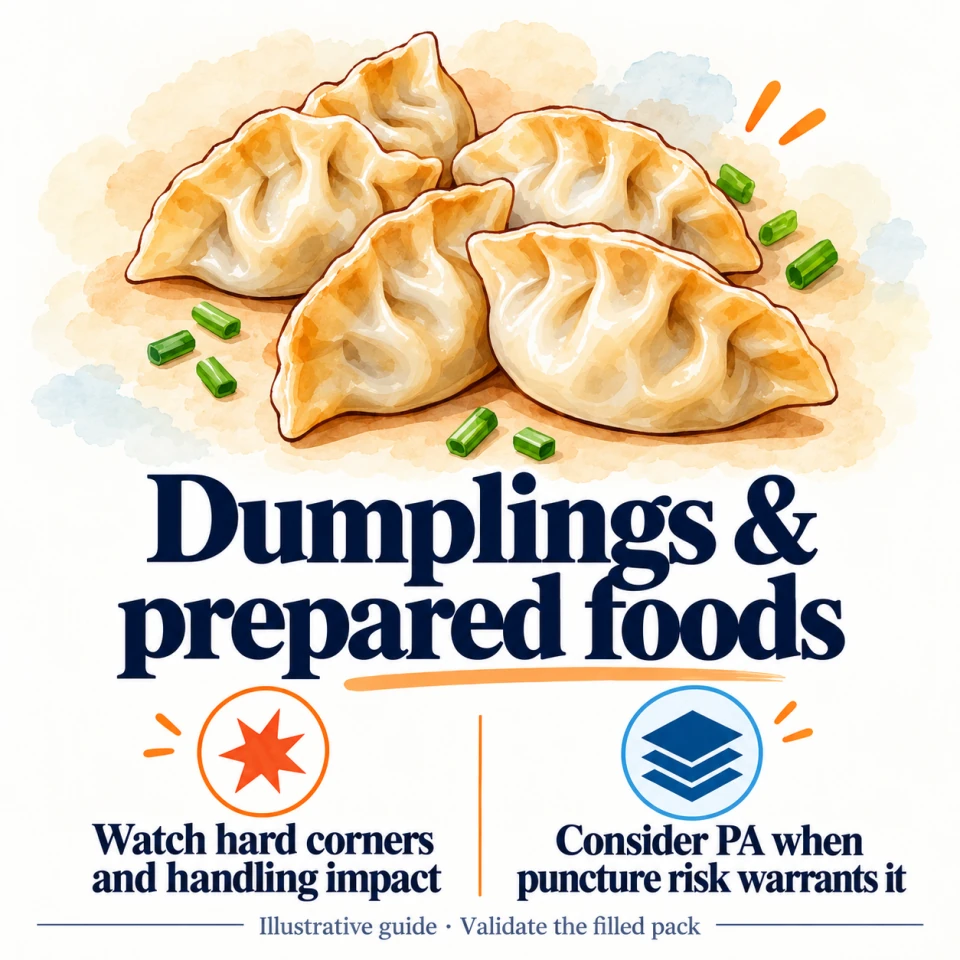
Prevent sub-zero brittle cracking, puncture leaks, and freezer burn on -18°C to -40°C frozen dumpling, meat, and seafood pouches with PA/PE and PET/PA/PE.
Direct answer
Frozen dumplings, shrimp, fish fillets, marinated meats, and IQF vegetables endure brutal mechanical shock: sharp ice crystals inside, rapid blast-freezing to -35°C or -40°C, and carton drops during cold-chain trucking. Standard snack films turn brittle below 0°C and shatter along side seals—requiring dedicated low-temperature PA/PE or PET/PA/LLDPE cold-chain laminates.
Contents
Evidence-reviewed technical guide
Evidence-reviewed technical guide
2026-11-27 · Huasheng Packaging Technical Editorial Review
Evidence scope
Applies to B2B custom flexible packaging specification review for cold-chain & frozen packaging projects sourced from direct gravure converting plants.
Scope and limitations
General engineering bands and procurement guidelines do not replace filled-pack shelf-life testing, machine compatibility trials, or destination-market regulatory review.
Key takeaways
- Why Standard Snack Laminates Crack and Leak in Sub-Zero Cold Chains
- Recommended Cold-Chain Structures by Frozen Product Profile
- Checklist for Quoting Frozen Food Pouches & Cold-Chain Roll Film
Why Standard Snack Laminates Crack and Leak in Sub-Zero Cold Chains
Ordinary BOPP/CPP or standard homopolymer PE films stiffen dramatically below -10°C. When frozen dumplings or bone-in seafood cartons shift on pallets, brittle seals fracture cleanly along the heat-seal edge or develop pinholes from frozen shrimp shells, triggering freezer burn, dehydration, and retail rejection.
Critical Material Mistakes in Frozen Food Pouch Procurement
First, substituting low-cost CPP as the heat-seal layer—CPP becomes glassy and brittle in freezers and must NEVER be used for frozen food pouches. Second, omitting a biaxially oriented nylon (PA/BOPA) layer for bone-in meat, frozen fish, or sharp-edged dumplings. Third, selecting standard adhesives that stiffen at sub-zero temperatures instead of cold-resistant polyurethane laminating adhesives.
Recommended Cold-Chain Structures by Frozen Product Profile
For smooth IQF dumplings, buns, and frozen vegetables (-18°C retail): PET (12 μm) / Cold-Grade LLDPE (80–110 μm) or BOPP (20 μm) / Cold-Grade PE (80–100 μm) with metallocene LLDPE (mLLDPE) sealant for strong cold impact resistance. For vacuum-packed frozen shrimp, fish, bone-in meat, and heavy 1 kg–2 kg bags (-18°C to -40°C): PA (15–25 μm) / Cold-Grade LLDPE (90–130 μm) or PET (12 μm) / PA (15 μm) / LLDPE (100–120 μm) for maximum puncture defense and crisp 9-color gravure branding. Engineering reliable cold-chain packaging requires balancing puncture toughness, heat-seal hot-tack strength, and low-temperature impact elongation across every transit step—from blast-freezer tunnels at -35°C through cold-storage pallet stacking, refrigerated trucking, and retail open-chest freezers where packages experience repeated handling and frost condensation. Specifying metallocene LLDPE (mLLDPE) inner sealant blended for sub-zero impact toughness alongside biaxially oriented nylon (PA 15 to 25 micron) prevents corner-seal fracturing even when frozen shrimp tails, bone edges, or hard dumpling pleats press tightly against the pouch wall during vacuum evacuation.
Sub-Zero Drop, Puncture & Vacuum-Leak Validation Before Bulk Runs
Always condition filled trial pouches at -18°C (or your actual blast-freezer temperature) for 24 hours before running a 1.0 m–1.2 m cold drop test onto a flat surface. Inspect corner seals, gusset folds, and zipper welds for hairline cracks, and verify dye-penetration or vacuum-chamber seal integrity on both pre-made pouches and VFFS roll film. In our 6,880 m² Chaozhou facility operating under ISO 22000:2018 (cert. 007FSMS2300214), pre-production and batch release records include calibrated gauge checks, GBPI heat-seal tensile strength logs, barrier verification where specified, barcode scan checks, and packed carton export inspections before FOB/CIF or China warehouse handover.
Checklist for Quoting Frozen Food Pouches & Cold-Chain Roll Film
Specify minimum freezing temperature (-18°C, -30°C, or -40°C blast freeze), whether contents have sharp bones/shells or frozen corners, vacuum vs. non-vacuum filling, pack weight (250 g to 2.5 kg), pouch format (three-side seal, stand-up zipper, pillow roll film), and target market condensation conditions.
Related Products
Related Applications
Claim-to-source evidence matrix
| Reviewed claim | Support | Sources | Boundary |
|---|---|---|---|
| Final flexible packaging specifications require confirming product chemistry, barrier needs, dimensions, and filling conditions before bulk production. | contextual | [1], [3] | Engineering review boundary prior to cylinder engraving or commercial conversion. |
| Seal integrity and laminate suitability should be verified on representative samples using actual product and sealing equipment. | direct | [2] | Quantitative seal testing and line trials supersede nominal film descriptions. |
| Huasheng Packaging operates integrated 9-color gravure printing, lamination, and pouch converting in Chaozhou under ISO 22000:2018 (007FSMS2300214). | direct | [3], [1] | Factory capability and active management-system scope; product-specific export compliance confirmed per order. |
Authoritative References
- ISO 22000:2018 Food safety management systems · International Organization for Standardization (ISO) · standard
Food-contact packaging production management relies on documented food-safety management controls and traceability. - ASTM F88/F88M-23 Standard Test Method for Seal Strength of Flexible Barrier Materials · ASTM International · standard
Flexible pouch and roll-film heat-seal performance should be verified quantitatively rather than assumed from film appearance. - Huasheng Packaging Chaozhou In-House Converting & Quality Control Overview · Huasheng Packaging · internal-evidence
Describes Chaozhou in-house 9-color gravure printing, lamination, slitting, pouch converting, and ISO 22000:2018 scope.
Frequently Asked Questions
Why should CPP never be used as the inner layer for frozen food pouches?
Standard cast polypropylene (CPP) loses impact toughness below 0°C and shatters easily during frozen shipping. Cold-grade metallocene LLDPE (mLLDPE) remains flexible down to -40°C.
When is a nylon (PA) layer mandatory for frozen seafood or dumplings?
Add 15–25 μm PA whenever the product is vacuum-sealed, contains sharp shells/bones/frozen pastry edges, or weighs over 500 g and faces rough cold-chain transit.
Can frozen food pouches use resealable zippers cleanly in home freezers?
Yes. Low-temperature PE zippers fused to PET/LLDPE or PET/PA/LLDPE stand-up pouches stay flexible in home freezers and let consumers reseal partially used dumpling or shrimp packs.
How thick should a 1 kg frozen shrimp or meat vacuum pouch be?
Most 500 g–1 kg frozen seafood and meat vacuum pouches run 100 μm to 150 μm total thickness (such as PA 15–25 / LLDPE 85–125 μm), tuned by shell sharpness and drop distance.
Can Huasheng supply both pre-made frozen pouches and automatic VFFS roll film?
Yes. We produce both pre-made frozen stand-up/three-side-seal pouches and low-COF cold-chain rollstock calibrated to your VFFS jaw temperature and repeat length.
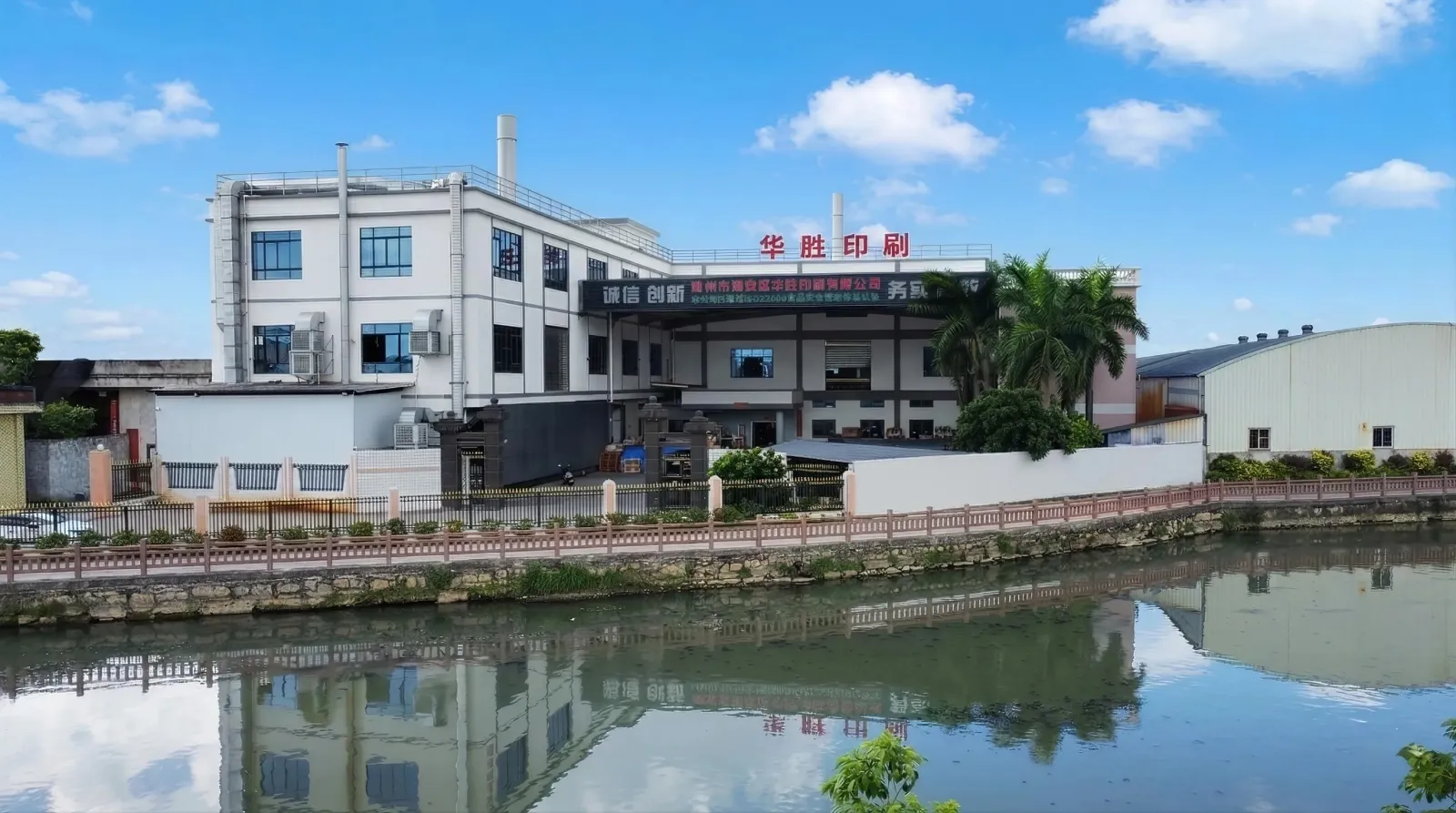
About Huasheng
In-house 9-color gravure printing, solventless lamination, slitting, and pouch converting across stand up pouches, spout pouches, retort bags, coffee bags, and automatic rollstock film.
A legacy of quality in flexible packaging since 1997.
1997 · 6,880 m²
Chaozhou · Guangdong · China
Longshewei, Neipan Management District, Dongfeng Town, Chao'an District, Chaozhou City, Guangdong Province, China