Retort Pouch vs Tin Can & Scheduled-Process Supplier Handoff Guide
Huasheng Packaging Technical Content Review
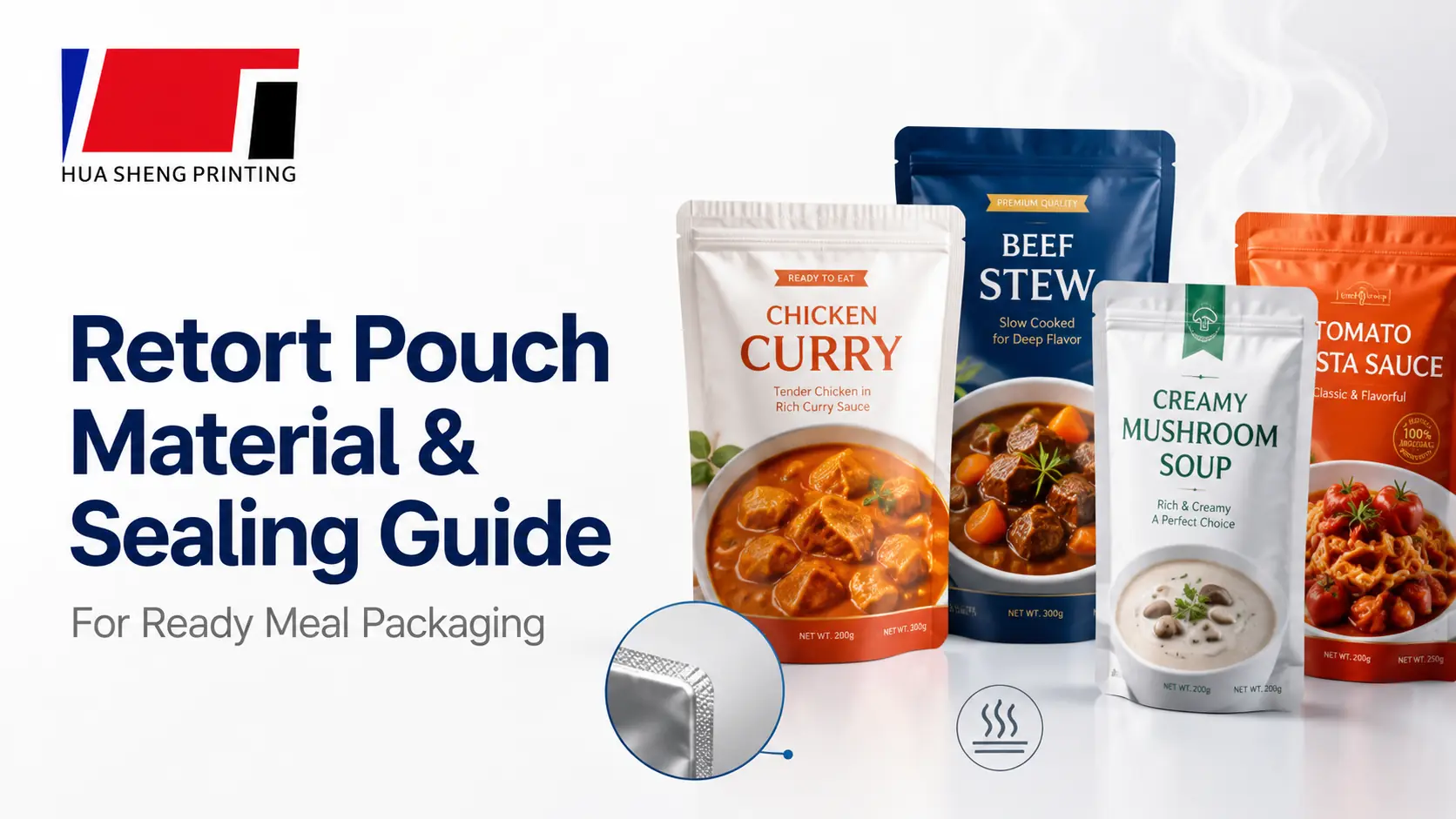
Compare retort pouches vs tin cans on thermal penetration, shipping weight and storage, then use our 4-layer foil vs clear microwaveable retort handoff checklist.
Direct answer
With US monthly search demand exceeding 1,000 queries for retort pouches, ready-meal and wet pet-food brands increasingly replace heavy tin cans and glass jars with flexible retort laminates. Prepared by Huasheng Packaging (Chaozhou Chao’an Huasheng Printing Co., Ltd., a 6,880 m² ISO 22000:2018 plant est. 1997 in Chaozhou), this guide compares retort pouches against cans and maps the exact autoclave handoff inputs your factory needs before trial runs.
Contents
Evidence-reviewed technical guide
Evidence-reviewed technical guide
2026-08-31 · Huasheng Packaging Technical Content Review
Evidence scope
How to Hand Off a Retort Pouch Project Without Overstepping the Scheduled Process
Scope and limitations
The scheduled process is specific to the food, package and retort system.
Key takeaways
- For an applicable thermally processed product, distinguish the decisions and records held by the process authority, food producer and packaging supplier. Begin with the product classification, formulation, container size and type, fill, headspace, process method, cycle, cooling, seal system, handling and target market. Assign a responsible owner and revision to each critical input so purchasing, production, quality and the product owner review the same configuration. Leave unknown values visibly pending; neither a typical recipe, an attractive sample nor a remembered setting fills the evidence gap.
- The principal limitation is that the pouch supplier cannot create a universal scheduled process, and maximum material temperature does not prove cycle compatibility, commercial sterility or shelf life. Separate appearance, material-property, component, seal, machine, distribution and product-stability questions because each needs different evidence. Mark any engineering inference as an inference, define what remains unknown and prevent sales copy from converting a provisional observation into a guarantee.
- Release a controlled specification, drawing, sample and evidence index with named approval owners. Reopen review when formulation, container size, pouch construction, seal process, loading pattern, cycle, cooling, equipment or process-authority instruction changes. The action is to compare the changed condition with the original evidence, choose bridging or full revalidation, record the disposition and block unsupported claims from the website, quotation and production handoff until the gap is closed.
Retort Pouch vs Tin Can: Thermal Processing, Freight & Retail Economics
A flat flexible retort pouch has a far thinner cross-section than a cylindrical metal can, allowing heat to reach the cold spot of curries, soups, stews, or wet pet food significantly faster—helping preserve texture, color, and nutrients while lowering autoclave energy consumption. Before filling, empty pouches ship flat in a fraction of the warehouse space required by empty cans or jars; after filling, lower pack weight reduces export freight and e-commerce breakage while expanding the printable front billboard with up to 9-color rotogravure graphics.
Five Costly Retort Specification & Autoclave Handoff Mistakes
Quoting only a peak temperature (such as 121°C) without specifying holding time, steam vs water-spray autoclave type, and cooling back-pressure.
Ordering 4-layer aluminum foil pouches (PET/AL/PA/RCPP) for a ready-meal line whose consumers expect direct microwave reheating.
Skipping full polyurethane adhesive curing checks or testing empty pouches instead of representative filled packs containing actual oil, acid, and spices.
Omitting a protective nylon (PA) layer when meat bones, firm vegetables, or vigorous autoclave handling risk foil pinholes.
Leaving excessive residual headspace air before top sealing, causing expansion bursts during autoclave pressure transitions.
Foil vs Clear Microwaveable Retort Laminate Selection Matrix
PET / AL / PA / RCPP (4-Layer Foil Retort): Primary opaque barrier for shelf-stable curries, braised meats, sauces, and wet pet food—blocks light and oxygen effectively (not microwave-safe).
PET / PA / RCPP or High-Barrier Clear Retort: Foil-free transparent structure enabling visual product appeal and direct microwave reheating after validating your thermal profile.
PET / AL / RCPP (3-Layer Foil): Compact option for smooth sauces and flat pouches when puncture stress is low and verified in autoclave trials.
PET / PA / AL / RCPP: Outer-positioned nylon configuration evaluated for sharp or rigid food chunks needing extra outer-wall toughness.
Factory Quality Controls & Representative Autoclave Trial Protocol
Under Huasheng’s ISO 22000:2018 management system, retort production enforces full high-temperature adhesive curing before slitting and pouch converting, heat-resistant rotogravure ink verification, rounded corner cutting, and uniform perimeter seal widths. Because commercial sterilization depends on your exact recipe, headspace control, and autoclave overpressure curve, we supply unprinted or trial pouches for representative filled-pack autoclave validation before engraving bulk cylinders.
Supplier Handoff Checklist for Faster Retort Quotations & Trials
Send your exact dish profile (oil, acidity, spices, solids/bones), full time-temperature-pressure retort curve and autoclave type, reheating method (boil-in-bag vs microwave), format (3-side-seal flat vs stand-up), net weight and dimensions, opaque foil vs clear preference, and SKU count. Custom premade retort pouches are reviewed from 30,000 pieces per size and artwork.
Related Products
Related Applications
Related Packaging Guides
- Retort Pouch Material Layers: PET, Aluminum Foil, Nylon and RCPP
- How to Test and Evaluate Retort Pouch Samples: Sterilization Validation, Seal Strength and Barrier Checklist
- Hot-Fill and Pasteurized Liquid Pouches: Decision Boundaries for Materials and Process
Claim-to-source evidence matrix
| Reviewed claim | Support | Sources | Boundary |
|---|---|---|---|
| Applicable low-acid shelf-stable foods require controlled scheduled-process responsibility | direct | [1] | The source supports only the named method, boundary or input; complete-project approval remains outside the citation. |
| Each component must be assessed by identity, authorization and intended use | direct | [2] | The source supports only the named method, boundary or input; complete-project approval remains outside the citation. |
| Seal-strip force and failure mode support process evaluation | direct | [3] | The source supports only the named method, boundary or input; complete-project approval remains outside the citation. |
| Internal pressurization is a destructive gross-leak method | direct | [4] | The source supports only the named method, boundary or input; complete-project approval remains outside the citation. |
| Distribution testing uses a defined shipping-unit assurance plan | direct | [5] | The source supports only the named method, boundary or input; complete-project approval remains outside the citation. |
Authoritative References
- Low-Acid Foods Packaged in Hermetically Sealed Containers · U.S. Food and Drug Administration · government
Applicable low-acid shelf-stable foods require controlled scheduled-process responsibility - Determining the Regulatory Status of Components of a Food Contact Material · U.S. Food and Drug Administration · government
Each component must be assessed by identity, authorization and intended use - ASTM F88/F88M-23: Seal Strength of Flexible Barrier Materials · ASTM International · standard
Seal-strip force and failure mode support process evaluation - ASTM F2096-11(2019): Detecting Gross Leaks by Internal Pressurization · ASTM International · standard
Internal pressurization is a destructive gross-leak method - ASTM D4169-23e1: Performance Testing of Shipping Containers and Systems · ASTM International · standard
Distribution testing uses a defined shipping-unit assurance plan
Frequently Asked Questions
Why do food brands switch from tin cans to flexible retort pouches?
Thin pouch geometry accelerates heat penetration during sterilization—often improving food taste and texture—while flat empty storage, lighter export shipping weight, easy tear opening, and 9-color gravure branding lower total landed cost.
Can aluminum-foil retort pouches be heated in a microwave oven?
No. Any laminate containing solid aluminum foil (AL) cannot go in a microwave. If microwave reheating is required, specify a foil-free transparent retort structure and validate it under your autoclave cycle.
What information does Huasheng need before recommending a retort laminate?
Share your dish ingredients (oil, acid, spices), autoclave type, complete heating/cooling curve, net weight, pouch format, reheating method, and SKU count.

About Huasheng
In-house 9-color gravure printing, solventless lamination, slitting, and pouch converting across stand up pouches, spout pouches, retort bags, coffee bags, and automatic rollstock film.
A legacy of quality in flexible packaging since 1997.
1997 · 6,880 m²
Chaozhou · Guangdong · China
Longshewei, Neipan Management District, Dongfeng Town, Chao'an District, Chaozhou City, Guangdong Province, China