Custom Pet Food Packaging Bags for Dry Food and Treats
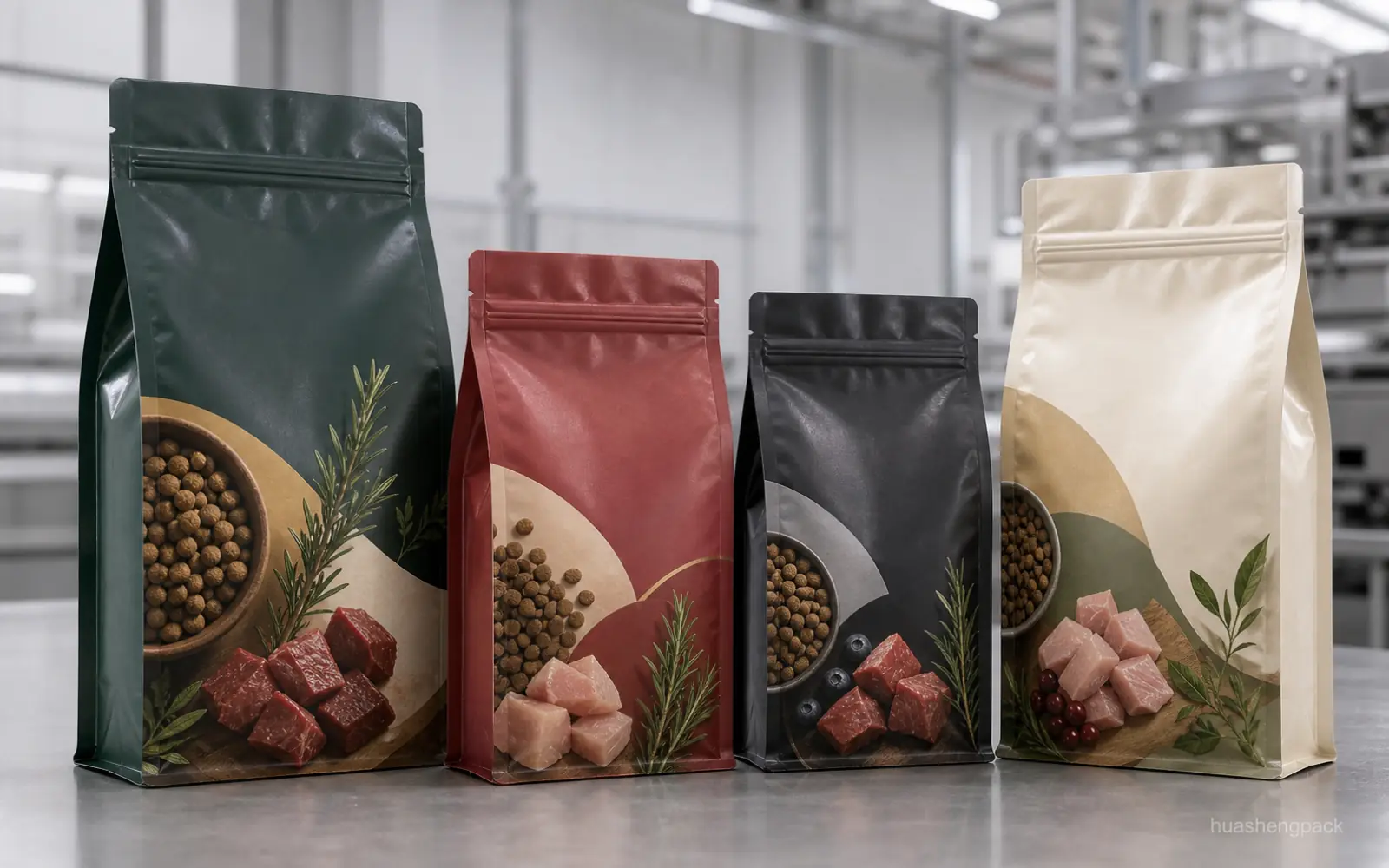
Pet food packaging bag manufacturer for dry food, treats and freeze-dried products. Review fill weight, pouch format, closure, handling and finished-pack evidence.
Reference Price
Custom flexible packaging is quoted based on product type, size, material structure, thickness, printing colors and order quantity. Reference price: from US$0.10/pc. Actual quotation may vary by specification. For an accurate quotation, please contact Huasheng Packaging with your size, material, quantity and artwork.
Material Structure Options
Pet Food Packaging Bags for Dry Food, Treats and Dog Food — Pet food packaging bags should be specified from the product form, fill weight, fat and aroma sensitivity, kibble shape, repeated opening, storage and filling process. Dry dog food, cat food, freeze-dried pieces, biscuits, chews, bird seed and small treats do not create the same puncture, barrier or closure requirements.
Application Recommendations
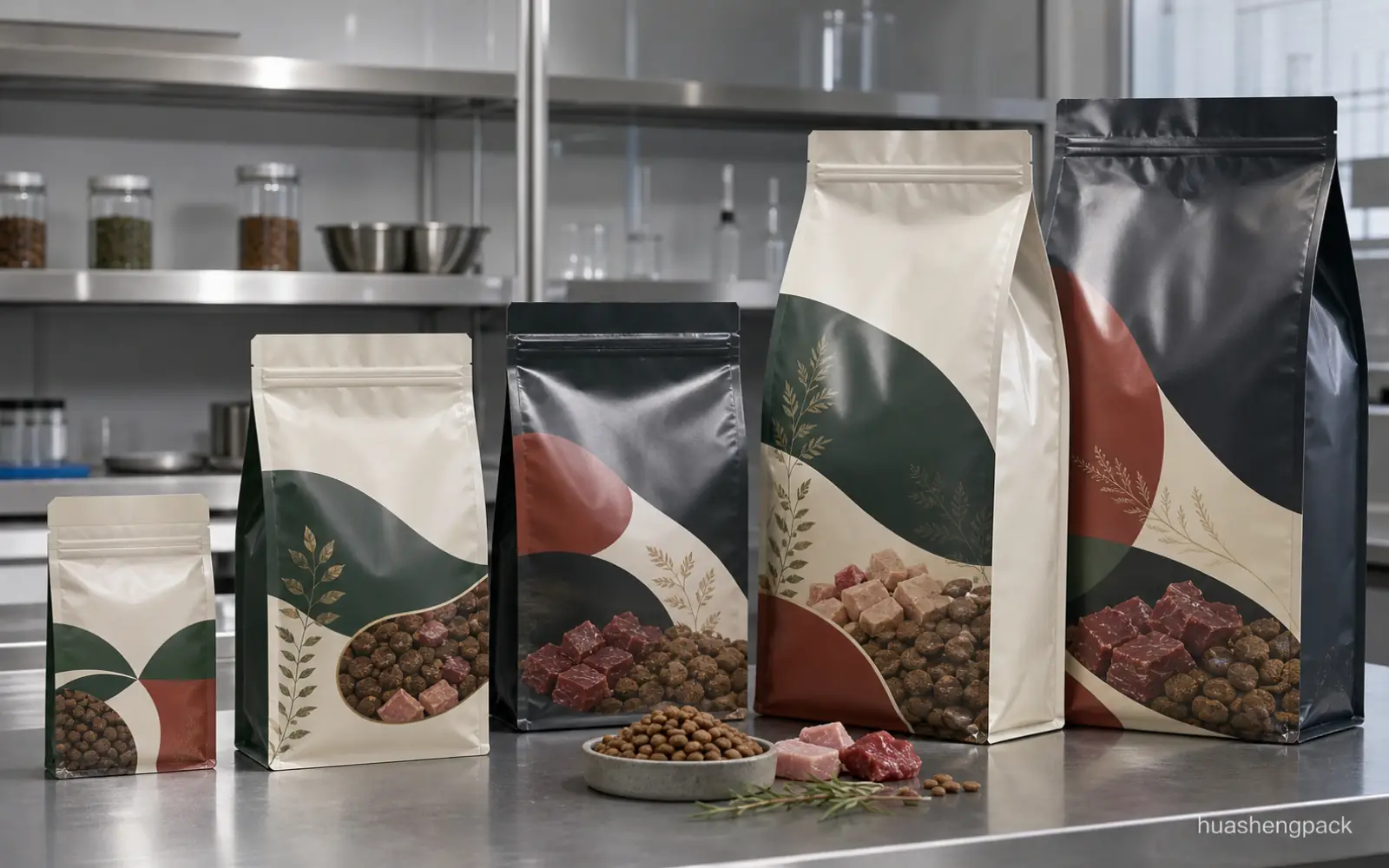
Choose the Bag Format by Fill Weight and Handling — Stand up zipper pouches may suit smaller retail packs when resealing and shelf display are priorities. Flat bottom and quad seal pouches can provide a wider base and more panels for medium or larger packs. Side gusset bags may support efficient volume for dry food. These are format directions rather than fixed weight rules: confirm filled dimensions, headspace, pallet or carton handling, carry features and drop performance with the actual product.
Bag Strength and Puncture Resistance
Grease, Aroma, Moisture and Oxygen Barrier — Fat-containing kibble and treats can require grease resistance, aroma retention and oxygen control, while crisp or freeze-dried products may be especially sensitive to moisture. PET/PE, PET/VMPET/PE, PET/AL/PE, kraft laminates and structures containing PA are possible families, not universal recommendations. State the target shelf life and storage conditions, then validate the complete laminate, seals and closure with the food.
Quality Control Points
Puncture and Mechanical Risk — Sharp kibble edges, bones, chews, heavy fills and repeated consumer handling can stress the pouch body, gussets, corners and seals. Film thickness alone does not prove puncture resistance. Review layer grades, orientation, PA where appropriate, seal layout, zipper area, filled-bag drop and compression conditions. A structure used for one kibble geometry should not be assumed suitable for another.
MOQ and Cost Notes
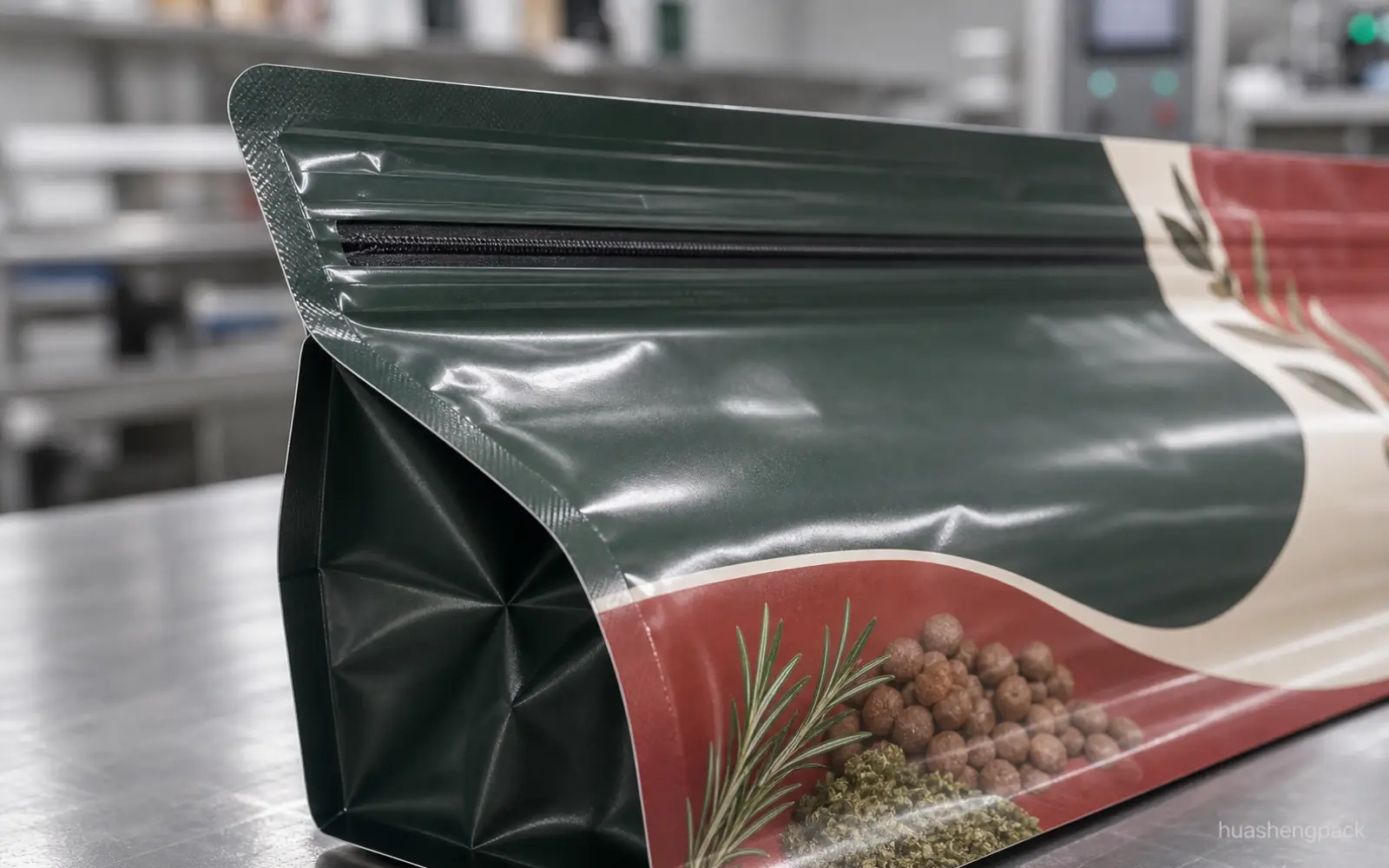
Zipper, Opening and Consumer Use — A press-to-close zipper may support repeated opening, but its profile, position and seal to the pouch must match the format and fill. Confirm tear notch, top-seal allowance, opening width, zipper contamination control and whether the consumer can pour or scoop the product without damaging the closure. Larger dog food bags may also need a handle or different opening approach, subject to conversion feasibility.
What to Prepare Before Requesting a Quote
Filled-Pack Validation and Quality Control — Use representative food and the intended filling and final-sealing process. Check dimensions, laminate bond, seal strength, leakage where relevant, zipper function, puncture, drop and compression behavior, print durability and storage performance. Barrier values for flat film do not by themselves establish finished-pack shelf life; the product owner should validate food compatibility, regulatory suitability and shelf life.
Quality and Certification
Quotation Checklist — Pet food type and composition; kibble or treat shape and sharp edges; fill weight; preferred pouch format and finished dimensions; current structure or sample; shelf-life and storage target; grease, aroma, moisture and oxygen concerns; zipper, notch, handle or window; filling and sealing process; artwork; printing colors; quantity per design; test and acceptance requirements; and nominated China packing site when applicable.
Related Products
Related Products and Guides — Flat Bottom Pouches, Stand Up Zipper Pouches, Quad Seal Pouches, Side Gusset Bags, Kraft Paper Packaging Bags, Food Packaging Roll Film and the Pet Food Packaging Bags Buyer Guide.
Material Structure Options
Q: Which bag is suitable for dry dog food? A: Flat bottom, quad seal, side gusset and stand up formats may be evaluated according to fill weight, handling, closure and display needs. Q: Does every pet food bag need aluminum foil? A: No. Select the barrier from the food, shelf-life target and storage conditions; VMPET is not aluminum foil. Q: How can puncture resistance be checked? A: Use representative kibble and filled-pack handling tests with agreed acceptance criteria. Q: Can pet food bags include a zipper? A: Yes, when the zipper profile, position and pouch construction are validated for the pack. Q: What information is needed for a quotation? A: Provide product, fill weight, format, dimensions, shelf life, storage, features, artwork and quantity per design.
Buyer Decision Matrix
- Pet Food Packaging Bags for Dry Food, Treats and Dog Food — Pet food packaging bags should be specified from the product form, fill weight, fat and aroma sensitivity, kibble shape, repeated opening, storage and filling process. Dry dog food, cat food, freeze-dried pieces, biscuits, chews, bird seed and small treats do not create the same puncture, barrier or closure requirements.
- Choose the Bag Format by Fill Weight and Handling — Stand up zipper pouches may suit smaller retail packs when resealing and shelf display are priorities. Flat bottom and quad seal pouches can provide a wider base and more panels for medium or larger packs. Side gusset bags may support efficient volume for dry food. These are format directions rather than fixed weight rules: confirm filled dimensions, headspace, pallet or carton handling, carry features and drop performance with the actual product.
- Grease, Aroma, Moisture and Oxygen Barrier — Fat-containing kibble and treats can require grease resistance, aroma retention and oxygen control, while crisp or freeze-dried products may be especially sensitive to moisture. PET/PE, PET/VMPET/PE, PET/AL/PE, kraft laminates and structures containing PA are possible families, not universal recommendations. State the target shelf life and storage conditions, then validate the complete laminate, seals and closure with the food.
- Puncture and Mechanical Risk — Sharp kibble edges, bones, chews, heavy fills and repeated consumer handling can stress the pouch body, gussets, corners and seals. Film thickness alone does not prove puncture resistance. Review layer grades, orientation, PA where appropriate, seal layout, zipper area, filled-bag drop and compression conditions. A structure used for one kibble geometry should not be assumed suitable for another.
Pet-food packaging buyer decisions
Match the product, pouch format and release evidence
Start with the actual formula, particles, fill weight and use cycle. A pouch family or pet-food photograph is not a project specification.
01
- Condition
- Formula form, particle profile, oil or moisture exposure, fill weight, use cycle and preferred pouch format are defined.
- Evidence
- Representative filled sample, controlled dimensions and handling observations for seals, closure, standing profile and carton packing.
- Limitation
- A pet-food image, net weight or pouch-family name does not prove capacity, puncture resistance, barrier, closure performance or shelf life.
- Next action
- Send the actual product or specification, fill weight, current pack and preferred format before approving dimensions.
02
- Condition
- Destination market, contact components, required documents and finished-pack acceptance owner are identified.
- Evidence
- Component records matched to intended use plus separate project records for sealing, handling and finished-pack validation.
- Limitation
- A management-system certificate or component statement does not approve every complete pet-food package.
- Next action
- List document, sample, production and change-control checks before the order specification is released.
These units organize a pet-food packaging review; they do not prescribe a universal pouch, laminate, test result, compliance outcome, shelf life, price, lead time or MOQ.
Suitable Applications
Food, beverage, snacks, coffee, pet food, daily chemical, powder, liquid, sauce, frozen products, ready meals, industrial products and more. Suitability depends on material structure, sealing method and packaging machine type.
Material Options
Common structures: PET/PE, PET/VMPET/PE, PET/AL/PE, BOPP/CPP, NY/PE, kraft paper laminates. Selection criteria: barrier requirements (oxygen, moisture, light), sealing method (heat seal, cold seal), shelf life, packaging machine compatibility and cost.
Key Features
Rotogravure printing, eye marks, sealant layers, zippers, tear notches, hang holes, windows, degassing valves, spouts and caps may be evaluated. Capability and suitability are confirmed against the product, format, equipment, target market and approved project specification.
Quality Control
Quality-control items, methods, specimens, conditions, frequency and acceptance criteria must be agreed in the project specification. A public management-system document, factory image or general workflow does not replace a material-, package- or batch-specific test record and release decision.
Plan product evidence before approval
The laboratory page records available instrument categories and one bounded sample report. It does not mean this product, structure or batch has passed testing.
Buyer Notes
- Provide product type, bag size or roll width — a photo or sample helps quick assessment
- If material structure or thickness is known, include specification
- Number of printing colors and artwork file affect cylinder cost and prepress time
- Packing machine type (VFFS/HFFS/manual) determines roll film vs premade pouch choice
- Target market compliance, China OEM filling requirements or nominated domestic warehouse handover details help confirm the final specification
Related Products
Related Applications
Related Packaging Guides
- Flat Bottom Pouches vs Stand Up Pouches: A Buyer Comparison
- Why Same Price Packaging Bags Can Have Different Quality
Frequently Asked Questions
What is the MOQ for custom printed flexible packaging?
Custom premade pouches are reviewed from 30,000 pieces per size and artwork, subject to final factory approval. Production timing is confirmed against the current factory schedule after the specification and artwork are approved.
Can Huasheng Packaging provide samples?
Yes. Existing production samples can be provided for material and workmanship reference. Custom printed samples, structure samples or pre-production samples should be confirmed by project according to artwork, size, material and printing colors. Sample method, timing and cost are confirmed before order placement.
What is the lead time for custom packaging orders?
Custom premade pouches are reviewed from 30,000 pieces per size and artwork, subject to final factory approval. Production timing is confirmed against the current factory schedule after the specification and artwork are approved.
What material structure should I choose?
Material structure depends on product type (dry, oily, frozen, liquid, high-temperature), shelf life requirements and packaging machine type. Common options include PET/PE, PET/VMPET/PE, BOPP/CPP, NY/PE and kraft paper laminates. We can recommend suitable structures based on your product details.
What is the difference between roll film and premade pouch?
Roll film is printed laminated film supplied on rolls for automatic packing machines (VFFS/HFFS), where filling, forming and sealing happen on one machine. Premade pouches are pre-formed bags delivered ready for filling on separate equipment. The choice depends on your production line and product format.