Coffee Bag Valve and Material Selection Guide
Huasheng Packaging Technical Content Review · Published:
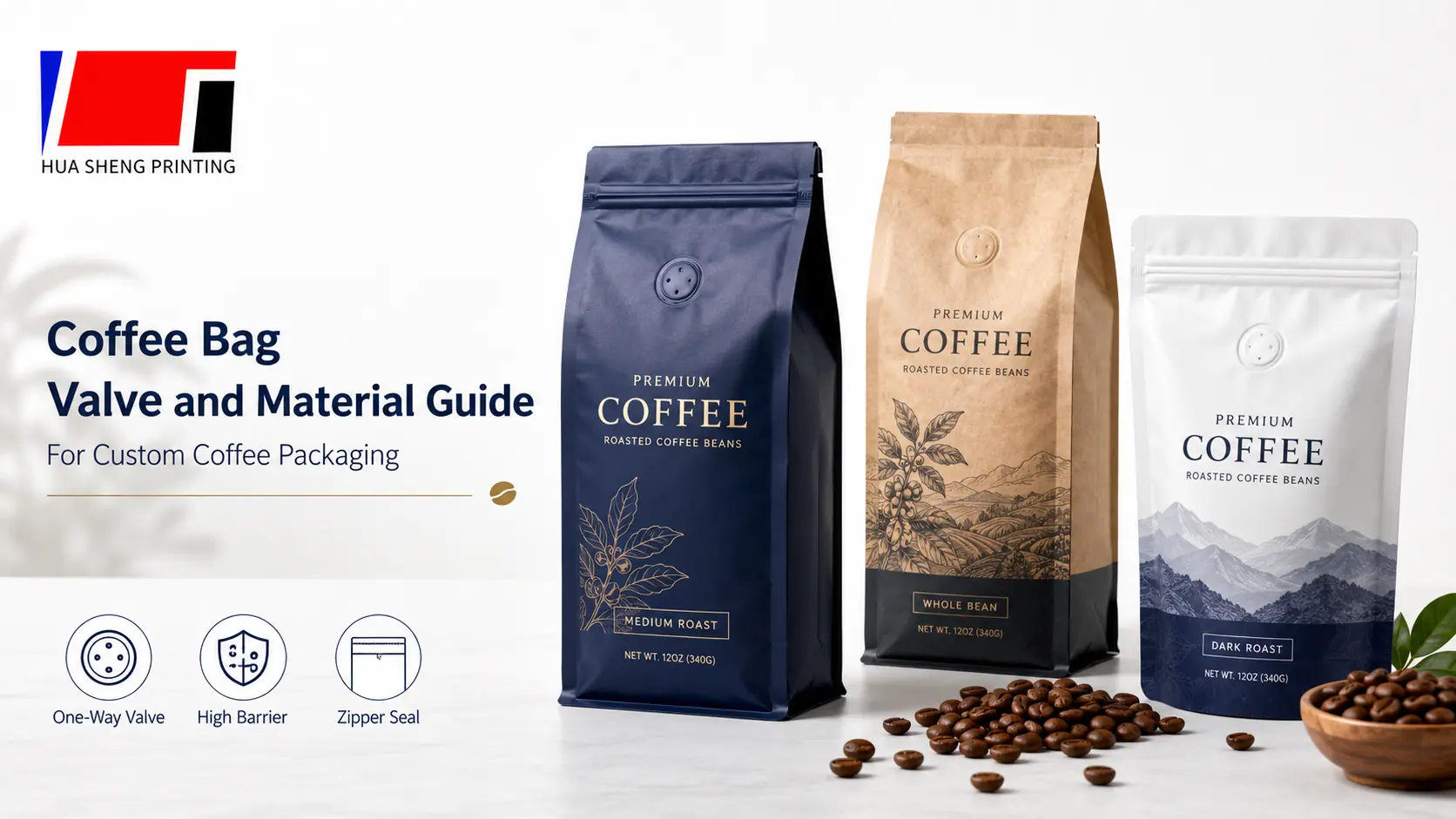 Technical guide visual for Coffee Bag Valve and Material Selection Guide.
Choose a coffee bag valve, laminate and pouch format by coffee form, packing interval, barrier target, valve position, zipper clearance and filled-pack tests.
Direct answer
A coffee bag valve, barrier laminate and pouch format should be specified as one package. Coffee form, roast and packing interval influence degassing needs, while oxygen, moisture, aroma, light, valve placement and seal integrity influence the finished pack.
Evidence-reviewed technical guide
2026-08-13 · Huasheng Packaging Technical Content Review
Evidence scope
One-way degassing-valve purpose and component boundary, component-specific intended-use review, and project-defined filled-package seal and gross-leak validation.
Scope and limitations
This review does not assign a universal laminate, valve pressure or position, oxygen-barrier approval, machine setting or shelf life. Method suitability and treatment of the valve opening must be defined for the actual package.
Key takeaways
- A one-way degassing valve is one component, not finished-package approval.
- Food-contact review remains component-, manufacturer- and intended-use-specific.
- Seal-strip strength and gross-leak examination answer different questions and do not replace project-defined filled-package validation.
Decide Whether the Coffee and Packing Process Need a Valve
Freshly roasted coffee can release carbon dioxide after packing, but the rate varies with coffee form, roast, resting time and packing interval. Whole bean and ground coffee should not automatically receive the same valve specification. Confirm the roaster’s process, expected gas release and package headspace before approving a valve direction.
A one-way degassing valve is intended to release internal gas while limiting reverse air entry. Its presence does not replace oxygen-barrier material, sound seals or suitable storage. A valve-free package may be possible for some validated processes, but that decision belongs to the coffee producer and packaging trial.
Coordinate Valve Position, Zipper and Pouch Geometry
Place the valve away from heat-seal zones, zipper tracks, gusset folds and areas that will be sharply creased during filling or display. Confirm the position on the dieline and on a converted sample, because a visually acceptable artwork position may interfere with valve application or bag opening.
Flat-bottom, side-gusset and stand-up pouches create different panels and folds. Fill weight, bulk density, required headspace and filling equipment should determine bag dimensions before valve coordinates are fixed.
Select Barrier Layers from the Freshness Risk
PET or BOPP may provide a printable outer web; PE commonly serves as a sealant; VMPET may provide an opaque metallized barrier direction; and aluminum foil may be evaluated where a different high-barrier direction is required. Kraft paper usually supplies appearance and stiffness rather than acting as the only freshness barrier.
PET/VMPET/PE, PET/AL/PE and paper-based laminates are possible structures, not universal answers. Compare the complete laminate, film grades, thickness, valve attachment area, sealant compatibility and expected flexing. A silver appearance alone does not identify foil or prove barrier performance.
Test the Valve and Finished Coffee Pack Together
Approve valve attachment, opening behavior and reverse-leakage control using an agreed method. Also inspect top, side and bottom seals, zipper operation, laminate adhesion, dimensions, standing stability and odor. Use representative coffee and fill weight, then observe package inflation or panel distortion under the intended packing and storage sequence.
Barrier data for flat film and a valve supplier’s component data do not by themselves validate the converted pouch. The coffee producer should confirm freshness and shelf life with filled packs under realistic conditions.
Coffee Pouch Specification Checklist
Provide whole bean or ground coffee; roast and packing interval; fill weight and bulk density; pouch format and dimensions; valve need and preferred panel; zipper requirement; target shelf life and storage climate; transparency or light-barrier requirement; candidate laminate and thickness if known; finish; filling and sealing equipment; quantity per artwork; and the filled-pack checks used for approval.
For supplier comparison, issue one controlled coffee-pack brief covering roast and format, fill weight, time from roasting to packing, target shelf life, storage climate, pouch dimensions, valve and closure specification, and the evidence expected from the finished bag. Keep film barrier data tied to the named specimen and test conditions, and keep valve performance tied to the exact component and installation. Approve the converted, filled package rather than transferring a result from a generic laminate or a visually similar coffee bag.
Related Products
Related Packaging Guides
Claim-to-source evidence matrix
| Reviewed claim | Support | Sources | Boundary |
|---|
| A one-way degassing valve is a specific component intended to release package gas while limiting external-air contact. | direct | [1] | It does not approve the laminate, valve attachment, oxygen barrier, gross-leak result or shelf life of a finished pouch. |
| Food-contact review depends on the identity, specifications, manufacturer and intended-use limits of each relevant component. | direct | [2], [3] | A base-film declaration cannot automatically cover ink, adhesive, sealant, valve or zipper. |
| Valve-bearing coffee pouches need project-defined filled-package seal and leak validation rather than approval from a seal-strip result alone. | contextual | [4], [5] | Method suitability and treatment of the valve opening must be defined for the actual package. |
JSON · CSV
Authoritative References
- Goglio Integrated Degassing Valves for Flexible Packaging · Goglio S.p.A. · manufacturer-data
A one-way degassing valve is a component intended to release package gas while limiting external-air contact. - Determining the Regulatory Status of Components of a Food Contact Material · U.S. Food and Drug Administration · government
Food-contact review depends on component identity, specifications, manufacturer and intended-use limitations. - Food Types and Conditions of Use for Food Contact Substances · U.S. Food and Drug Administration · government
Food type and temperature-based conditions of use are part of intended-use review. - ASTM F88/F88M-23: Seal Strength of Flexible Barrier Materials · ASTM International · standard
Seal-strip strength is a method-specific process output with a recorded failure mode. - ASTM F2096-11(2019): Detecting Gross Leaks by Internal Pressurization · ASTM International · standard
The destructive internal-pressurization method examines gross leaks within its stated scope.
Frequently Asked Questions
Does every coffee bag need a degassing valve?
No. The need depends on coffee form, roast, resting and packing interval, gas release and the validated packing process.
Where should a coffee bag valve be placed?
Keep it clear of heat seals, zipper tracks and gusset folds, then confirm the coordinates on the dieline and a converted filled sample.
Is VMPET the same as aluminum foil in a coffee bag?
No. VMPET is metallized PET and foil is a distinct layer. Buyers should confirm the complete laminate rather than relying on a silver appearance.
Does kraft paper protect coffee aroma by itself?
Kraft paper mainly contributes appearance and stiffness. Aroma, oxygen and moisture protection depend on the complete inner laminate and finished-package integrity.
Can the valve replace a high-barrier laminate?
No. Valve function and laminate barrier address different risks and should be evaluated together with seals and storage conditions.
How should a custom coffee pouch sample be approved?
Use representative coffee, fill weight, packing interval and sealing conditions; inspect valve function, seals, zipper, dimensions, appearance and storage behavior.