Infant Cereal Powder Packaging: Moisture Control, Barrier, Pouch Size and Shelf-Life Validation
Huasheng Packaging Technical Content Review · Published:
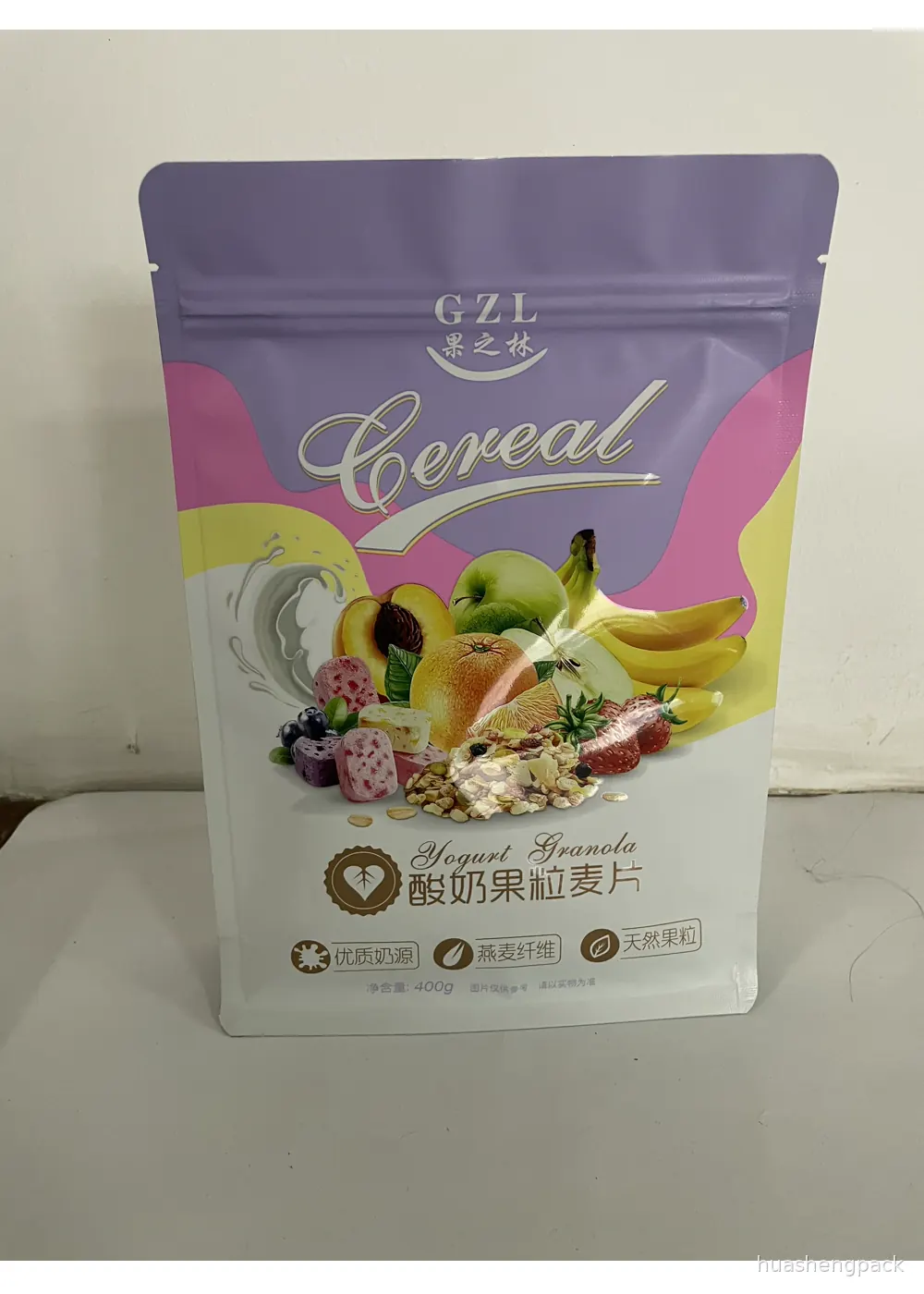 The photograph shows visible format and print layout only; product suitability and shelf life require project validation.
Plan infant cereal and rice-cereal powder pouches by water activity, bulk density, moisture and oxygen barrier, zipper use, seal cleanliness and shelf-life validation.
Direct answer
A list of target filling weights does not determine a pouch size by itself. Infant cereal, rice cereal and nutrition powders can have very different bulk density, particle size, fat content, water activity and flow behavior. Packaging selection should therefore begin with the product and filling process, then convert the target shelf life into measurable barrier, seal and storage requirements. This guide explains that decision path without assigning a universal moisture limit, laminate or shelf-life promise.
Evidence-reviewed technical guide
2026-08-31 · Huasheng Packaging Technical Content Review
Evidence scope
Infant cereal and rice-cereal powder pouch sizing, product-condition inputs, moisture and oxygen barrier, zipper and seal-zone decisions, and filled-pack shelf-life validation.
Scope and limitations
No universal moisture percentage, water-activity limit, laminate, pouch dimension or shelf life is assigned. Final requirements belong to the exact formulation, process, market and validation plan.
Key takeaways
- Fill weight alone does not determine pouch dimensions.
- Moisture content and water activity are different product controls.
- Barrier, seals, product condition and storage must be validated as one shelf-life system.
1. Confirm the Product Before Recommending Pouch Dimensions
Net weight is only one sizing input. A fine, compact cereal powder may occupy much less volume than a coarse, aerated cereal blend at the same weight. Powder can also settle after filling, while flakes or inclusions may bridge at the filling opening or need more headspace. Start by recording product form, measured bulk density, particle distribution, fill weight, filling method, acceptable headspace, scoop or serving system, and whether the product is filled directly into the outer pouch or first packed in individual sachets.
Use a representative product sample or a controlled bulk-density measurement to estimate an initial internal volume. Then make several pouch mock-ups, fill them at the intended weight and check top-seal clearance, zipper clearance, standing shape, consumer access and carton fit. A dimensional recommendation based only on kilograms or a product photo is a starting hypothesis, not an approved production size. If individual sachets will be placed inside an outer pouch, the sachet count, trapped air, arrangement and carton compression must be evaluated separately.
This photograph supports visible pouch format, zipper and artwork-layout review only. It does not prove infant-food approval, laminate structure, barrier performance or shelf life.2. Separate Moisture Content, Water Activity and Packaging Protection
Moisture content and water activity are related but are not interchangeable. Moisture content measures how much water is present; water activity describes how available that water is for microbial, physical and chemical change. The relationship depends on formulation, ingredients, temperature and the product sorption curve. A single fixed moisture percentage cannot be treated as a universal infant-cereal rule without a validated product specification and method.
Drying, formulation and hygienic processing establish the product entering the pouch. Packaging cannot correct an inadequately dried, contaminated or unstable product. Its role is to limit moisture gain, oxygen exposure, light where relevant and contamination during the intended distribution period. The product manufacturer should define the finished-product moisture and water-activity limits, sampling method, release criteria and storage conditions. The packaging brief should then use those approved product limits rather than a generic percentage copied from another cereal or milk-powder project.
3. Translate the Shelf-Life Target into a Complete Barrier System
A stated month-based shelf-life target is not established by naming PET, VMPET, aluminum foil or PE. The required protection depends on initial product condition, critical moisture gain, oxidation sensitivity, fat content, headspace oxygen, package surface area, storage temperature and humidity, light exposure, seals and repeated opening. Research on powdered infant formula illustrates a useful design principle: water-vapor and oxygen protection should be related to product-specific deterioration limits and storage variables. It does not create a universal laminate recipe for cereal powder.
Compare candidate laminates with stated oxygen-transmission and water-vapor-transmission methods, specimens and conditions. Then assess the converted pouch because folds, flexing, zipper insertion and seals can change the complete-package result. A metallized or foil direction may be evaluated when light, oxygen or moisture protection is demanding, while a transparent direction may be evaluated when visibility is important. The final decision belongs to the exact laminate grade, thickness distribution, converted sample and filled-pack study—not the visible silver color or a material-family name.
4. Treat the Zipper, Filling Method and Final Seal as One System
A zipper mainly supports reclosure after opening. The unopened shelf-life barrier normally depends on the intact laminate, the final top seal and the rest of the package system. Fine powder on the zipper or across the seal area can interfere with closure and heat sealing, so the filling process must keep the sealing zone acceptably clean. Manual filling is not automatically unsuitable, and automatic filling is not automatically approved: both require a repeatable dosing method, controlled product presentation and a stable sealing process.
For larger fill weights, review filled-pouch handling, bottom and side stresses, zipper access, consumer pouring or scooping, and carton compression. Record the actual sealer or premade-pouch machine, seal-jaw geometry, temperature, pressure, dwell time and speed. Seal-strength measurements support process control but do not by themselves prove absence of channels or long-term barrier. Visual inspection, an appropriate integrity method and representative handling should answer separate failure risks.
5. Build a Shelf-Life Validation Plan Before Bulk Approval
Approve the project in stages. First lock the product specification, intended market, filling weight, bulk density, pouch format, laminate grades, dimensions, zipper and artwork. Next review empty converted samples and representative filled samples. Then verify filling cleanliness, final-seal consistency, leakage risk, handling, drop or compression where relevant, and storage under conditions linked to the intended market.
The shelf-life study should define the product quality endpoints that matter, such as moisture or water-activity change, clumping, flow, aroma, oxidation, color, nutrient or microbiological criteria where applicable. It should also define storage conditions, sampling intervals, controls and pass rules. Packaging-supplier data can support material screening, but the product owner or qualified laboratory must establish the finished food shelf-life conclusion. Before quotation, provide product composition and fat sensitivity, validated moisture and water-activity specification, bulk density, fill weights, direct-fill or inner-sachet route, target shelf life, destination climate, pouch preferences, filling equipment, quantity by artwork and a representative sample.
Related Products
Related Packaging Guides
Claim-to-source evidence matrix
| Reviewed claim | Support | Sources | Boundary |
|---|
| Water activity and moisture content are different controls, and the suitable water-activity level depends on formulation and validated product data. | direct | [1] | The source does not establish a universal infant-cereal moisture percentage. |
| Processed cereal-based foods for infants and young children should be packed in containers that safeguard hygienic and other food qualities. | direct | [2] | The standard does not prescribe one pouch format or laminate. |
| Storage temperature, product water activity and packaging material can interact in baby-food flour stability. | direct | [3] | The study results cannot be transferred as universal acceptance limits to another formulation. |
| Dry powdered-food barrier design can relate moisture and oxygen ingress to product-specific deterioration limits and storage variables. | contextual | [4] | The cited model concerns powdered infant formula and is used only as a design principle, not a cereal laminate recipe. |
| OTR and WVTR comparisons require named methods, specimens and test conditions. | direct | [5], [6] | Flat-film transmission data does not establish finished-pack shelf life. |
| Seal strength is a process measure interpreted with the specimen, test technique and failure mode. | direct | [7] | Seal strength alone does not prove absence of channels or long-term package integrity. |
JSON · CSV
Authoritative References
- Water Activity (aw) in Foods · U.S. Food and Drug Administration · government
Water activity differs from total moisture and must be controlled using product-specific formulation and data - Standard for Processed Cereal-Based Foods for Infants and Young Children (CXS 74-1981) · Codex Alimentarius · technical-organization
Processed cereal-based infant foods should be packed in containers that safeguard hygienic and other qualities - Effects of storage temperature and packaging material on extruded composite baby food flour · Journal of Food Science and Technology · peer-reviewed
Product water activity, storage temperature and packaging material were evaluated together for one baby-food flour formulation - Water vapor and oxygen barrier estimation in designing a single-serve package of powdered infant formula for required shelf life · Journal of Food Process Engineering · peer-reviewed
Powder-package barrier design can connect moisture and oxygen ingress with product-specific deterioration limits and storage variables - ASTM D3985-24: Oxygen Gas Transmission Rate Through Plastic Film and Sheeting Using a Coulometric Sensor · ASTM International · standard
OTR is measured for a defined specimen under named conditions - ASTM F1249-25: Water Vapor Transmission Rate Through Plastic Film and Sheeting Using a Modulated Infrared Sensor · ASTM International · standard
WVTR applies to defined flexible barrier specimens and stated test conditions - ASTM F88/F88M-23: Seal Strength of Flexible Barrier Materials · ASTM International · standard
Seal strength is a quantitative process measure interpreted with specimen, technique and failure mode
Frequently Asked Questions
Can pouch size be selected from fill weight alone?
No. Measure or estimate bulk density, then confirm usable volume, headspace, seal clearance and filled shape with the actual product.
Can one moisture percentage be used for every infant cereal powder?
No. The product manufacturer should define moisture and water-activity limits using the formulation, process, method and shelf-life study.
Does a high-barrier pouch guarantee a stated shelf life?
No. Barrier is one input. Initial product condition, oxygen, seals, storage, handling and the selected quality endpoints must be validated together.
Should larger multi-use cereal pouches use a zipper?
A zipper can improve reclosure after opening, but the decision should consider serving pattern, powder contamination, opening size, consumer access and the final top seal.
Is automatic filling always better than manual filling?
Not automatically. Compare dosing repeatability, dust control, seal-zone cleanliness, sealing stability and production volume on the intended process.
What should be tested before bulk production?
Use the actual product and fill weight to check dimensions, headspace, zipper and seal clearance, filled-pouch handling, package integrity and a defined storage study.