Liquid Pouch Material Safety: Formula Compatibility, Seals and Validation
Huasheng Packaging Technical Content Review · Published: · Updated:
 Liquid packaging materials, seals and fitments should be validated with the intended contents and filling process.
Review food-contact use, formula compatibility, spout welds, seals and filled-pouch validation before approving liquid packaging materials.
Direct answer
A material name does not prove that a liquid pouch is suitable for every sauce, beverage, detergent or concentrate. The complete laminate, direct-contact layer, ink, adhesive, spout system and sealing process must be reviewed against the actual formula and conditions of use. This guide separates regulatory documentation from chemical compatibility and finished-pouch performance.
Evidence-reviewed technical guide
2026-08-12 · Huasheng Packaging Technical Content Review
Evidence scope
Liquid pouch material and fitment review, component evidence boundaries, representative filling and controlled sealing validation.
Scope and limitations
No laminate or test method is universally suitable for every liquid. Formula safety, regulatory status, compatibility and shelf life require project-specific responsibility.
Key takeaways
- Define the actual liquid and conditions of use before selecting materials.
- Regulatory status and chemical compatibility are separate assessments.
- Validate pouch seals and spout welds with representative filled packs.
Define the Liquid and Conditions of Use First
Record whether the contents are aqueous, acidic, oily, alcoholic, concentrated or chemically active; the fill and storage temperatures; contact time; headspace; package size; and whether pasteurization, freezing or reheating occurs. The FDA conditions-of-use framework illustrates why food type and temperature belong in the assessment. Non-food liquids also require formula-specific compatibility rather than a generic food-pouch assumption.
Do Not Confuse Regulatory Status with Compatibility
A component may have documentation for a defined food-contact use and still require compatibility evaluation with the actual liquid, temperature and duration. Conversely, a pouch that appears stable in a short trial does not establish regulatory suitability. Identify every component and its evidence boundary, then review swelling, softening, stress cracking, odor, color transfer, delamination and fitment interaction separately.
Review the Laminate, Sealant and Fitment as One System
Possible structures and sealant grades depend on product and process; no PET/PE, PA/PE or barrier laminate is universal. Confirm the direct-contact layer, adhesive cure, print and coating placement, spout and cap resin, weld geometry, top and side seals, drop risk and opening or reclose behavior. A supplier data sheet is an input, not proof of the converted filled pouch.
 Regulatory status, formula compatibility and finished-package performance should be reviewed as separate but connected evidence.
Validate with Representative Filled Pouches
Use the intended formula, fill weight, filling temperature and production-representative equipment. Establish a controlled sealing range, inspect welds and seal areas, and apply suitable leak, seal-strength, drop, compression or storage checks according to risk. Laboratory seal preparation can support screening, but production validation remains necessary. Record failures by location and mode rather than reporting only pass or fail.
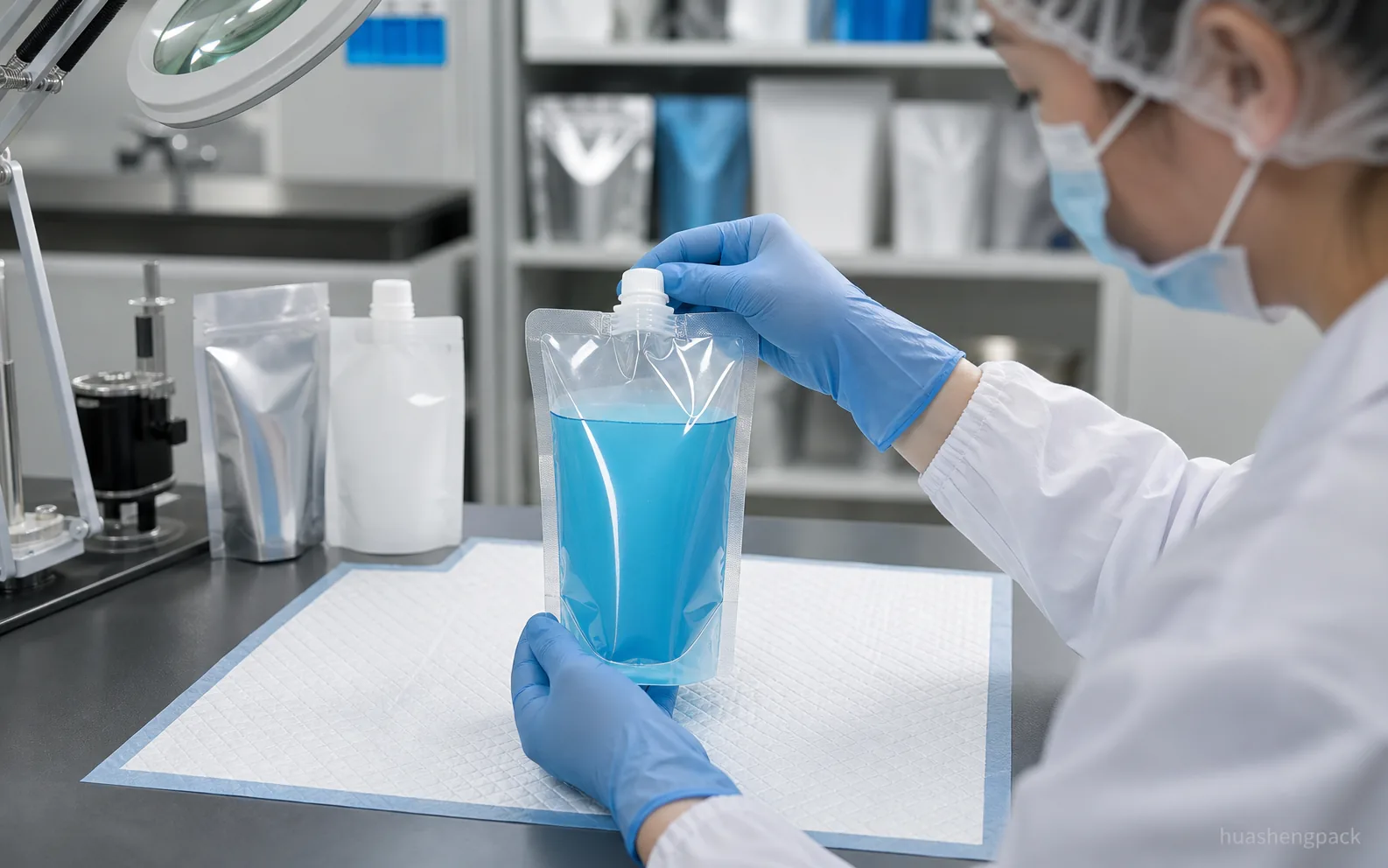 Spout welds and pouch seals should be checked with representative contents and agreed test conditions.
Liquid Packaging Review Brief
Provide formula category and relevant safety data, pH or oil/alcohol context where applicable, fill temperature, contact duration, storage, package size, spout and cap specification, machine, target shelf life, complete proposed structure, direct-contact layer and required market documents. Final compatibility, regulatory suitability and shelf life must be confirmed for the actual product-package system.
Related Products
Related Packaging Guides
Claim-to-source evidence matrix
| Reviewed claim | Support | Sources | Boundary |
|---|
| Food-contact review depends on food type, temperature and conditions of use. | direct | [1], [3] | Non-food chemical compatibility requires separate formula-specific evidence. |
| Each food-contact component must be assessed against its authorization and use limitations. | direct | [2] | A component status does not establish finished-pouch performance. |
| Material properties, process settings and contamination can affect seal integrity. | direct | [4] | Specific acceptance limits must be agreed for the actual package. |
| Laboratory seal preparation does not replace production-equipment validation. | direct | [5] | Representative contents and equipment remain necessary. |
JSON · CSV
Authoritative References
- Food Types and Conditions of Use for Food Contact Substances · U.S. Food and Drug Administration · government
Food-contact review depends on the food type and the intended temperature and storage conditions - Determining the Regulatory Status of Components of a Food Contact Material · U.S. Food and Drug Administration · government
Food-contact status depends on each component, its authorization, specifications and conditions of use - Commission Regulation (EU) No 10/2011 on Plastic Materials and Articles Intended to Come into Contact with Food · EUR-Lex · regulation
Plastic food-contact compliance is tied to authorized substances, restrictions and migration rules - Understanding the Factors Affecting the Seal Integrity in Heat Sealed Flexible Food Packages: A Review · Packaging Technology and Science · peer-reviewed
Seal integrity is affected by material properties, process parameters and contamination - ASTM F2029-16(2021): Laboratory Heat Seals for Determination of Heat Sealability of Flexible Barrier Materials · ASTM International · standard
Laboratory heat-seal curves provide starting relationships and do not replace production-equipment validation
Frequently Asked Questions
Is one PE sealant suitable for every liquid?
No. Resin grade, formula, temperature, seal geometry and process conditions affect suitability.
Does food-contact documentation prove chemical compatibility?
No. It supports a defined regulatory use; compatibility with the actual contents and duration is a separate assessment.
Why test the spout weld separately?
The weld joins different components and can fail differently from the pouch side or top seal.
Can water be used instead of the actual liquid?
Water may support an early mechanical check but cannot reproduce every interaction with oils, acids, alcohols, concentrates or detergents.
Which test guarantees a leak-free pouch?
No single test guarantees every use. Select methods and acceptance criteria for the actual defect risk, package and distribution conditions.
Who validates shelf life?
The product owner should validate shelf life using the actual formula, package, filling process and storage conditions.