Food Packaging Material Selection Guide for Flexible Pouches and Roll Film
Huasheng Packaging Technical Content Review · Published:
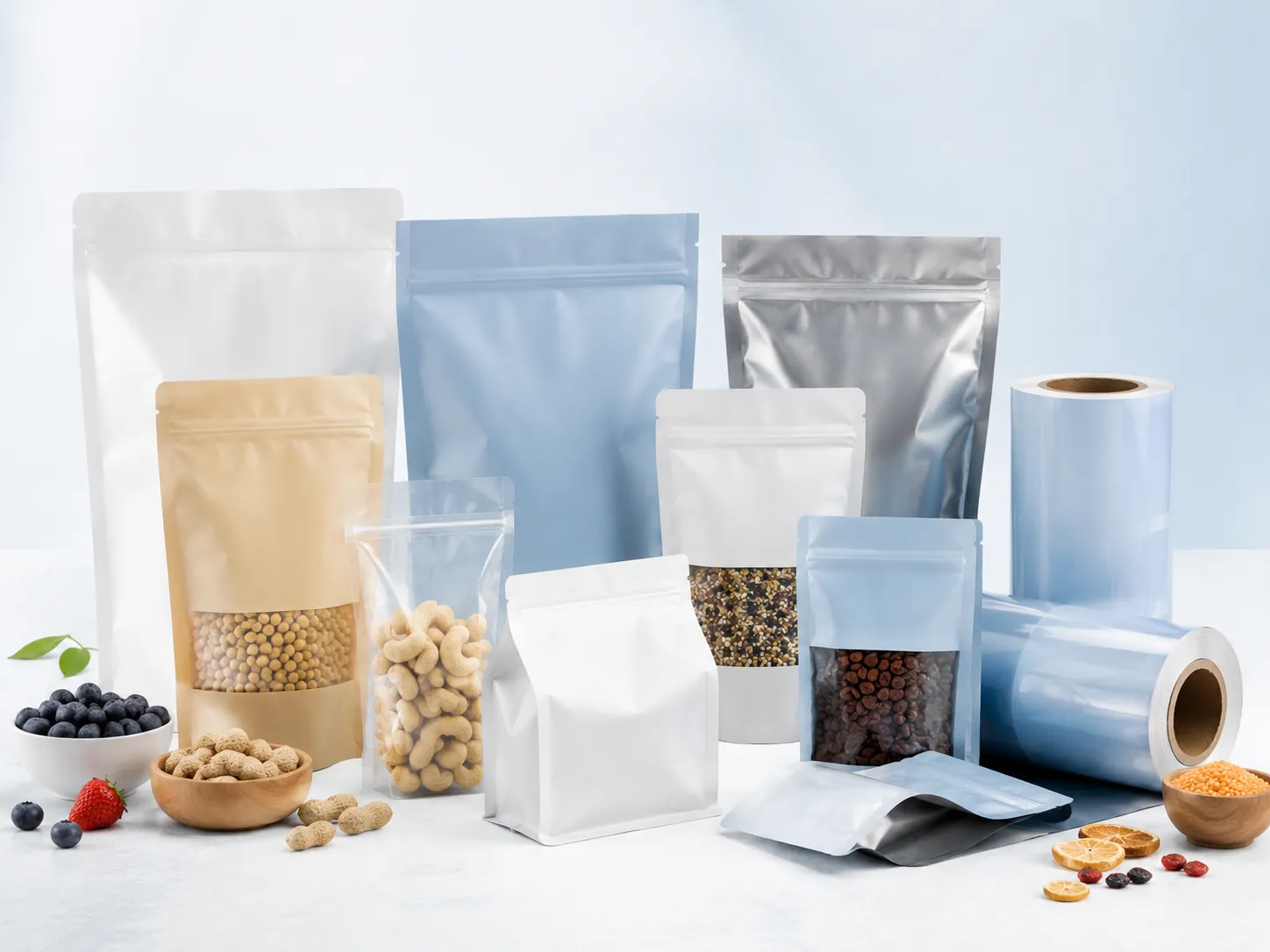 Technical guide visual for Food Packaging Material Selection Guide for Flexible Pouches and Roll Film.
Choose flexible food packaging materials by product risk, barrier need, sealing process and packing line. Compare PET/PE, PA, VMPET, foil and CPP roles.
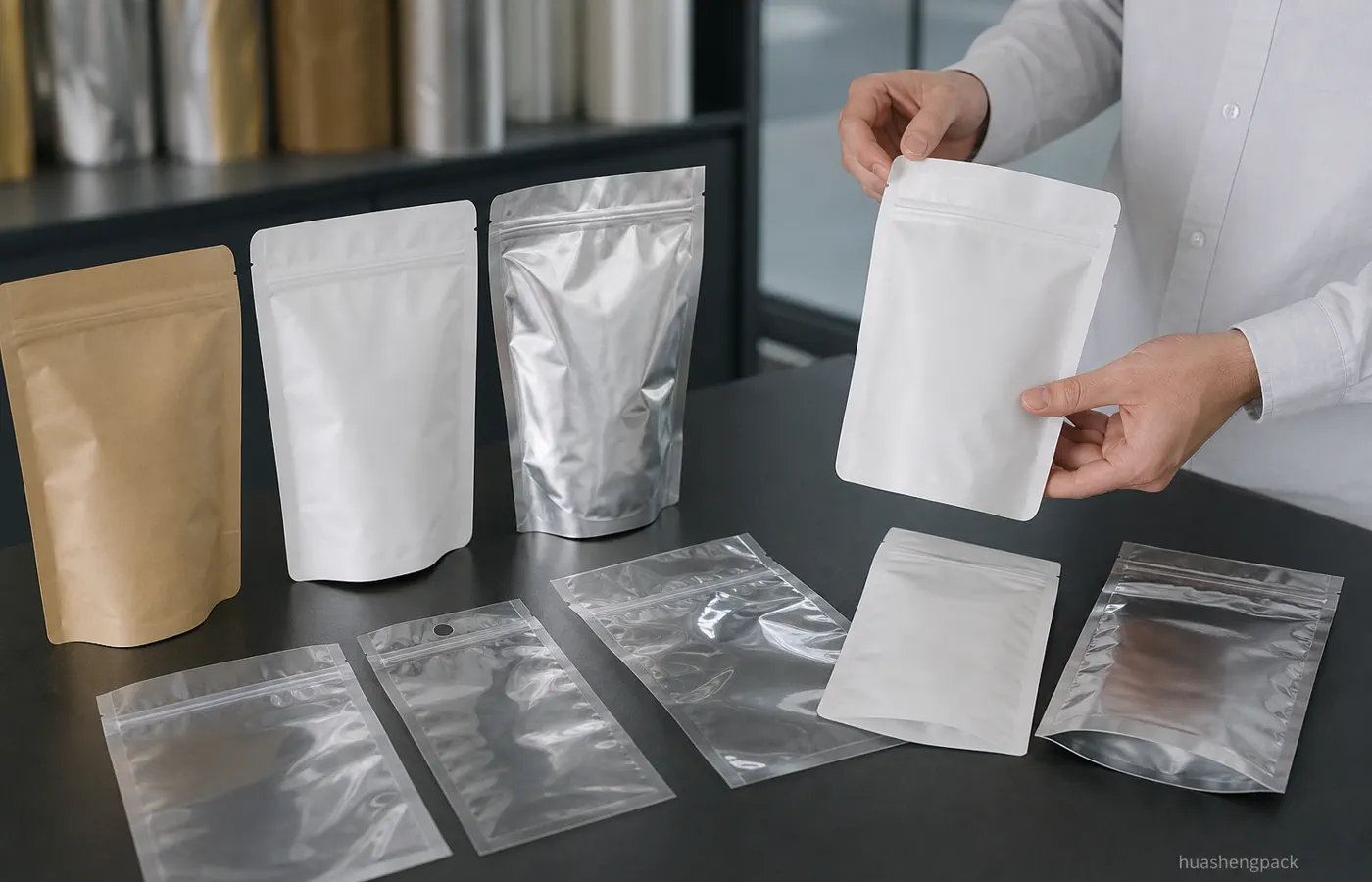
Direct answer
Food packaging material selection starts with the product and process, not a laminate name. Buyers should define moisture, oxygen, light, aroma, puncture, sealing and temperature risks, then compare candidate structures through representative pouch or roll-film trials.
Evidence-reviewed technical guide
2026-08-21 · Huasheng Packaging Technical Content Review
Evidence scope
Component identity, intended use, condition-specific barrier evidence, converted-package sealing and versioned release records.
Scope and limitations
The sources do not prescribe one laminate, thickness, acceptance value or shelf life. Final selection remains specific to the product, market, process and finished package.
Key takeaways
- Every component and condition of use needs a defined record.
- Barrier values require named specimens and conditions.
- Seal-strip evidence does not approve the complete filled package.
Translate the Food Risk into Packaging Functions
Start with food form, fat and moisture content, sensitivity to oxygen or light, fill weight, hard edges, target shelf life and storage temperature. Then define how the package is filled, sealed and handled. Dry powder can contaminate a seal, frozen pieces can create puncture points, and liquid or oily products can place different demands on the sealant.
Separate the required functions: print surface, mechanical support, oxygen or moisture barrier, puncture resistance and food-contact heat sealing. This prevents a familiar material name from being mistaken for a complete specification.
Compare Layer Roles, Not Universal Recipes
PET may provide printability, dimensional stability and stiffness. PE or LLDPE commonly provides the inner heat-seal and contact layer. PA may be evaluated where toughness or puncture resistance matters. CPP or retort-grade CPP may be considered for compatible sealing and thermal-process requirements. VMPET is metallized PET, while aluminum foil is a separate foil layer; they should not be quoted or evaluated as equivalent.
PET/PE, BOPP/CPP, PET/VMPET/PE, PET/AL/PE and PA/PE are possible starting directions, not fixed recommendations. Film grade, thickness, adhesive, inks, pouch geometry and converting quality can change finished-pack performance.
Match the Structure to Filling and Packing Equipment
For roll film, confirm machine type, web width, repeat length, unwind direction, eye mark, core, maximum roll diameter, coefficient of friction and sealing window. For premade pouches, confirm opening, feeding, zipper or spout position, top-seal area and filled-pack geometry.
Evaluate candidate structures on representative equipment with the intended product. Record line speed and sealing settings, then inspect tracking, wrinkles, curling, seal contamination, leakage and package appearance. A material data sheet alone does not prove machine compatibility.
Material directions should be compared against the product, pack format, sealing process and validation plan.Validate Barrier and Shelf Life Conservatively
OTR and WVTR can help compare materials only when test method, temperature, humidity, specimen and units are stated. Flat-film values do not include seals, folds, valves, spouts or damage introduced during conversion and filling.
Use filled packages to assess seal integrity and handling, then connect package results with product quality and storage studies. The food producer remains responsible for confirming product safety, regulatory suitability and shelf life. Avoid assigning a shelf-life promise from one laminate name or an unqualified barrier value.
Material Selection Brief for a Useful Quotation
Provide product form and ingredients relevant to packaging; fill weight; pouch format or roll-film machine; dimensions or web width and repeat; target shelf life; storage and filling temperatures; oxygen, moisture, light, aroma or puncture priorities; transparency requirement; zipper, spout or tear feature; preferred finish; known structure and thickness if available; quantity per artwork; artwork status; and the filled-package tests used for approval.
Close the selection with a versioned evidence matrix. For every candidate, record the exact layers and grades, intended food and contact conditions, supplier declarations, stated barrier test conditions, seal and conversion checks, representative filled-pack observations, unresolved items and the person responsible for approval. Compare suppliers only where assumptions match. Any change to a component, thickness, process, food, market, format or filling condition should reopen the affected evidence instead of inheriting the previous conclusion.
Related Products
Related Packaging Guides
Claim-to-source evidence matrix
| Reviewed claim | Support | Sources | Boundary |
|---|
| Food-contact review depends on each component identity, authorization and limitation. | direct | [1] | This does not establish finished-package barrier, sealing or shelf life. |
| Food type and time-temperature conditions belong in intended-use review. | direct | [2] | The source does not select a pouch format or laminate. |
| OTR and WVTR comparisons require named specimens, methods and conditions. | direct | [3], [4] | Flat-material values do not establish a universal finished-package shelf life. |
| Seal-strip strength is a method-specific process output with failure-mode context. | direct | [5] | It does not prove whole-package integrity or product compatibility. |
JSON · CSV
Authoritative References
- Determining the Regulatory Status of Components of a Food Contact Material · U.S. Food and Drug Administration · government
Food-contact review depends on the identity, authorization and limitations of each component - Food Types and Conditions of Use for Food Contact Substances · U.S. Food and Drug Administration · government
Food type and time-temperature conditions belong in intended-use review - ASTM D3985-24: Oxygen Gas Transmission Rate Through Plastic Film and Sheeting · ASTM International · standard
OTR results belong to the named specimen, method and test conditions - ASTM F1249-25: Water Vapor Transmission Rate Through Plastic Film and Sheeting · ASTM International · standard
WVTR results require the specimen and environmental conditions to be stated - ASTM F88/F88M-23: Seal Strength of Flexible Barrier Materials · ASTM International · standard
Seal-strip strength is a method-specific output that includes failure-mode context
Frequently Asked Questions
How do I select a food packaging material?
Define the product, shelf-life target, storage, filling and sealing process, mechanical risks and required barrier functions. Compare candidate structures through representative machine and filled-pack trials.
Is PET/PE suitable for every food pouch?
No. PET/PE may be evaluated for some applications, but barrier, puncture, temperature and sealing requirements can justify a different structure or grade.
Are VMPET and aluminum foil the same?
No. VMPET is a metallized PET film and aluminum foil is a distinct foil layer. Their barrier behavior, flex response, opacity, converting and cost considerations differ.
Do OTR and WVTR values guarantee food shelf life?
No. They describe a material under stated test conditions. Seals, package geometry, filling, storage and the food itself also influence finished-pack shelf life.
What information is needed for roll-film material selection?
Include the product, machine type, web width, repeat, unwind, eye mark, core, roll limits, line speed, sealing range, storage target and approval trial conditions.
Should samples be tested with the actual food?
Yes. Representative product, fill weight, equipment and storage conditions provide more useful evidence than an empty pouch or flat-film test alone.