How Many Pouches per Kilogram of Printed Roll Film? Yield Calculation & Unit Cost Guide
Huasheng Packaging Technical Content Review
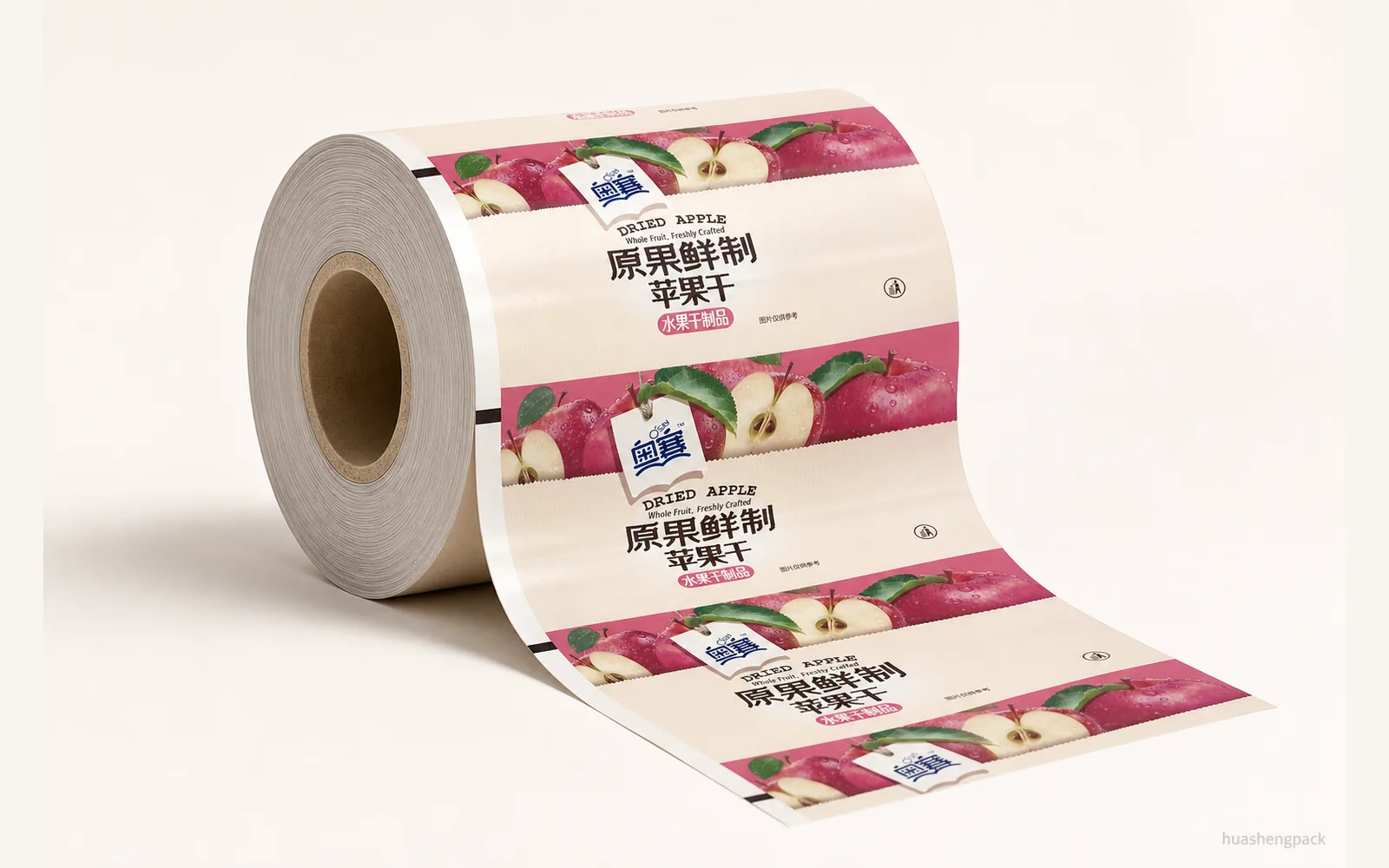
Calculate finished packs per kilogram of custom printed VFFS/HFFS rollstock film accurately: film basis weight (g/m²), web width × cut-off repeat math, density differences, and per-pack cost comparison.
Direct answer
Printed automatic rollstock film is almost always quoted by the kilogram (kg), yet brand managers and finance teams budget packaging cost per finished bag, sachet, or stick pack. Comparing two roll-film quotations solely on price-per-kilogram is one of the easiest ways to miscalculate real unit cost—because a slightly denser laminate (such as aluminum foil or thick PET) yields fewer square meters and fewer finished packs per kilogram than a lighter BOPP/CPP film. Here is the exact physical yield math our engineers use to translate kilograms of roll film into finished pouches.
Contents
Evidence-reviewed technical guide
Evidence-reviewed technical guide
2026-11-26 · Huasheng Packaging Technical Editorial Review
Evidence scope
Applies to B2B custom flexible packaging specification review for rollstock yield & cost math projects sourced from direct gravure converting plants.
Scope and limitations
General engineering bands and procurement guidelines do not replace filled-pack shelf-life testing, machine compatibility trials, or destination-market regulatory review.
Key takeaways
- Why Price per Kilogram Never Tells You True Cost per Finished Pack
- Step-by-Step Formula: Converting Roll Film Kilograms into Finished Packs
- Four Numbers to Send Us for a Side-by-Side Per-Kg and Per-Pack Estimate
Why Price per Kilogram Never Tells You True Cost per Finished Pack
Every polymer layer has a distinct material density: polypropylene (BOPP/CPP) sits near ~0.91 g/cm³, polyethylene (LDPE/LLDPE) near ~0.92 g/cm³, nylon (PA) near ~1.15 g/cm³, polyester (PET) near ~1.40 g/cm³, and aluminum foil (AL) near ~2.70 g/cm³. Because aluminum foil is nearly three times denser than BOPP, one kilogram of heavy PET/AL/PE foil rollstock covers significantly less surface area (m²/kg) than one kilogram of BOPP/VMCPP snack film of equal micron thickness. Always convert quoted price-per-kg into cost-per-1,000-packs using actual basis weight (grams per square meter, GSM) before comparing suppliers.
Four Yield Calculation Mistakes That Skew Packaging Budgets
First, using nominal film thickness alone without adding lamination adhesive and printed ink mass—solventless or dry-lamination adhesives and heavy full-bleed white/colored gravure inks add roughly 3–6 g/m² to real laminate GSM, slightly reducing theoretical packs per kilogram. Second, forgetting VFFS/HFFS setup and splice waste: high-speed automated lines consume film during reel threading, temperature stabilization, and changeover, so procurement teams typically budget a practical 3%–8% line-running allowance on top of pure mathematical yield. Third, confusing finished flat bag width with flat slit web width—a pillow bag 120 mm wide actually requires ~260–270 mm of flat rollstock web width once both faces plus the back fin-seal allowance are unfolded. Fourth, comparing a thinner, lower-barrier structure's higher yield against a true high-barrier laminate without checking shelf-life risk.
Step-by-Step Formula: Converting Roll Film Kilograms into Finished Packs
Calculate theoretical pack yield cleanly in three steps: Step 1 — Estimate Laminate Basis Weight (GSM, in g/m²): multiply each layer's thickness in microns (µm) by its typical density (g/cm³), then sum all layers plus ~4 g/m² for ink and lamination adhesive. Example: a typical BOPP 20 µm / VMCPP 25 µm snack film equals (20 × 0.91) + (25 × 0.91) + ~4 ≈ 45 g/m², giving roughly 22.2 m² per kg. By contrast, a typical PET 12 µm / AL 7 µm / PE 60 µm sachet film equals (12 × 1.40) + (7 × 2.70) + (60 × 0.92) + ~5 ≈ 96 g/m², giving roughly 10.4 m² per kg. Step 2 — Calculate Area per Single Pack (m²): multiply flat slit Web Width (in meters) by Cut-Off Repeat Length (in meters). Example: a 260 mm web (0.26 m) × 180 mm repeat (0.18 m) = 0.0468 m² per pack. Step 3 — Divide Square Meters per kg by Area per Pack: at 22.2 m²/kg ÷ 0.0468 m² = ~474 theoretical packs per kg (or ~440–455 net packs after practical line startup allowance). Divide your per-kg price by net packs per kg to get true cost per finished pack.
Keeping Actual Slit Width and Gauge Consistent With Quoted Yield
If a supplier delivers film 8% thicker than specified, your per-kg order yields 8% fewer finished bags—silently raising your real cost per pack even when the per-kg invoice looks identical. Inside Huasheng Packaging's ISO 22000:2018 Chaozhou facility, controlled incoming raw-film gauge checks, exact adhesive coat-weight monitoring, and tight slitting tolerances help align real delivered square-meter yield closely with your quoted structure.
Four Numbers to Send Us for a Side-by-Side Per-Kg and Per-Pack Estimate
Send four specifications with your roll-film RFQ and we will return both your per-kg quotation and an estimated finished-pack yield: (1) target flat slit web width (mm) and cut-off repeat length (mm), (2) desired laminate structure or product barrier need (e.g., BOPP/VMCPP, PET/VMPET/PE, or PET/AL/PE), (3) packing machine type (VFFS, HFFS, multi-lane stick-pack, or cup lidding) plus core ID (common 76 mm / 152 mm) and unwind chart, and (4) target order volume (in kg or estimated finished pack count per SKU).
Related Products
Related Applications
Related Packaging Guides
- Stock Sample vs. Digital Prototype vs. Unprinted Trial Pouch: Which Sample Should You Order?
- Flexible Packaging Micron Thickness Guide (80 µm to 150 µm+): Matching Gauge to Weight & Barrier
- Export Carton Weight, CBM Volume & Air vs. Sea Freight Break-Even for Custom Pouches and Roll Film
Claim-to-source evidence matrix
| Reviewed claim | Support | Sources | Boundary |
|---|---|---|---|
| Final flexible packaging specifications require confirming product chemistry, barrier needs, dimensions, and filling conditions before bulk production. | contextual | [1], [3] | Engineering review boundary prior to cylinder engraving or commercial conversion. |
| Seal integrity and laminate suitability should be verified on representative samples using actual product and sealing equipment. | direct | [2] | Quantitative seal testing and line trials supersede nominal film descriptions. |
| Huasheng Packaging operates integrated 9-color gravure printing, lamination, and pouch converting in Chaozhou under ISO 22000:2018 (007FSMS2300214). | direct | [3], [1] | Factory capability and active management-system scope; product-specific export compliance confirmed per order. |
Authoritative References
- ISO 22000:2018 Food safety management systems · International Organization for Standardization (ISO) · standard
Food-contact packaging production management relies on documented food-safety management controls and traceability. - ASTM F88/F88M-23 Standard Test Method for Seal Strength of Flexible Barrier Materials · ASTM International · standard
Flexible pouch and roll-film heat-seal performance should be verified quantitatively rather than assumed from film appearance. - Huasheng Packaging Chaozhou In-House Converting & Quality Control Overview · Huasheng Packaging · internal-evidence
Describes Chaozhou in-house 9-color gravure printing, lamination, slitting, pouch converting, and ISO 22000:2018 scope.
Frequently Asked Questions
Why does printed roll film get quoted in kilograms instead of pieces?
Rollstock is manufactured, laminated, and slit as continuous master webs measured by weight and linear length. Providing your exact web width and cut-off repeat length lets us convert kg pricing cleanly into an estimated finished-pack yield.
How does aluminum foil affect how many sachets I get per kilogram of roll film?
Aluminum foil has a density near 2.70 g/cm³ (roughly triple BOPP or PE), so foil laminates weigh more per square meter and yield fewer packs per kg than metallized VMPET or BOPP/CPP films—offset by much tighter oxygen, light, and moisture shielding.
How do I find my flat slit web width from a finished pillow bag?
Cut open a finished pillow bag cleanly along the back fin seal, lay the film completely flat, and measure from left cut edge to right cut edge (typically 2 × bag width + 20–30 mm fin-seal allowance).
Should I add a waste buffer when ordering roll film by finished pack targets?
Yes. High-speed VFFS and HFFS lines use film during threading, registration setup, and reel changeovers—most plant managers add a practical 3%–8% operational allowance above theoretical yield depending on run length.
Can Huasheng Packaging confirm estimated packs per roll before we order?
Yes. Share your slit web width, repeat length, core ID, maximum reel OD or max roll weight, and target laminate structure so we estimate linear meters and finished packs per reel alongside your quotation.

About Huasheng
In-house 9-color gravure printing, solventless lamination, slitting, and pouch converting across stand up pouches, spout pouches, retort bags, coffee bags, and automatic rollstock film.
A legacy of quality in flexible packaging since 1997.
1997 · 6,880 m²
Chaozhou · Guangdong · China
Longshewei, Neipan Management District, Dongfeng Town, Chao'an District, Chaozhou City, Guangdong Province, China