Beef Jerky and Meat Snack Packaging: Stock Pouch vs Custom Printed for Startup Brands
Huasheng Packaging Technical Content Review · Published:
 Stock pouch and custom printed pouch options for meat snack brands.
Compare stock pouches with labels and custom printed pouches for beef jerky and meat snack packaging, including barrier material, startup launch strategy and quotation checklist.
Direct answer
Beef jerky and meat snack brands face a specific packaging challenge: the product needs strong moisture and oxygen barrier protection, but startup brands often work with smaller launch quantities where custom printed packaging MOQ can feel out of reach. This guide compares two practical paths — stock pouch with label and custom printed pouch — so you can choose the right approach for your brand stage, budget and growth plan.
Evidence-reviewed technical guide
2026-08-21 · Huasheng Packaging Technical Content Review
Evidence scope
Jerky process boundary, intended use, condition-specific barrier evidence and finished-pouch seal validation.
Scope and limitations
No source selects one laminate, predicts shelf life or approves the jerky process for a specific product.
Key takeaways
- Packaging cannot replace validated jerky product and process controls.
- Barrier data require a named specimen and conditions.
- The converted filled pouch needs project-specific release evidence.
Why Beef Jerky Packaging Is Different from Ordinary Snack Packaging
Beef jerky and dried meat snacks are not the same as dry snacks like chips or biscuits. The product contains residual moisture, oil and protein that require careful packaging consideration.
Key packaging requirements for jerky and meat snacks:
- Moisture control: Jerky has a specific water activity level. If the pouch barrier is insufficient, external moisture can enter and affect texture or shelf stability.
- Oxygen barrier: Exposure to oxygen can cause fat oxidation, affecting flavor and product quality over time.
- Grease resistance: The inner sealing layer must resist oil penetration from the product. Standard PE sealing layers work for many jerky products, but the structure should be confirmed based on actual oil content.
- Seal integrity: A strong, consistent seal is critical. Leakers mean product returns and brand damage.
- Puncture resistance: Dried meat pieces can have sharp edges. The pouch material needs adequate puncture resistance to survive handling, transport and retail display.
- Optional nitrogen flush: Some jerky brands use nitrogen flushing to displace oxygen in the headspace. This requires good seal integrity and barrier performance to retain the modified atmosphere.
Important note on shelf life: Packaging material can support moisture and oxygen barrier performance, but final shelf life should be validated by the brand or food producer based on product formula, water activity, processing conditions, packaging structure and storage environment. No packaging supplier can guarantee a specific shelf life without product-specific validation.
Option 1 — Stock Pouch with Custom Printed Label
Stock pouches are pre-made, ready-to-use pouches in common sizes, materials and colors. You apply your own custom printed label or sticker for branding.
When this option works well:
- First product launch or market testing: You can avoid committing to a large production run before demand is known.
- Small initial quantity: If your first batch is a few thousand units, stock pouches avoid the MOQ and cylinder cost of custom printing.
- Design still evolving: Your brand design may change after market feedback. Stock pouches let you iterate labels without re-making printing cylinders.
- Availability and planning: Existing stock can simplify launch planning, but the exact size, structure, quantity and dispatch arrangement must be confirmed with the supplier.
Limitations to consider:
- Brand presentation: A label on a stock pouch will not look as unified as a fully custom printed pouch. The label edge, adhesive appearance under different temperatures, and overall shelf impact differ from custom printing.
- Size and material constraints: Stock pouches come in limited size and material combinations. You choose from what is available, not what is optimal for your product.
- Label application consistency: Manual or semi-automatic label application can vary in position and adhesion quality. At higher volumes, this becomes a production bottleneck.
- Premium perception: If your jerky is positioned as a premium brand, a stock pouch with label may not convey the quality level your pricing suggests.
Who this option is best for: Startup brands launching their first SKU, brands testing a new market or flavor, and brands with very small batch production that can use an available stock specification.
Option 2 — Custom Printed Pouch
Custom printed pouches are manufactured specifically for your brand, with your design printed directly onto the packaging film using rotogravure printing.
When this option works well:
- Brand design is finalized: Your logo, colors, and packaging layout are locked in and unlikely to change for at least several production runs.
- Order quantity is established: You have predictable order volumes that meet the MOQ for custom printed pouches. MOQ depends on pouch size, material structure, printing colors and production planning.
- Retail shelf presence matters: Your product competes on crowded retail shelves or online marketplaces where packaging is a key purchase driver.
- Consistent brand experience: Every pouch looks identical, with no label positioning variation, no peeling edges, and professional finish.
- Repeat orders are expected: The cylinder cost (one-time setup) is amortized over multiple production runs, reducing per-unit cost over time.
What to know before committing:
- Cylinder cost / printing plate fee: Custom rotogravure printing requires engraved cylinders — one per color. This is a one-time setup cost. See our cylinder cost guide for details.
- MOQ requirements: Custom printed pouches have minimum order quantities. These vary by pouch type, size, material and printing complexity. Discuss your target quantity with the supplier early.
- Production planning: Confirm the current material, cylinder, artwork-approval and production schedule before setting an inventory or launch date.
- Artwork preparation: You need print-ready artwork files (AI, PDF, PSD or CDR format, CMYK color mode, 300 dpi minimum). The supplier can help review file suitability.
Who this option is best for: Established brands with confirmed packaging design, brands with consistent order volumes meeting MOQ, brands selling through retail or marketplace channels, and brands ready to invest in professional packaging for long-term growth.
Material Structure Considerations for Beef Jerky and Meat Snacks
Do not select jerky packaging from a fixed material menu. Compare exact candidate constructions against the product condition, intended use, oxygen and moisture objectives, puncture exposure, closure, distribution and validation plan. Record every layer and grade, food-contact side, nominal thickness, adhesive or coating route and test specimen. Barrier values must state method and conditions. Seal-strip strength, flat-film barrier data and a visually similar stock pouch answer different questions and do not establish finished-pack shelf life.
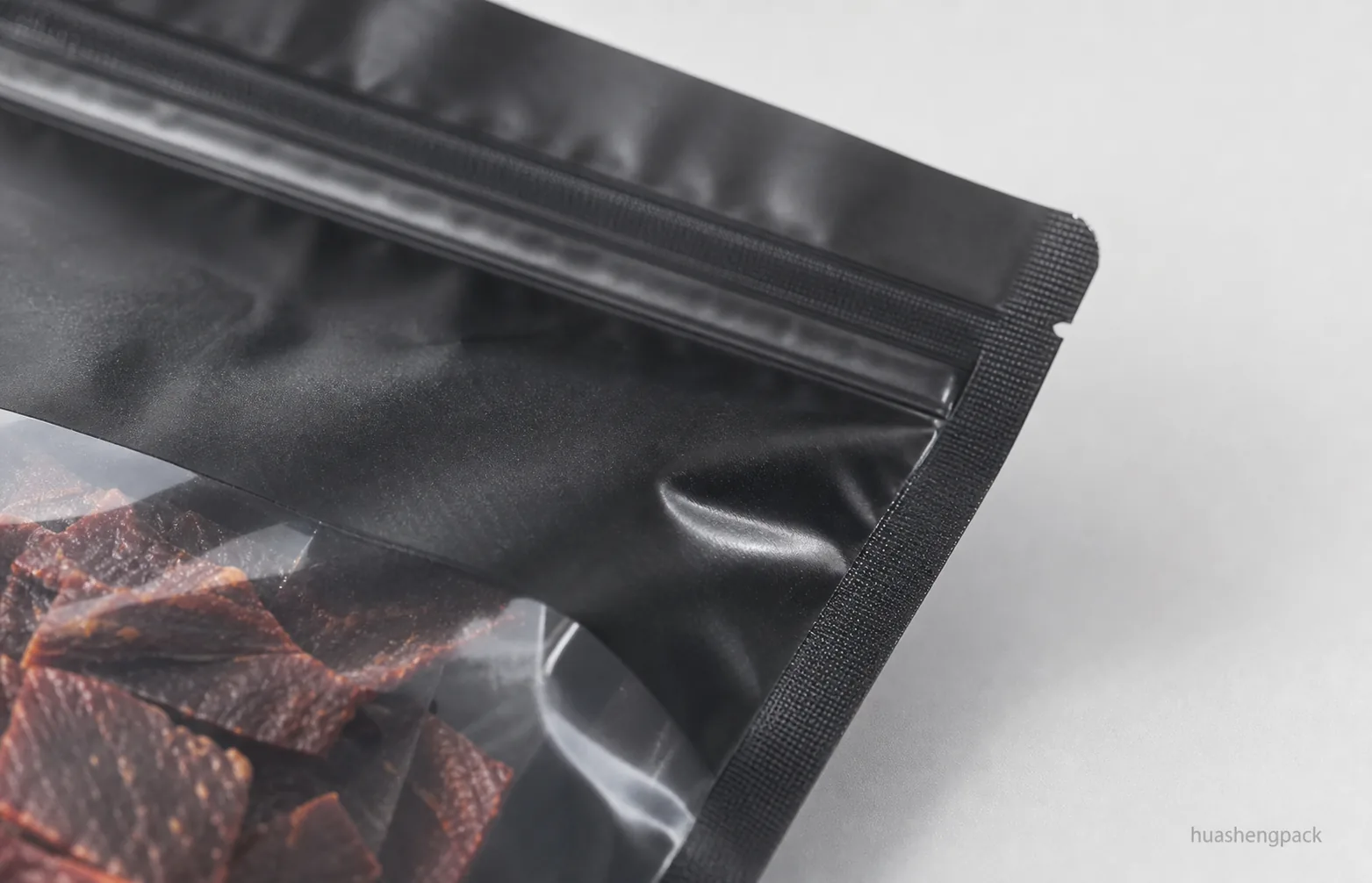 Meat snack pouch structure, seals and product visibility should be validated against the intended shelf-life conditions.
What Startup Brands Should Prepare Before Requesting a Packaging Quotation
Prepare the jerky process owner, product form and condition at packing, fill weight and piece geometry, oil or sharp-edge exposure, closure and opening needs, storage and distribution, target market, pouch drawing, quantities by artwork and shelf-life protocol. Mark unknown fields for review instead of choosing a structure from appearance. Submit any current packaging, controlled product sample and existing test evidence under the appropriate confidentiality process.
Make the stock-versus-custom decision from the product and release evidence, not from a generic laminate menu. Record the jerky formulation and process owner, product condition at packing, fill weight and shape, sharp-edge or puncture exposure, oxygen and moisture objectives, closure needs, storage and distribution conditions, target market and the shelf-life protocol. USDA process guidance makes clear that jerky safety and shelf stability depend on validated product and process controls; the pouch supplier must not turn a packaging discussion into a food-process approval.
For each candidate, compare the exact converted pouch rather than a material family name. Tie OTR and WVTR values to the named specimen and test conditions, review every food-contact component for the intended use, and test seals and filled packs with representative product. A flat-film barrier report, a stock-pouch catalogue description or a strong seal strip cannot by itself establish finished-pack integrity or shelf life. The action is to approve a versioned pouch specification and record which product, process and distribution conditions it covers.
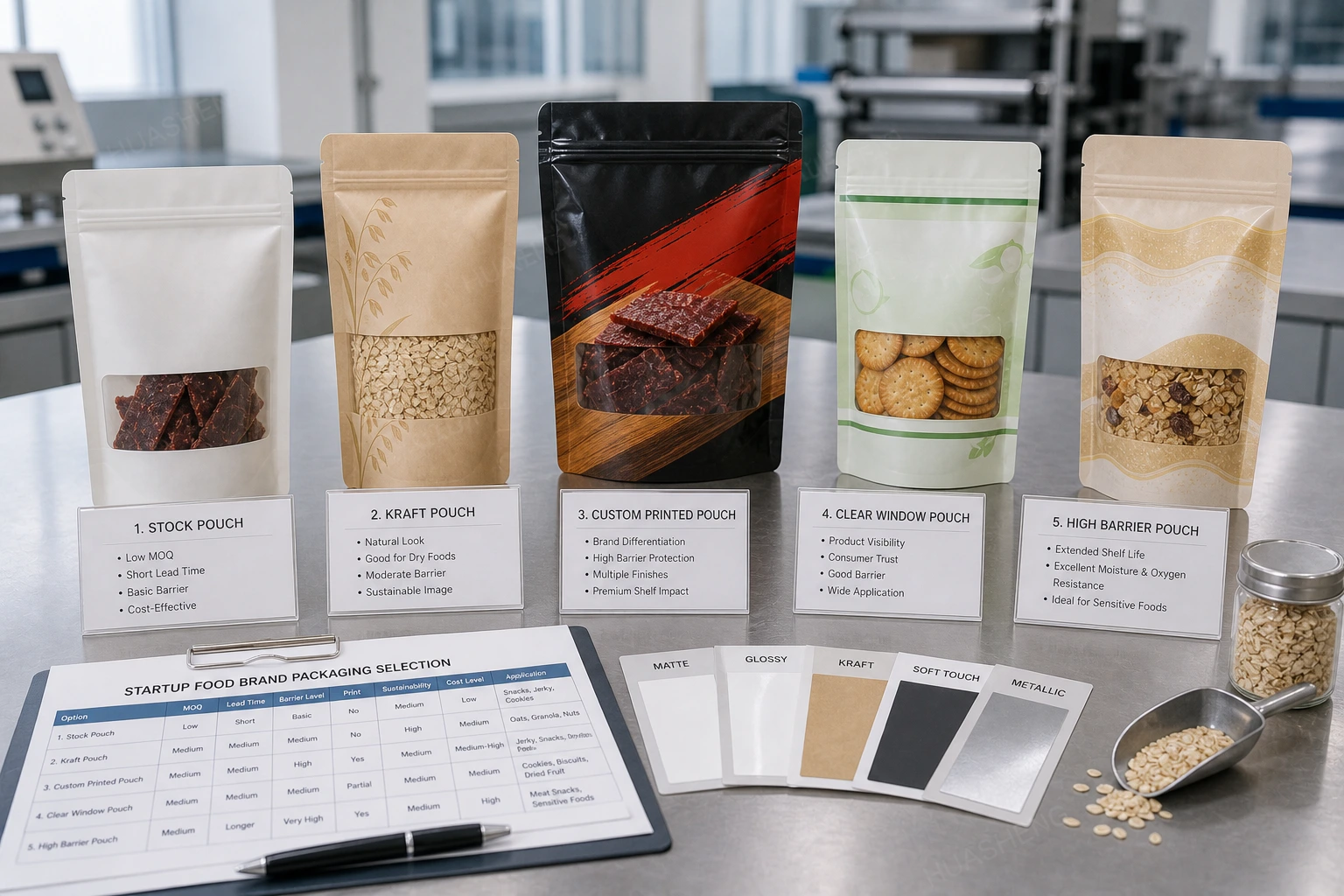 Startup brands should prepare pouch size, quantity, artwork and barrier requirements.
Related Products
Related Packaging Guides
Claim-to-source evidence matrix
| Reviewed claim | Support | Sources | Boundary |
|---|
| Jerky safety and shelf stability depend on validated product and process controls. | direct | [1] | This is not a packaging-material approval or a shelf-life value. |
| Food type and time-temperature conditions belong in food-contact intended-use review. | direct | [2] | The source does not select a pouch structure. |
| OTR and WVTR comparisons require the named specimen and test conditions. | direct | [3], [4] | Flat-film values do not establish finished-package shelf life. |
| Seal-strip strength is a method-specific output with failure-mode context. | direct | [5] | It does not prove whole-package integrity. |
JSON · CSV
Authoritative References
- Compliance Guideline for Meat and Poultry Jerky · USDA Food Safety and Inspection Service · government
Jerky safety and shelf stability depend on validated product and process controls - Food Types and Conditions of Use for Food Contact Substances · U.S. Food and Drug Administration · government
Food type and time-temperature conditions belong in intended-use review - ASTM D3985-24: Oxygen Gas Transmission Rate · ASTM International · standard
OTR belongs to the named specimen, method and conditions - ASTM F1249-25: Water Vapor Transmission Rate · ASTM International · standard
WVTR requires the specimen and environmental conditions to be stated - ASTM F88/F88M-23: Seal Strength of Flexible Barrier Materials · ASTM International · standard
Seal-strip strength is a method-specific output with failure-mode context
Frequently Asked Questions
What type of packaging is suitable for beef jerky?
Stand up zipper pouches and flat bottom pouches are common choices for beef jerky. They provide resealable convenience, good shelf display, and can be made with barrier materials (PET/VMPET/PE, PET/AL/PE, Kraft/VMPET/PE) depending on moisture and oxygen protection needs. Three side seal pouches are also used for smaller portion packs.
Is stock pouch with label suitable for launching a first food product?
Yes, stock pouches with custom labels are a practical option for first launches. They avoid cylinder setup cost and may support a smaller initial quantity when a suitable specification is available. The trade-off is less unified branding compared with custom printed pouches. Confirm current inventory and dispatch terms rather than assuming a fixed schedule.
When should a startup switch from stock pouch to custom printed pouches?
Consider switching when: your design is finalized and stable, order quantities consistently meet MOQ, you are selling through retail or marketplace channels where packaging quality directly impacts purchase decisions, and unit economics can support the initial cylinder investment. There is no single "right time" — it depends on your brand stage and growth trajectory.
What material structure is suitable for meat snack packaging?
Common structures include PET/PE for basic dry jerky, PET/VMPET/PE for improved moisture and light barrier, PET/AL/PE for higher barrier needs (not transparent), and Kraft/VMPET/PE for a natural paper look with barrier. The final structure should be confirmed based on product oil content, moisture level, oxygen sensitivity and shelf life target.
Can beef jerky packaging include a zipper and tear notch?
Yes. Stand up pouches and flat bottom pouches can include a resealable zipper for consumer convenience after opening. A laser-scored or mechanically cut tear notch above the zipper makes opening easy. Both features are standard options for jerky packaging.
Can packaging guarantee 12-month shelf life for beef jerky?
Packaging material can support moisture and oxygen barrier performance, but final shelf life must be validated through actual product testing. Key factors include: product water activity, formulation (preservatives, antioxidants), processing method, filling atmosphere (nitrogen flush or not), packaging barrier level, seal integrity, and storage/distribution conditions. No packaging supplier can guarantee a specific shelf life claim without product-specific shelf life testing.
What information is needed for a beef jerky pouch quotation?
Provide: product type and characteristics (moisture, oil content), filling weight, target shelf life (for material guidance), packaging method (nitrogen flush, oxygen absorber, etc.), pouch type and size, quantity, branding preference (stock vs custom), artwork status, color count, accessories (zipper, tear notch, window), surface finish, and destination market. Sample photos are very helpful.