How to Choose Food Packaging Materials for Custom Flexible Packaging
Huasheng Packaging Technical Content Review · Published: · Updated:
 Food packaging material selection for custom pouches and roll film.
Learn how to choose food packaging materials based on product type, shelf life, barrier needs, sealing method and production requirements.
Introduction: Material Structure Decides Packaging Performance
Choosing the right food packaging material affects shelf life, sealing strength, product appearance, machine compatibility and overall packaging cost. Flexible packaging is almost always a laminated structure — multiple layers bonded together, each serving a different function. There is no single 'best' material for all food products.
This guide explains common material layers, what each layer does, typical laminated structures and how to think about material selection based on your product type, shelf-life target, barrier needs and packing process. Huasheng Packaging can help review suitable material options, but the final structure should be confirmed based on your specific product, testing and production requirements.
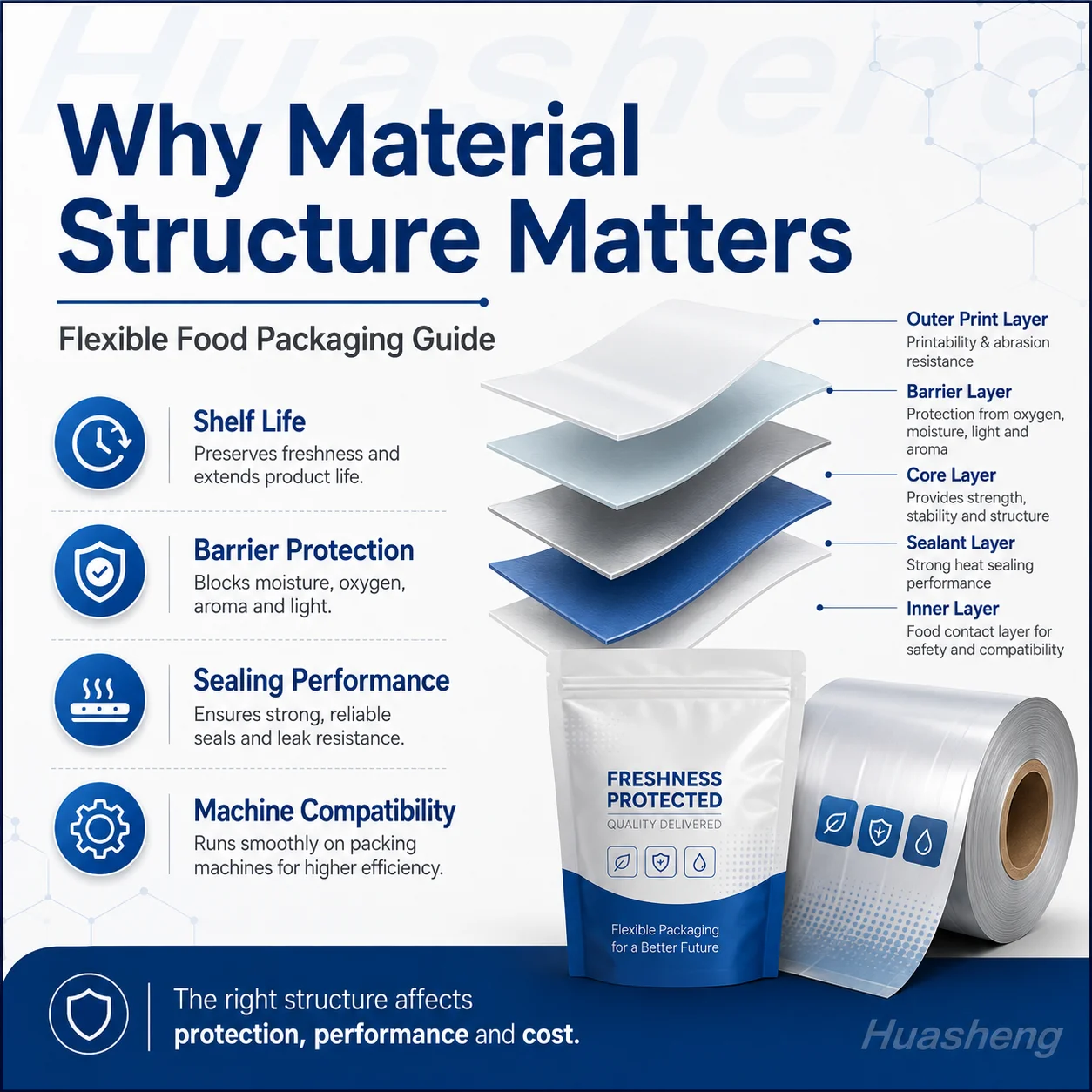
 Material structure affects shelf life, barrier protection, sealing performance and machine compatibility.
What Is a Laminated Material Structure?
Laminated flexible packaging combines multiple layers — typically a printing layer, a barrier layer and a sealing layer — into one film or pouch. Each layer has a specific function. The outer layer provides print surface and stiffness, the middle layer provides barrier (oxygen, moisture, light), and the inner layer provides heat sealing and food contact safety.
Common laminated structures include: PET/PE (general dry food and powder packaging), BOPP/CPP (lightweight snack and flow pack applications), PET/VMPET/PE (improved moisture and light barrier with metallic appearance), PET/AL/PE (strong oxygen, aroma, moisture and light barrier), PA/PE or PET/NY/PE (puncture resistance and flexibility), and PET/AL/RCPP or PA/AL/RCPP (retort-grade for high-temperature sterilization).
These are common starting points for evaluation, not fixed solutions. The final structure should be confirmed according to product type, filling weight, shelf-life target, storage condition, packing process and destination market requirements.
Common Material Layers and Their Functions
Understanding what each layer does helps you communicate more effectively with your packaging supplier.
PET (Polyester) — Outer/printing layer. Provides stiffness, dimensional stability and good print surface. Common in many laminated structures.
BOPP (Biaxially Oriented Polypropylene) — Outer/printing layer. Good clarity, lightweight, good machinability on automatic packing lines. Common in snack and biscuit flow pack.
PE (Polyethylene) — Inner/sealing layer. Provides heat sealing and flexibility. Food-grade PE is selected for direct food contact. Different PE grades exist for different sealing temperature ranges.
CPP (Cast Polypropylene) — Inner/sealing layer. Higher heat resistance than PE in some applications. Used in some food packaging where higher sealing temperature is needed.
RCPP (Retort Cast Polypropylene) — Inner/sealing layer for retort pouches. Designed to withstand high-temperature sterilization (typically 121°C to 135°C depending on structure and conditions).
VMPET (Vacuum Metallized PET) — Middle/barrier layer. PET with a thin metal coating. Provides improved light and moisture barrier with metallic appearance. Not the same as aluminum foil — do not overclaim barrier performance.
Aluminum Foil (AL) — Middle/barrier layer. Provides the strongest oxygen, aroma, moisture and light barrier among common flexible packaging materials. Used in coffee, high-barrier and long shelf-life packaging. Adds cost and reduces flexibility.
PA/Nylon — Middle/stiffness layer. Provides puncture resistance, toughness and flexibility. Common in frozen food, liquid, sauce and heavy product packaging. PA can absorb moisture; confirm storage conditions before converting.
Kraft Paper — Outer/appearance layer. Gives a natural paper look. Must be laminated with plastic/barrier layers for food packaging — not used alone. Common in coffee, tea and organic food packaging.
PET/PE: General Food Packaging Structure
PET/PE is one of the most common starting structures for dry food, powder, snacks and general food packaging. PET provides good print surface and stiffness. PE provides heat sealing and flexibility.
This structure offers basic moisture protection and is cost-effective for standard shelf-life products. However, PET/PE alone may not provide enough barrier for products that need strong oxygen, aroma or light protection, or for products requiring extended shelf life beyond 6–9 months.
When PET/PE is not enough, structures like PET/VMPET/PE or PET/AL/PE can be considered.
BOPP/CPP: Lightweight Snack and Flow Pack Structure
BOPP/CPP is commonly used for lightweight snack, biscuit, candy and flow pack applications. BOPP provides good clarity and stiffness. CPP provides heat sealing.
This structure offers good machinability on horizontal flow pack and VFFS lines. It is often selected when clarity, cost and machine speed are priorities. BOPP/CPP may not be suitable for products needing strong oxygen or moisture barrier — confirm shelf-life requirements before selecting this structure.
PET/VMPET/PE: Better Light and Moisture Barrier
PET/VMPET/PE adds a metallized PET layer between the outer PET and inner PE. The VMPET layer improves light barrier and moisture barrier compared to PET/PE, and gives the packaging a metallic appearance without the full cost of aluminum foil.
Common applications include snacks, coffee, powder, dry food and some pet food packaging where improved moisture protection or metallic shelf appearance is valued. Note: VMPET provides improved barrier but is not equivalent to aluminum foil. For products needing maximum oxygen or aroma barrier, PET/AL/PE should be evaluated.
PET/AL/PE: High Barrier Structure
PET/AL/PE includes an aluminum foil layer that provides strong oxygen, aroma, moisture and light barrier. This structure is commonly considered for coffee (whole bean and ground), sensitive powder products, high-fat snacks and products requiring 12+ month shelf life.
Aluminum foil adds cost and reduces pouch flexibility. The foil thickness should be selected based on the required barrier level and expected handling. Thinner foil may develop pinholes under repeated flexing — confirm foil specifications with your supplier based on your product and distribution conditions.
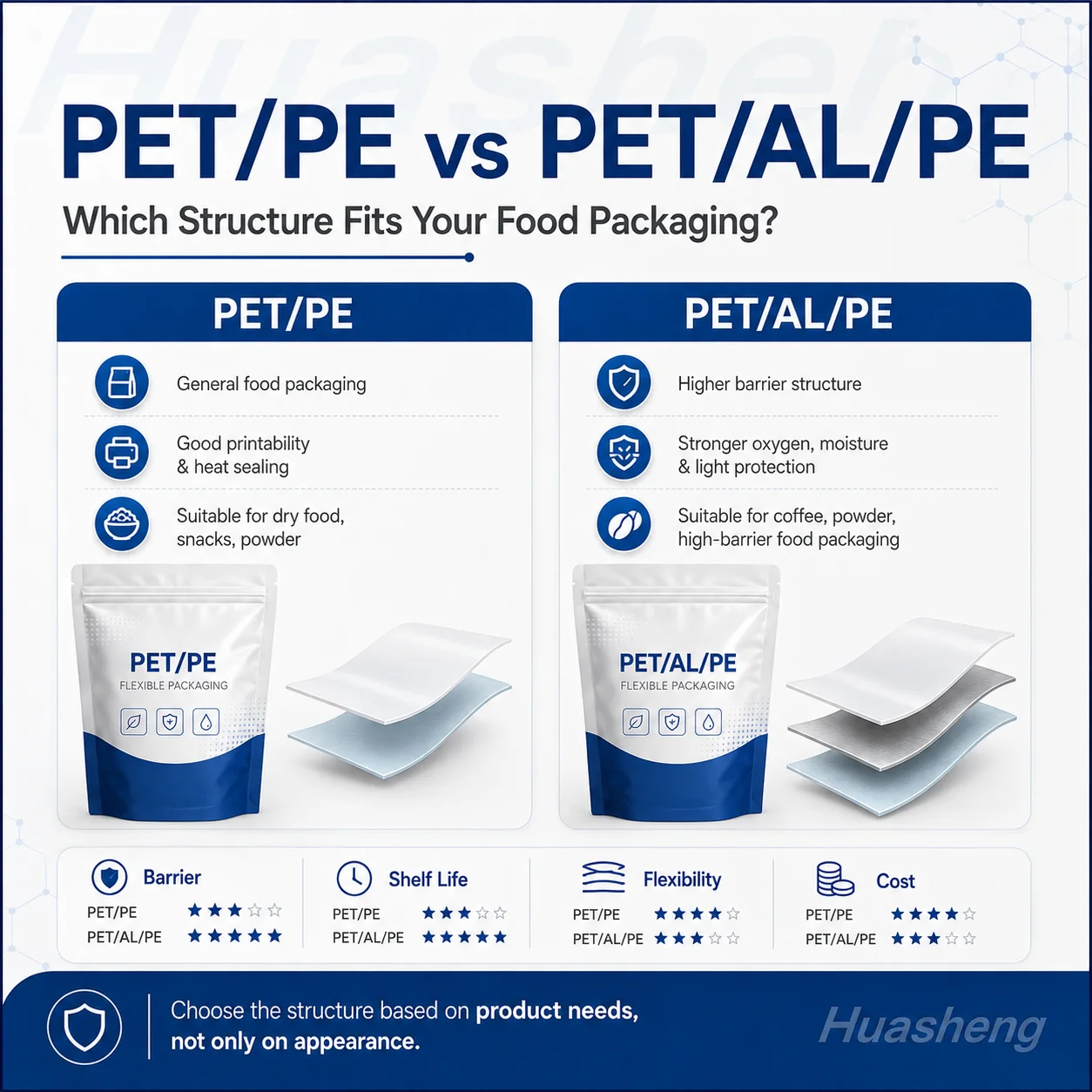 PET/PE and PET/AL/PE may look similar, but their barrier performance and cost logic can be very different.
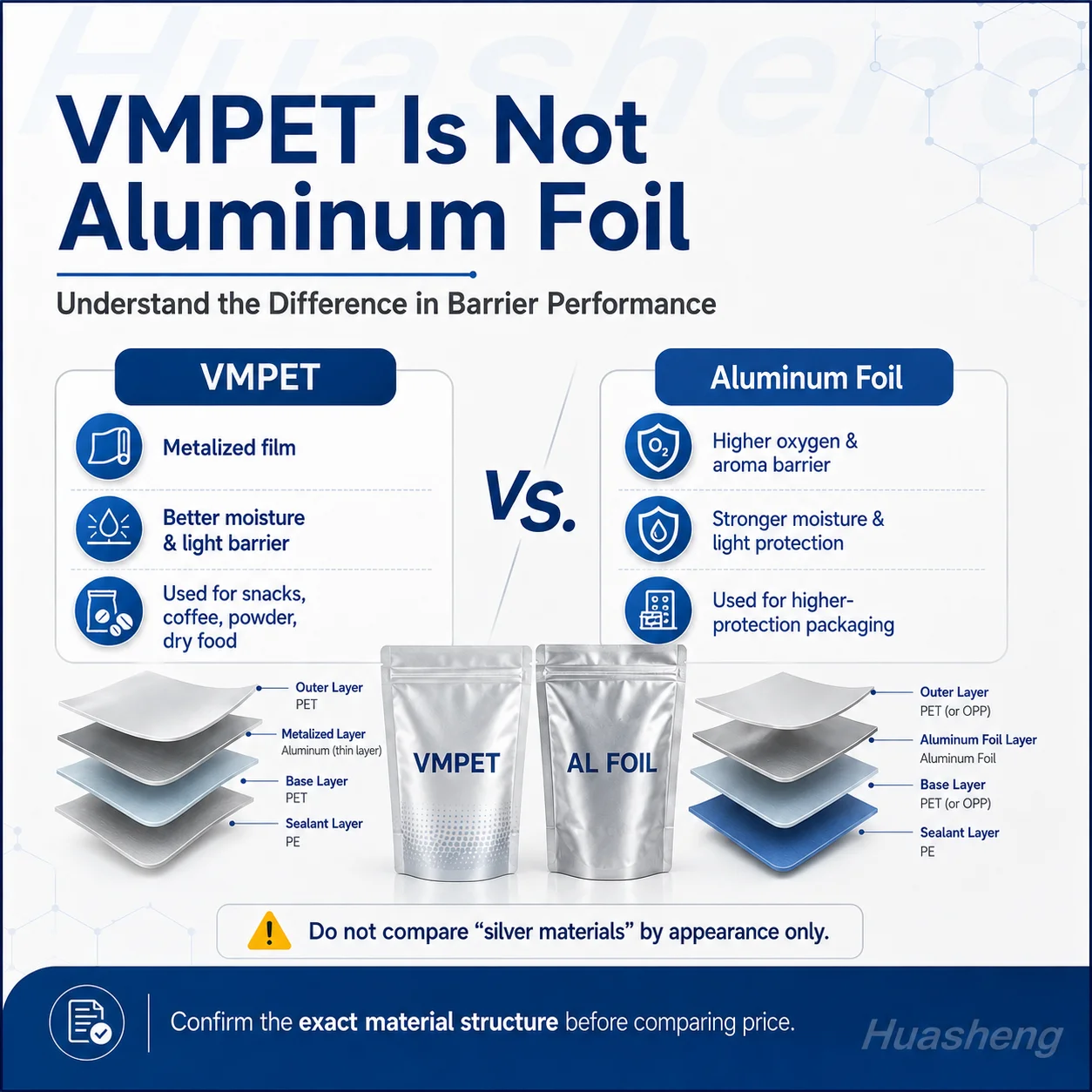 VMPET is not the same as aluminum foil. Buyers should confirm the exact material structure before comparing price.
PA/PE or Nylon-Based Structures
PA (Nylon) layers are added when the packaging needs better puncture resistance, toughness and flexibility. PA/PE or PET/NY/PE structures can help when the product has sharp edges (frozen food, dry pet food), is heavy (larger pouch formats), or needs cold-temperature performance (frozen storage and transport).
PA can absorb moisture from the air, which may affect the lamination process. Storage and converting conditions should be confirmed with the supplier.
Nylon-based structures are not automatically needed for every product — they should be evaluated when the product weight, shape, handling or storage conditions create a puncture or flexibility requirement.
RCPP and Retort Material Structures
RCPP (Retort Cast Polypropylene) is a specialized sealing layer designed for retort pouches that undergo high-temperature sterilization. Retort pouch structures may include PET/AL/RCPP, PA/AL/RCPP or PET/PA/RCPP, depending on the sterilization temperature, time, food type, oil and acidity level, and filling weight.
Not all pouches can withstand retort conditions. Standard PE sealing layers are not suitable for retort processing. The retort structure must be selected and tested for each specific application. Do not assume a pouch rated for 121°C will work at 135°C without confirmation — temperature, time and food characteristics all matter.
Kraft Paper Laminated Structures
Kraft paper provides a natural, organic or artisanal appearance for food packaging, but kraft paper alone is not a food packaging material. It must be laminated with inner plastic and barrier layers.
Common kraft paper laminated structures include Kraft/PE (basic moisture protection with paper look), Kraft/VMPET/PE (improved barrier with metallic layer behind kraft paper), and Kraft/AL/PE (high barrier with aluminum foil behind kraft paper). Kraft paper coffee bags, tea pouches and snack packaging are common applications.
The barrier performance of a kraft paper bag comes from the inner laminated layers, not the paper itself. A kraft paper bag with only PE inside may have much lower barrier than one with aluminum foil — buyers should confirm the full structure, not just the exterior appearance.
Material Selection by Product Type
The table below shows common material directions for different food products. These are starting points for discussion, not fixed rules. Final confirmation depends on your specific product, shelf life, packing process and market requirements.
Snacks and chips — PET/VMPET/PE or BOPP/CPP. Key concern: moisture barrier and crispness retention.
Biscuits and cookies — BOPP/CPP or PET/PE. Key concern: sealing stability and machinability on flow pack lines.
Candy and jelly — PET/PE or PET/VMPET/PE. Key concern: sealing strength for liquid or gel products.
Coffee beans and ground coffee — PET/AL/PE or Kraft/AL/PE. Key concern: aroma and oxygen barrier.
Powder and seasoning — PET/PE or PET/AL/PE. Key concern: moisture barrier and powder leakage at seal area.
Sauce and liquid — PET/AL/PE or PA/PE. Key concern: sealing integrity and inner layer compatibility with oil and acidity.
Frozen food — PA/PE or PET/PE. Key concern: cold-temperature flexibility and puncture resistance.
Retort ready meals — PET/AL/RCPP or PA/AL/RCPP. Key concern: sterilization temperature, time and seal integrity under retort conditions.
Pet food — PET/VMPET/PE or PET/AL/PE. Key concern: puncture resistance, odor barrier and zipper durability.
Bakery and bread — BOPP/CPP or PET/PE. Key concern: freshness retention and optional window design.
Barrier Requirements: Moisture, Oxygen, Aroma and Light
Different products need different types of barrier protection. Understanding which barriers matter for your product helps you discuss material options more effectively.
Moisture barrier — important for snacks, biscuits, powder, dried food. Moisture ingress can make products soft, clumpy or spoiled. PET/VMPET/PE or PET/AL/PE may be considered.
Oxygen barrier — important for coffee, nuts, high-fat snacks, nutritional products. Oxygen exposure causes oxidation, rancidity and flavor loss. PET/AL/PE provides strong oxygen barrier.
Aroma barrier — important for coffee, tea, spices, flavored products. Aroma loss reduces product quality and consumer experience. Aluminum foil provides strong aroma barrier.
Light barrier — important for light-sensitive food, products with natural colors, or products displayed in bright retail environments. VMPET or aluminum foil can provide light barrier.
Puncture resistance — important for pet food, frozen food, products with sharp edges or heavy weight. PA/Nylon layers may be considered.
Heat resistance — important for retort and hot-fill products. RCPP sealing layer and retort-grade adhesives are needed.
Machine Compatibility and Sealing Layer
Material selection is not only about barrier performance — the material must also run smoothly on your packing machine. For roll film, confirm: roll width, repeat length, sealing layer activation temperature, eye mark position, film tension and coefficient of friction (COF), roll direction and core size. For premade pouches, confirm: pouch size, sealing width, zipper type, spout or cap specifications, filling opening and machine gripper compatibility.
A material structure that works well on one machine may not work on another if the sealing temperature, film tension or forming specifications are different. Share your packing machine brand, model and specification sheet during quotation so compatibility can be reviewed.
The sealing layer must match both the product (food contact, chemical resistance) and the machine (sealing temperature range, dwell time, pressure). PE, CPP and RCPP have different sealing characteristics and are not interchangeable without confirmation.
Common Mistakes Buyers Should Avoid
- Choosing material only by unit price without comparing structure — the same structure name may mean different specifications across suppliers
- Comparing thickness without comparing material composition — a thicker PET/PE pouch may have lower barrier than a thinner PET/AL/PE pouch
- Treating VMPET as equivalent to aluminum foil — VMPET provides improved barrier but is not the same as aluminum foil
- Ignoring sealing layer compatibility — the sealing layer must match both the product and the packing machine
- Choosing high-barrier structure when the product does not need it — adds unnecessary cost without benefit
- Forgetting to confirm machine compatibility — a material that tests well in the lab may not run smoothly on your specific packing line
- Skipping sample testing with actual product before bulk production — especially important for liquid, sauce, retort and high-barrier applications
- Using one material structure for all product lines — different products need different barrier, sealing and stiffness
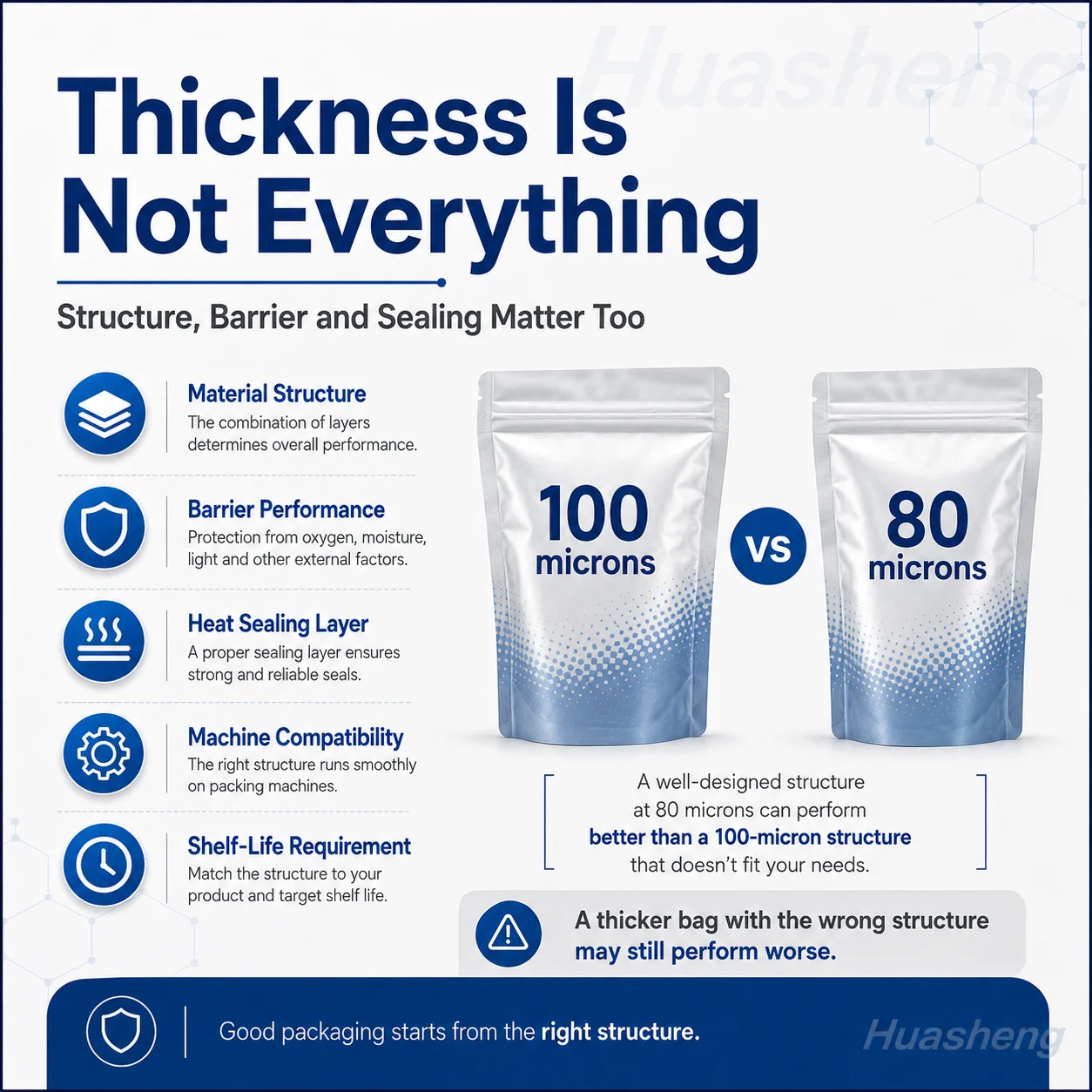 Thickness is only one factor. Structure, barrier, sealing layer and machine compatibility also affect packaging performance.
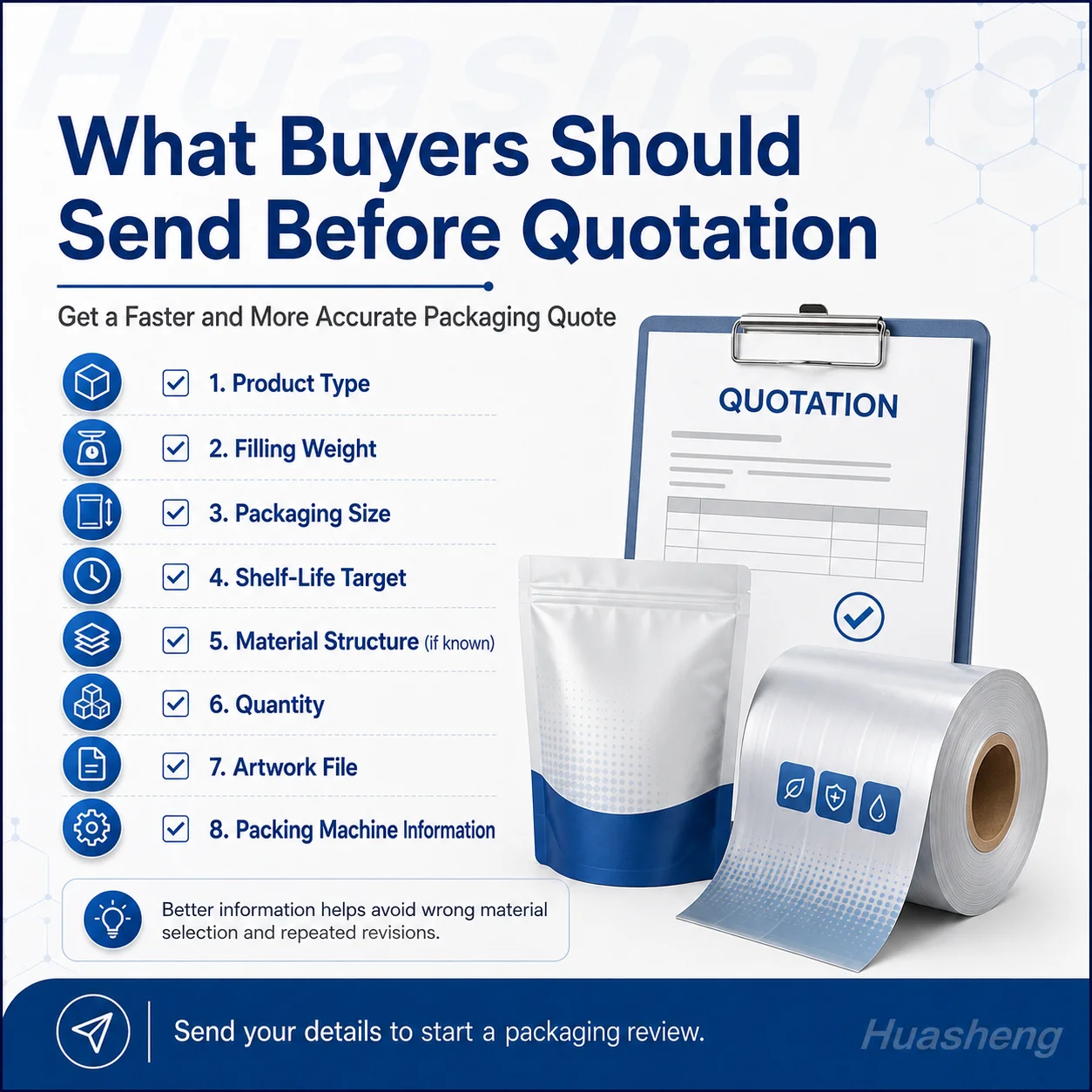
What to Prepare Before Material Recommendation
Providing complete information helps us recommend the most suitable material structure for your product and application.
- Product type and description (dry, oily, liquid, frozen, retort)
- Filling weight (grams or ml per pack)
- Shelf-life target (how many months at what storage temperature)
- Storage and transport conditions
- Preferred packaging type (roll film / stand up pouch / flat bottom / spout / retort)
- Target pouch size or roll film width
- Material structure if known
- Thickness if known
- Order quantity
- Number of printing colors
- Artwork file availability
- Packing machine type and model (for roll film orders)
- Target market (affects material compliance requirements)
- Sample photo or reference image if available
 Clear product and packaging information helps suppliers recommend a more suitable material structure and quotation.
Related Products
Related Packaging Guides
Frequently Asked Questions
How do I choose the right food packaging material?
The material should be selected based on product type, shelf life, barrier requirement, filling weight, storage condition, packing machine and target market. There is no single best material for all products.
What is the difference between PET/PE and PET/AL/PE?
PET/PE is commonly used for general food packaging with basic moisture protection. PET/AL/PE provides stronger light, oxygen and moisture barrier for products that need higher protection such as coffee, sensitive powders or longer shelf-life products.
When should I use VMPET or aluminum foil?
VMPET provides improved light and moisture barrier with metallic appearance. Aluminum foil provides stronger oxygen, aroma, moisture and light barrier. VMPET and aluminum foil are not the same — the right choice depends on your product's sensitivity and required shelf life.
Can one material structure fit all food products?
No. Different products such as snacks, powder, sauce, coffee and retort food may require different material structures and sealing layers. Each structure must be selected based on the specific product characteristics.
What should I provide if I do not know the material structure?
You can send product type, filling weight, shelf life target, storage condition, packaging size, quantity and sample photo if available. Our team can review suitable options based on your specific product requirements.
Is thicker packaging always better?
Not always. Thickness is only one factor. Material structure, sealing layer type, barrier performance, stiffness and machine compatibility all affect packaging performance. A thinner high-barrier structure may protect the product better than a thicker basic structure.