ISO 22000 and Flexible Packaging Quality Control: Evidence Buyers Should Check
Huasheng Packaging Technical Content Review · Published: · Updated:
 Quality controls should connect incoming materials, in-process checks and finished packaging release.
Understand what ISO 22000 supports, what it does not prove, and how to review material, process, traceability and finished-pack evidence.
Direct answer
ISO 22000 is management-system evidence, not blanket approval for every film, ink, adhesive or finished pouch. A useful buyer review connects the certificate scope with intended-use documents, controlled material specifications, process records and package-performance validation. This guide separates those evidence layers so a project is not approved on one document alone.
Evidence-reviewed technical guide
2026-08-12 · Huasheng Packaging Technical Content Review
Evidence scope
Buyer interpretation of ISO 22000 and ISO 22002-4, document-to-object mapping, traceability and the boundary between laboratory screening and production validation.
Scope and limitations
The guide does not certify a package or replace destination-market review. Test methods and acceptance criteria remain project-specific.
Key takeaways
- ISO 22000 is management-system evidence, not blanket product approval.
- Each document must identify the object and intended-use boundary it supports.
- Laboratory results and production validation should remain separate evidence layers.
Separate Management-System Evidence from Product Evidence
ISO 22000 establishes requirements for a food-safety management system across organizations in the food chain. ISO 22002-4 addresses prerequisite programmes for food-packaging manufacturing. These sources support assessment of systematic controls, but they do not establish the food-contact status, barrier result, sealing window or shelf life of every package.
Start by checking the legal entity, site, activity scope, issue and validity information on the applicable certificate. Then build a separate project file for the exact films, inks, adhesives, coatings and accessories. A certificate whose scope covers packaging manufacture still does not replace the intended-use assessment for the proposed package.
Avoid the One-Document Approval Error
Common errors include treating ISO 22000 as a product certificate, extending one migration or restriction report to a different laminate, and accepting a material name without grade or supplier traceability. The same mistake occurs when an empty-bag result is used to claim filled-package performance.
For each document, record what object it covers: management system, raw film, ink, adhesive, laminate, empty pouch or filled package. Also record the source, revision, date, test conditions and limitations. If a structure, supplier, thickness, coating or intended use changes, decide whether the evidence must be reviewed again.
Use a Four-Layer Quality Evidence Model
Layer 1 is management-system scope and factory controls. Layer 2 is material and intended-use documentation for every relevant component. Layer 3 is process evidence from printing, lamination, curing, slitting and pouch or roll-film conversion. Layer 4 is finished-package validation with the intended product and equipment.
The four layers answer different questions and should point to one controlled specification. This model helps buyers identify a missing record without overstating what an available certificate or test report proves.
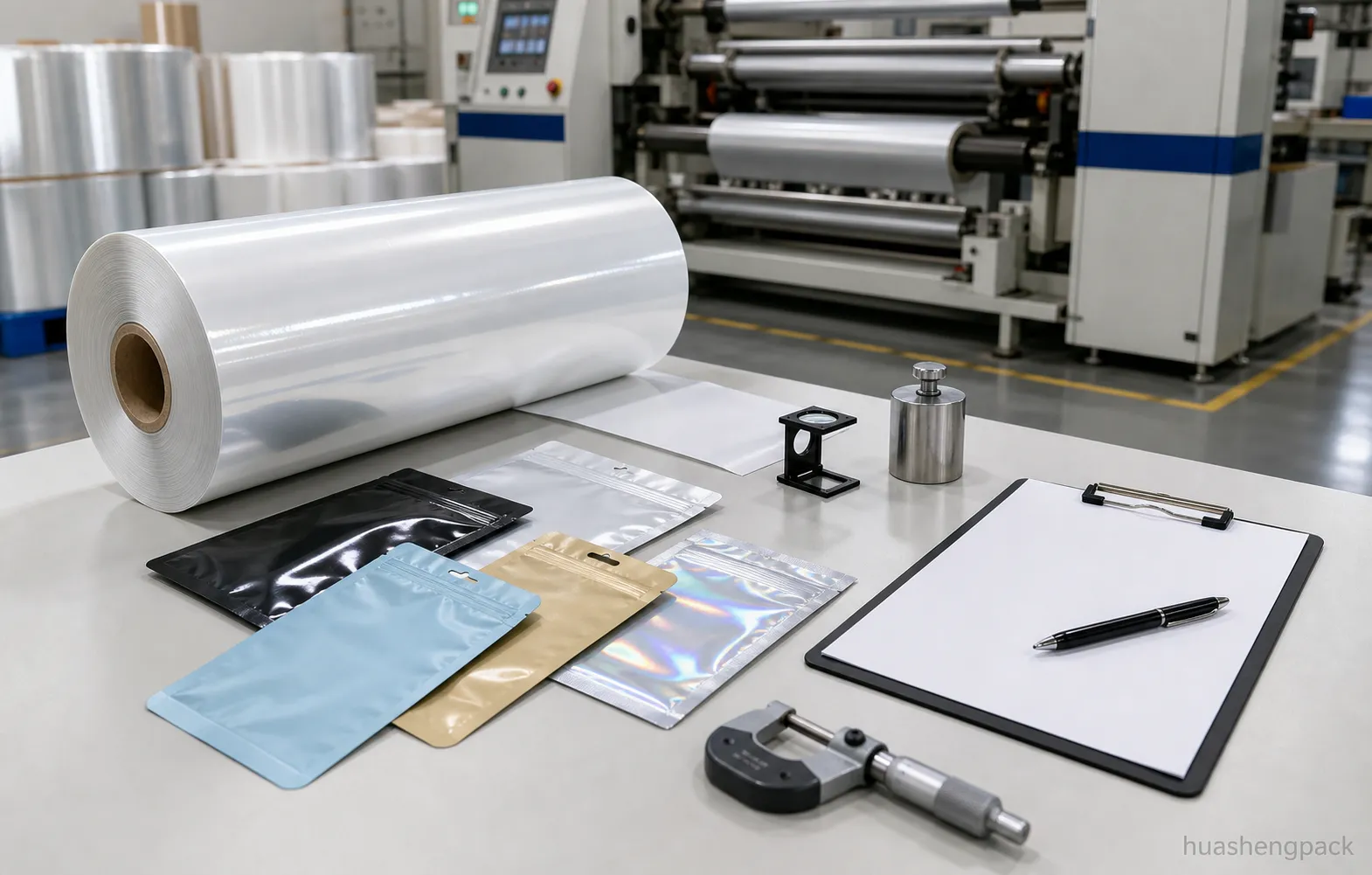 Incoming checks should follow the agreed material specification and identification records.
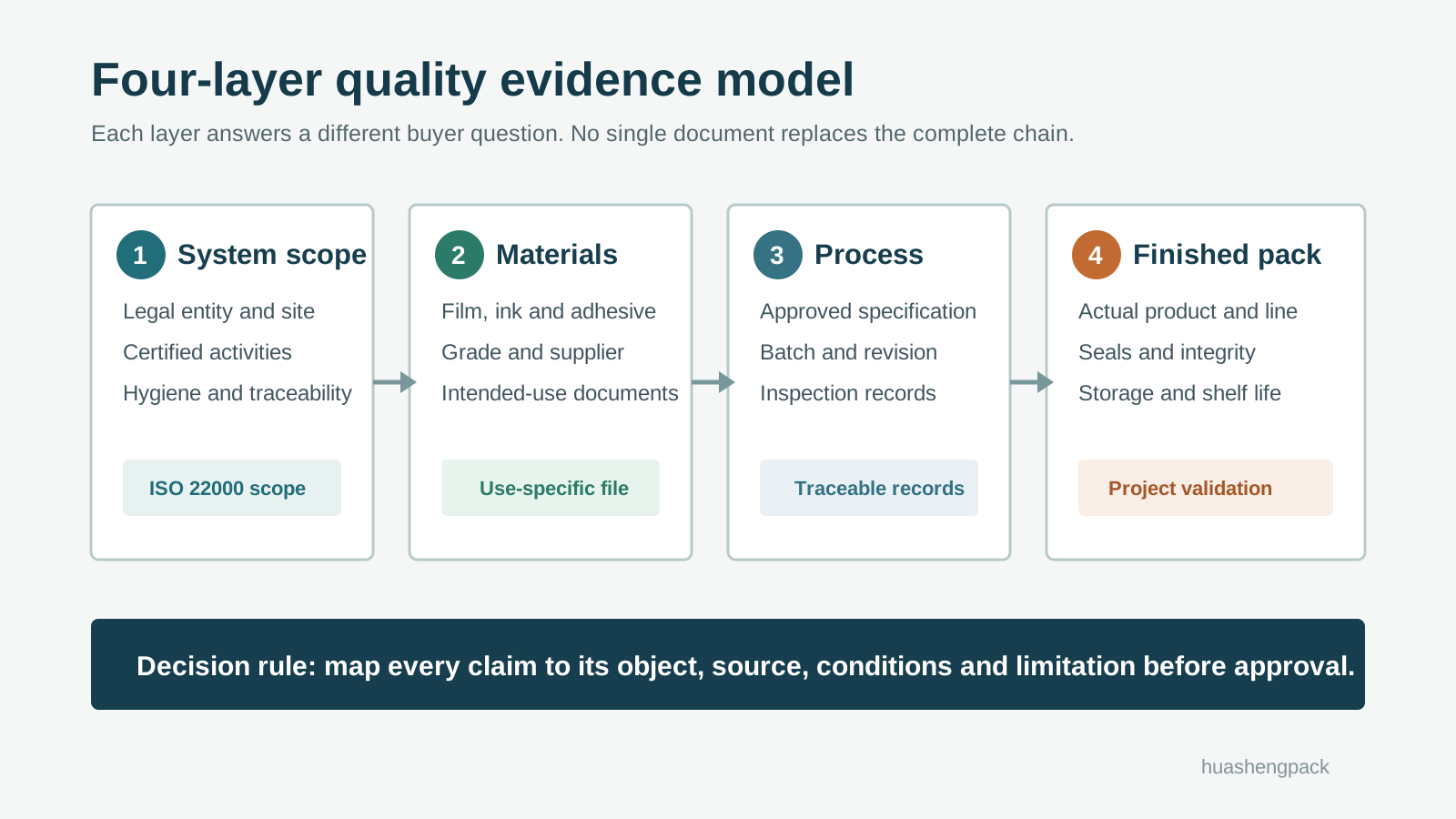 Management-system, material, process and finished-package evidence answer different approval questions.
Connect Traceability to Agreed Acceptance Checks
The control plan can identify incoming-material verification, approved artwork and structure, batch identity, process settings, dimensions, visual inspection, laminate bond, seal-strength or leak checks, and roll-film data where relevant. Not every test is required for every project. Methods, specimens, conditioning and acceptance limits should be agreed according to the actual risk.
Laboratory heat-seal work can help establish a starting relationship, but ASTM F2029 explicitly distinguishes laboratory preparation from production-equipment validation. Use representative production trials before final release.
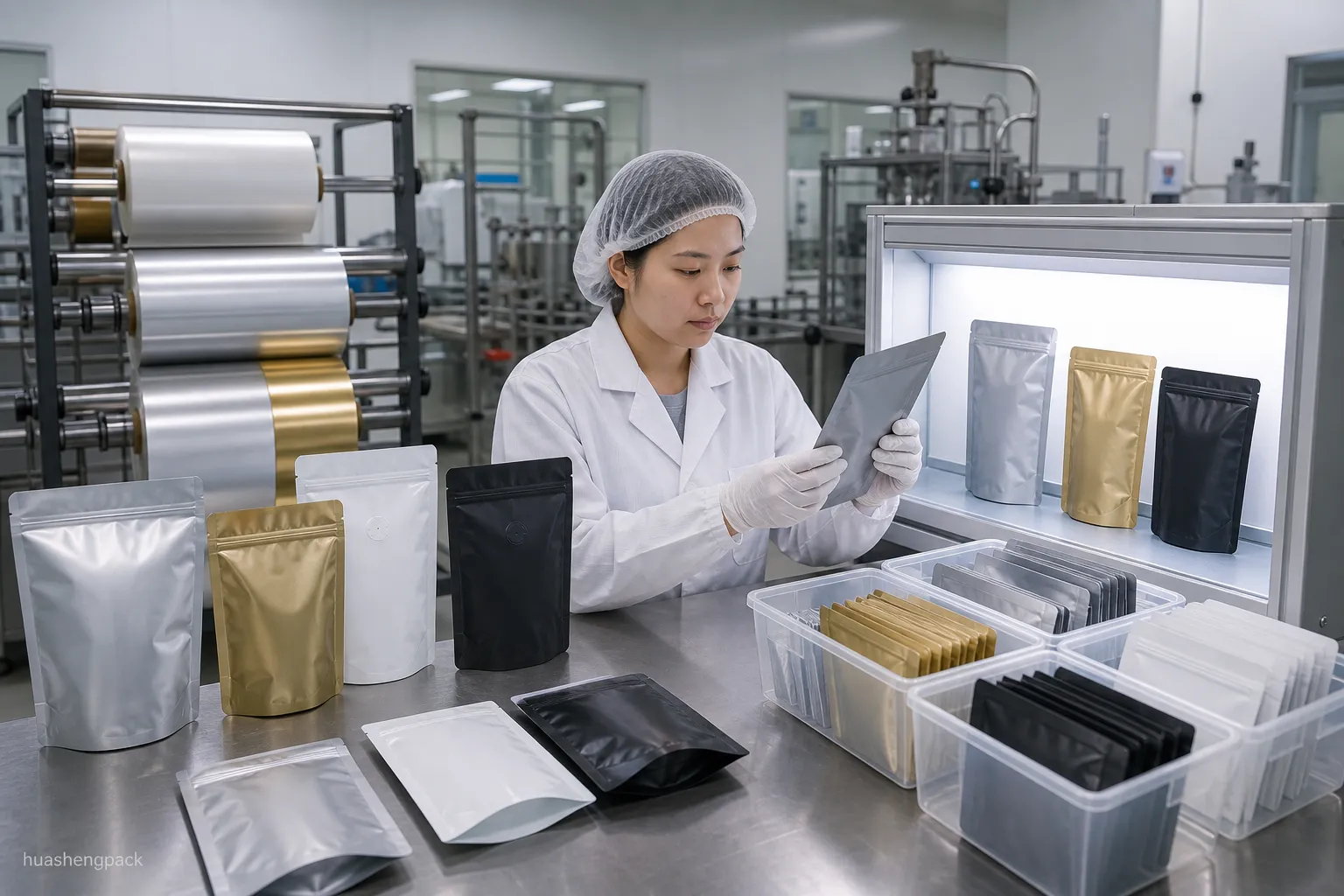 Finished-package release should use agreed criteria and retained samples where applicable.
Buyer Evidence Checklist
Provide destination market, product type, food-contact conditions, filling and storage temperature, package format, complete structure and thickness, ink and adhesive requirements, zipper or fitment, machine information, target shelf life and required documents. Request a matrix that maps each document to a material, process or finished-package question. Huasheng Packaging can organize available project evidence; the buyer or qualified responsible party confirms final regulatory suitability and product shelf life.
Related Products
Related Packaging Guides
Claim-to-source evidence matrix
| Reviewed claim | Support | Sources | Boundary |
|---|
| ISO 22000 defines a food-safety management-system framework rather than universal product approval. | direct | [1] | Certificate scope still needs to be checked against the legal entity, site and activity. |
| Food-packaging manufacturing prerequisite programmes support operational hazard controls. | direct | [2], [5] | Operational controls do not replace material- and use-specific compliance evidence. |
| Food-contact assessment is tied to components and conditions of use. | direct | [3], [4] | Destination-market requirements must be identified separately. |
| Laboratory heat-seal work is a starting relationship and does not validate production equipment. | direct | [6] | The intended line, product and operating conditions require representative validation. |
JSON · CSV
Authoritative References
- ISO 22000:2018: Food Safety Management Systems - Requirements for Any Organization in the Food Chain · International Organization for Standardization · standard
ISO 22000 defines a food-safety management-system framework and does not certify every material or package design - ISO 22002-4:2025: Prerequisite Programmes on Food Safety - Food Packaging Manufacturing · International Organization for Standardization · standard
Food-packaging manufacturing prerequisite programmes address operational controls for food-safety hazards - Determining the Regulatory Status of Components of a Food Contact Material · U.S. Food and Drug Administration · government
Food-contact status depends on each component, its authorization, specifications and conditions of use - Food Types and Conditions of Use for Food Contact Substances · U.S. Food and Drug Administration · government
Food-contact review depends on the food type and the intended temperature and storage conditions - 食品相关产品质量安全监督管理暂行办法(国家市场监督管理总局令第62号) · 国家市场监督管理总局 · government
China requires controls and records for raw materials, production, inspection and delivery of food-related products - ASTM F2029-16(2021): Laboratory Heat Seals for Determination of Heat Sealability of Flexible Barrier Materials · ASTM International · standard
Laboratory heat-seal curves provide starting relationships and do not replace production-equipment validation
Frequently Asked Questions
Does ISO 22000 certify every packaging material?
No. It is a food-safety management-system standard. Material- and use-specific food-contact evidence remains separate.
What should buyers verify on an ISO 22000 certificate?
Check the legal entity, site, certified activity scope, issue and validity information against the factory being evaluated.
Can one test report cover another laminate?
Not automatically. Compare supplier, grade, layers, thickness, inks, adhesives, processing and intended use before deciding whether it is relevant.
Does a laboratory heat-seal curve prove production performance?
No. It can provide starting information, while production equipment, speed, jaw geometry, product and contamination still require validation.
Which evidence should link to the production batch?
The approved specification, material identity, artwork revision, process and inspection records should be traceable according to the agreed control plan.
Who confirms final food-contact suitability?
The responsible buyer, importer or qualified compliance party should confirm the route for the exact package, intended use and market.