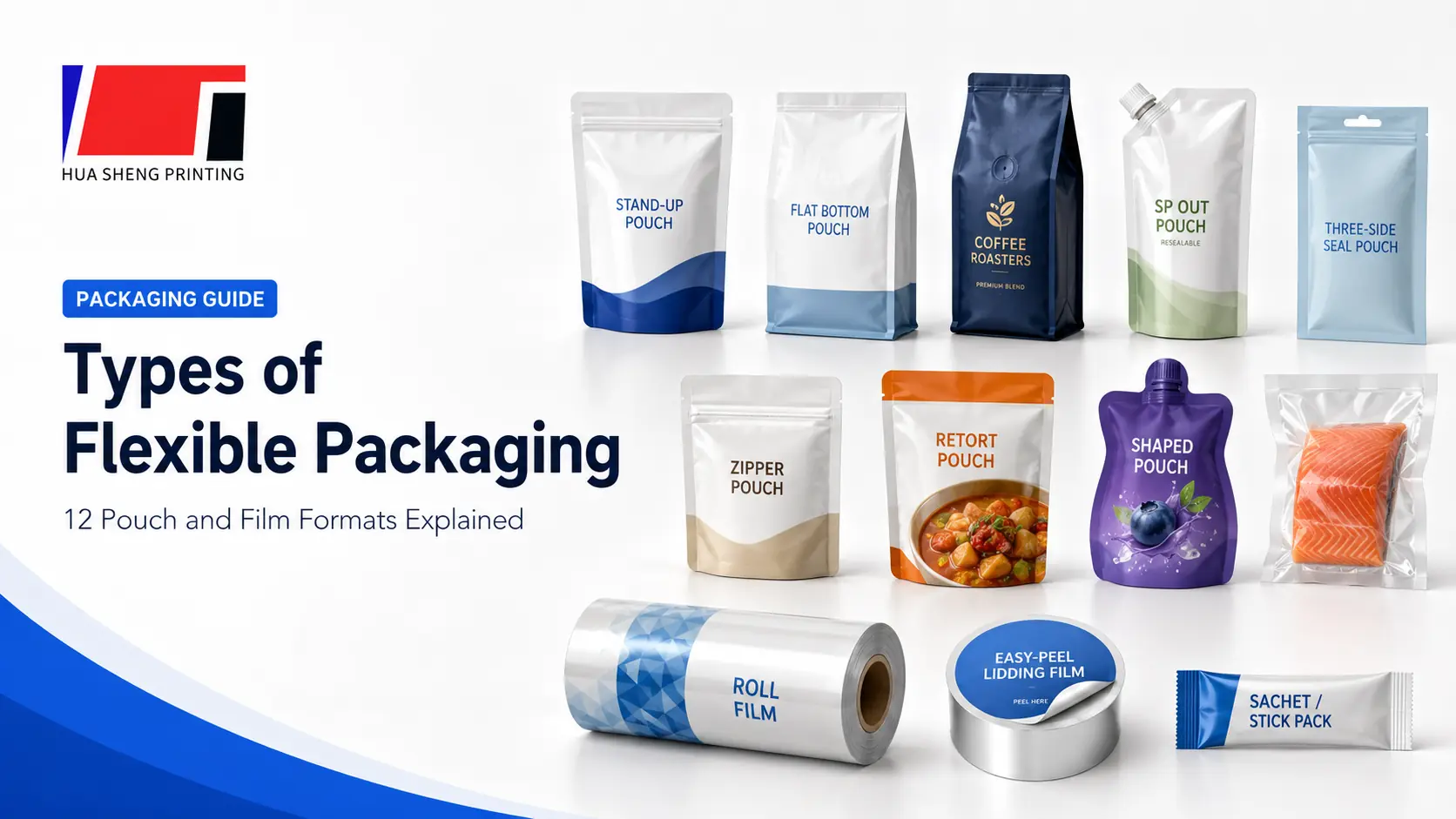
12 Types of Flexible Packaging: A Complete Guide to Pouches and Roll Film

Complete guide to 12 types of flexible packaging: stand up pouch, flat bottom, spout, quad seal, side gusset, 3-side seal, retort, coffee bags, roll film, shaped pouch, kraft paper bags and easy peel film.
Published: 2025-07-20 | Updated: 2026-05-21
Introduction: Why Packaging Format Matters
Flexible packaging is not one single product — it covers roll film, premade pouches, sealing film and special pouch formats, each designed for different products, filling methods, shelf lives and brand presentations. Choosing the right packaging type affects production efficiency, product protection, shelf display, consumer convenience and total procurement cost.
This guide explains the main types of flexible packaging for food products, what each format is used for, the key quality points to check, and the products available from Huasheng Packaging. Whether you are buying for the first time, comparing options or preparing a sourcing plan, this overview helps you understand the landscape and make an informed choice.
Main Types of Flexible Packaging at a Glance
The table below gives a quick overview of the main flexible packaging types and what they are commonly used for.
Food Packaging Roll Film — Best for: automatic packing lines (VFFS / HFFS / flow pack). Typical products: snacks, biscuits, candy, powder, sachet, stick pack. Key advantage: high-speed continuous production. Main quality concern: eye mark accuracy, film tension, sealing layer.
Stand Up Zipper Pouches — Best for: resealable retail packaging and shelf display. Typical products: snacks, nuts, candy, powder, dried fruit, coffee. Key advantage: resealable zipper, good shelf standing. Main quality concern: zipper function, standing performance, tear notch.
Flat Bottom Pouches — Best for: premium shelf display and larger filling weight. Typical products: coffee beans, pet food, nuts, premium snacks. Key advantage: five printable panels, stable box-like display. Main quality concern: bottom size accuracy, multi-panel print registration.
Spout Pouches — Best for: liquid, sauce and refill packaging. Typical products: juice, sauce, puree, liquid detergent, beverage. Key advantage: convenient pouring, leak-resistant spout. Main quality concern: spout welding strength, cap compatibility.
Retort Pouches — Best for: high-temperature sterilization. Typical products: ready meals, seafood, sauces, sterilized food. Key advantage: shelf-stable without refrigeration. Main quality concern: heat resistance, seal integrity under retort conditions.
Three Side Seal Pouch — Best for: sachet, powder, seasoning and sample packs. Typical products: single-serve snacks, powder sachets, trial packs. Key advantage: cost-effective flat pouch, fast production. Main quality concern: sealing strength, tear notch position.
Easy Peel Sealing Film — Best for: cup sealing applications. Typical products: jelly cups, pudding cups, yogurt cups, sauce cups. Key advantage: consistent peel strength. Main quality concern: peel force consistency, cup material compatibility.
Kraft Paper Packaging Bags — Best for: natural look and brand presentation. Typical products: coffee, tea, snacks, organic food. Key advantage: kraft paper appearance with barrier lamination. Main quality concern: barrier performance, surface finish consistency.
Custom Shaped Pouches — Best for: creative or promotional packaging. Typical products: candy, jelly, kids products, gift packaging. Key advantage: unique shelf shape. Main quality concern: die-cut tolerance, sealing edge integrity.
Food Packaging Roll Film
Food packaging roll film is supplied in rolls for use on automatic VFFS, HFFS, sachet, stick pack and flow pack machines. It is commonly used for snacks, biscuits, candy, powder, seasoning and other products packed at medium to high speed. The film is printed, laminated and wound onto a core — the buyer's packing machine forms, fills and seals the pouch in one continuous process.
Key technical points to confirm before ordering: roll width (must match the machine's forming tube), repeat length (printed pattern repeat distance), eye mark position and dimensions, sealing layer type and activation temperature, film thickness and coefficient of friction (COF), roll direction and core size, packing machine brand and model. Incorrect specifications can cause machine stoppages, misaligned seals or poor print registration.
Stand Up Zipper Pouches
Stand up zipper pouches are one of the most versatile flexible packaging formats. They feature a bottom gusset that expands when filled, allowing the pouch to stand upright on retail shelves. The resealable zipper allows consumers to open and close the package multiple times, which is valued for snacks, nuts, dried fruit, coffee, powder supplements and small pet treats.
Key quality points: standing performance after filling, zipper open-close durability, tear notch position for easy opening, sealing strength along the bottom gusset and side edges, and material barrier matching the product's shelf-life requirement. Huasheng Packaging supports custom sizes, zipper types, surface finishes and full-color gravure printing.
Flat Bottom Pouches
Flat bottom pouches — also called box bottom pouches — have a flat base and side gussets that create a stable, box-like shape. They offer five printable panels (front, back, two sides and bottom), making them a popular choice for premium coffee, pet food, nuts, specialty snacks and dry food products where shelf presence matters.
Key quality points: bottom panel size and folding accuracy, side gusset depth, zipper or valve compatibility, multi-panel print registration, and material stiffness for heavy filling weights. Flat bottom pouches can support larger filling volumes (up to 2 kg or more) with good standing stability.
Spout Pouches
Spout pouches integrate a spout and cap into a flexible stand up pouch, providing convenient pouring and reclosing for liquid, sauce and semi-liquid products. Common applications include juice, beverage, sauce, puree, liquid detergent refill packs and liquid food packaging.
Key quality points: spout welding strength and leak resistance, spout diameter and cap type matching the product viscosity and consumer use, inner layer compatibility with the product's pH, oil content and filling temperature, and overall pouch sealing integrity. Different liquid products need different material structures and spout configurations — there is no single spout or material that works for all liquids.
Retort Pouches
Retort pouches are designed to withstand high-temperature sterilization (commonly 121°C to 135°C depending on the structure), allowing food products to be stored at ambient temperature without refrigeration. They are used for ready meals, seafood, sauces, pet food and other sterilized food applications.
Key quality points: material structure must match the specific sterilization temperature, time and pressure profile; sealing layer must maintain integrity during and after the retort process; lamination strength must prevent delamination under heat and pressure; pouch thickness should be appropriate for filling weight and handling. Not all pouches can withstand retort conditions — the structure must be selected and tested for each specific application.
Common structures may include PET/AL/RCPP, PA/AL/RCPP or project-specific retort-grade laminates. The final structure should be confirmed according to sterilization conditions, food type, filling weight and shelf-life target.
Three Side Seal Pouch
Three side seal pouches are a flat, cost-effective sachet format with three sealed edges and one open side for filling. They are widely used for single-serve powder sachets, seasoning packs, sauce portion packs, sample packs, wet wipe packaging and small food portions.
Key quality points: sealing strength on all three edges, tear notch position for easy opening, pouch size tolerance, and material barrier matching the product's moisture and oxygen sensitivity. Three side seal pouches can be supplied as premade pouches or produced from roll film on automatic sachet machines.
Easy Peel Sealing Film
Easy peel sealing film is a lidding film used to seal cups, trays and containers with a peelable seal. Common applications include jelly cups, pudding cups, yogurt cups, sauce cups, dessert cups and other cup-sealed food products. The film must provide a secure seal during transport and storage, yet peel open cleanly without tearing or leaving residue.
Key quality points: consistent peel strength across the production batch, compatibility with the cup material (PP, PS or PET — each requires a different seal layer formulation), sealing temperature matching the cup sealing line, and barrier performance for the product's shelf-life requirement. Peel performance must be tested with the actual cup material and sealing machine before bulk production.
Kraft Paper Packaging Bags
Kraft paper packaging bags combine a natural kraft paper exterior with an inner laminated barrier layer. They offer a premium, organic or artisanal appearance while maintaining the functional barrier properties of flexible packaging. Common applications include coffee beans, specialty tea, organic snacks, dried fruit and natural food brands.
Key quality points: kraft paper surface consistency, lamination bond between the paper outer layer and barrier inner layer, sealing strength, and overall barrier performance. Kraft paper bags are laminated flexible packaging bags — not simple single-layer paper shopping bags. The inner barrier layer (PE, VMPET or aluminum foil) determines the actual moisture, oxygen and aroma protection.
Custom Shaped Pouches
Custom shaped pouches are die-cut into unique shapes for creative food packaging, candy, jelly, kids products, promotional gift packaging and brand-differentiated retail displays. The shape is created by a custom-made cutting die, giving the pouch a distinctive outline beyond standard rectangular formats.
Key quality points: die-cut accuracy and tolerance, sealing edge integrity along the shaped perimeter, filling opening design, and production feasibility for the specific shape. Custom shapes require longer tooling preparation and are generally suited for medium to large production volumes where the die cost can be amortized.
How to Choose the Right Packaging Type
Use this quick reference to match your needs with the most common packaging type. Final confirmation depends on your specific product, filling method, quantity and material requirements.
You need automatic high-speed packing → Food Packaging Roll Film
You need a resealable retail pouch → Stand Up Zipper Pouch
You need premium coffee or pet food shelf display → Flat Bottom Pouch
You need liquid or sauce packaging → Spout Pouch
You need high-temperature sterilization → Retort Pouch
You need small sachet, powder pack or sample → Three Side Seal Pouch
You need cup sealing for jelly or pudding → Easy Peel Sealing Film
You need a natural paper appearance → Kraft Paper Packaging Bag
You need a creative or distinctive shelf shape → Custom Shaped Pouch
If you are unsure which type is best for your product, send your product details, filling weight, size and machine information. Our team can help review suitable packaging formats.
Material Structure Considerations
All the packaging types above can be produced with different material structures depending on barrier requirements, product sensitivity and shelf-life targets. Common laminated structures include:
BOPP/CPP — lightweight snack and flow pack applications with good machinability on automatic lines.
PET/PE — general dry food, powder and snack packaging with basic moisture protection and good print surface.
PET/VMPET/PE — stronger moisture and light barrier with a metallized layer for extended shelf-life products.
PET/AL/PE — higher oxygen, aroma, moisture and light barrier; commonly used for coffee, sensitive powders and longer shelf-life products.
PA/PE — flexibility and puncture resistance; suitable for frozen food or products needing cold-temperature performance.
PET/AL/RCPP or PA/AL/RCPP — retort-grade structures for high-temperature sterilization; subject to temperature, time and product characteristics.
The final material structure should be confirmed according to product type, shelf-life requirement, filling weight, storage condition, packing process and destination market. No single structure works universally.
Common Mistakes Buyers Should Avoid
- Choosing the bag type before confirming the product characteristics and filling method
- Comparing unit prices without confirming material structure, thickness and specifications
- Ignoring packing machine compatibility when selecting roll film or premade pouches
- Selecting a pouch format only based on appearance without checking filling weight and size
- Ignoring barrier and shelf-life requirements during material selection
- Skipping sample testing with actual product before confirming bulk production
- Sending an inquiry without artwork, size, material preference or product details
- Assuming one material structure can fit all food products
What to Prepare Before Inquiry
Providing complete information helps our team recommend the most suitable packaging format and material structure for your product.
- Product type and description
- Filling weight (grams or ml per pack)
- Preferred packaging type (or describe your needs)
- Target pouch size or roll film width
- Material structure if known
- Thickness if known
- Order quantity
- Number of printing colors
- Artwork file availability
- Packing machine type and model (if using roll film)
- Shelf-life requirement
- Destination country
- Sample photo or reference image if available
Related Products
Related Packaging Guides
Frequently Asked Questions
What are the main types of flexible packaging for food products?
Common types include food packaging roll film, stand up zipper pouches, flat bottom pouches, spout pouches, retort pouches, three side seal pouches, easy peel sealing film, kraft paper packaging bags and custom shaped pouches. Each type serves different products, filling methods and shelf-display needs.
What is the difference between roll film and premade pouches?
Roll film is supplied in rolls for automatic packing machines where forming, filling and sealing happen on one machine. Premade pouches are already formed bags used for manual, semi-automatic or premade pouch filling lines. The choice depends on production volume, machine availability and packaging format.
Which flexible packaging type is suitable for automatic packing machines?
Food packaging roll film is commonly used for automatic packing machines, but roll width, repeat length, sealing layer, eye mark and machine compatibility must be confirmed before production.
Which pouch type is better for shelf display?
Stand up zipper pouches and flat bottom pouches are commonly used for retail shelf display because they stand upright. Flat bottom pouches offer five printable panels and better stability for premium products. Stand up pouches are more cost-effective for standard retail sizes.
Can one material structure fit all food products?
No. Different products such as snacks, coffee, powder, sauce, liquid food and retort food may require different barrier levels, sealing layers and material structures. Each structure should be selected based on the specific product characteristics.
What information should I provide before requesting a quote?
Buyers should provide product type, filling weight, packaging type preference, target size, material requirement if known, quantity, printing colors, artwork file, packing machine information if applicable and destination country. The more detail provided, the more accurate the recommendation.