Spout Pouch Material Guide for Juice, Sauce and Liquid Packaging
Huasheng Packaging Technical Content Review · Published: · Updated:
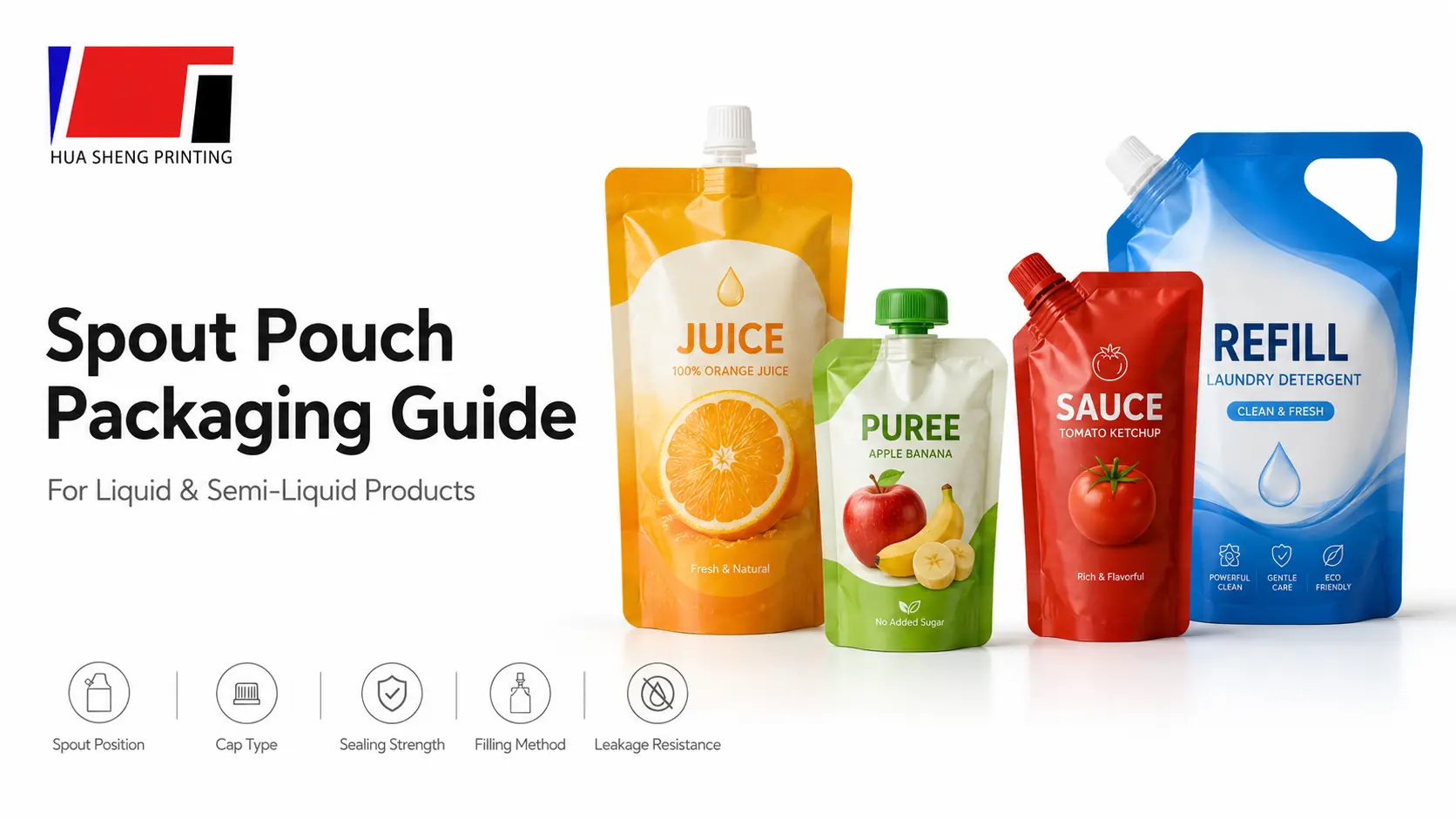 Technical guide visual for Spout Pouch Material Guide for Juice, Sauce and Liquid Packaging.
Learn how to choose spout pouch materials for juice, sauce, baby food, refill and liquid packaging, including barrier structures, leakage risk, spout and cap selection, sterilization and quality control.
Direct answer
Custom spout pouches are widely used for juice, sauce, puree, baby food, liquid detergent, refill packaging and other liquid or semi-liquid products. Choosing the right spout pouch is not only about pouch shape — the material structure, spout size, cap type, sealing strength, filling method, sterilization condition and storage environment all affect the final packaging performance. This guide helps packaging buyers understand the key factors in spout pouch material selection and quality control.
What Is a Spout Pouch and What Is It Used For?
A spout pouch is a flexible packaging bag with an integrated spout and cap, designed for liquid, semi-liquid and refill products. Common applications include juice and beverage, sauce and condiment, puree and baby food, liquid detergent refill, shampoo or personal care refill, and liquid seasoning. Different products cannot use the same material structure by default — the material, spout and sealing must match the specific product characteristics. Huasheng Packaging supports custom spout pouches with different spout positions, cap types, material structures and printing designs.
Common Spout Pouch Material Structures
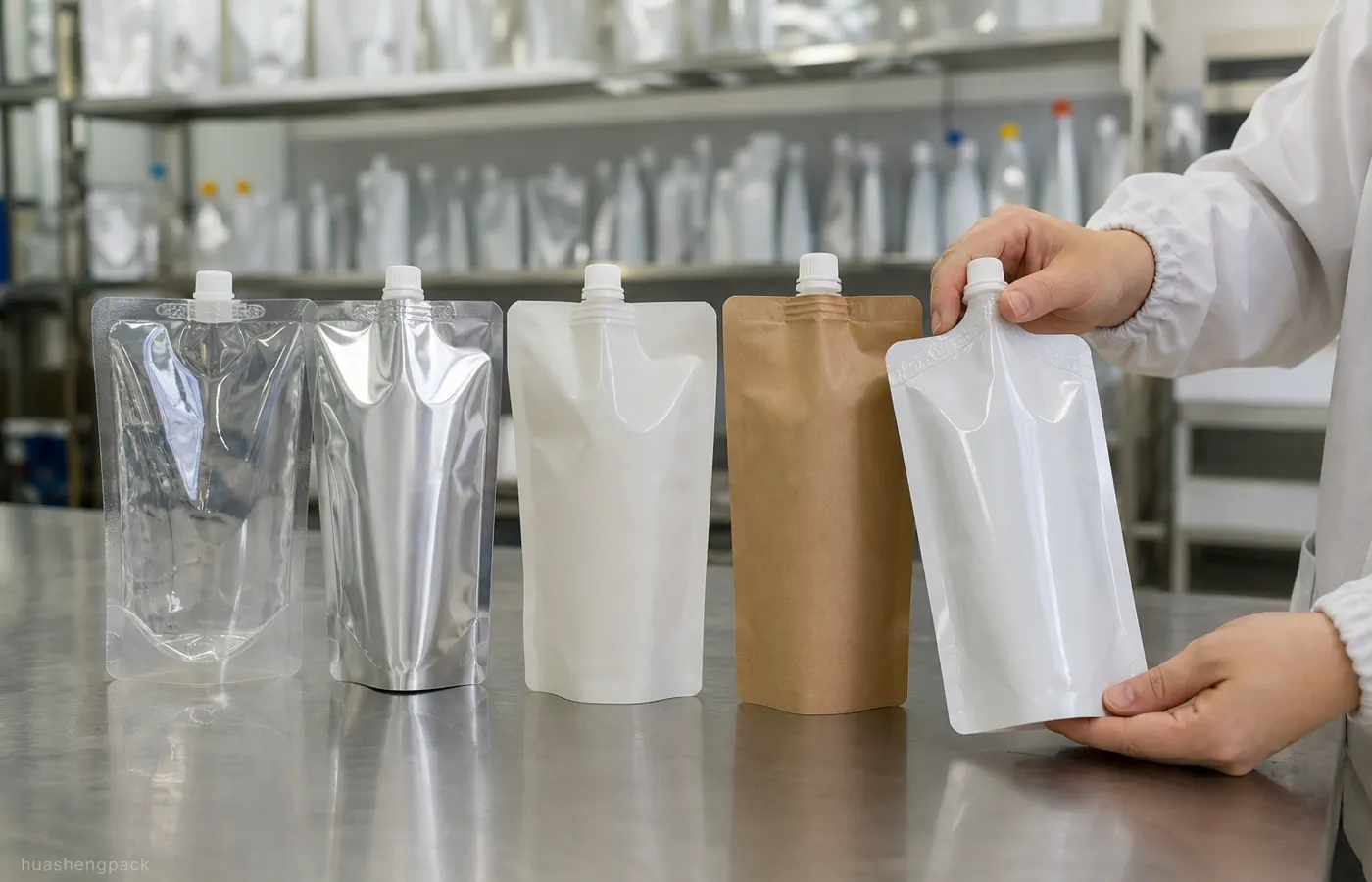
The material structure of a spout pouch should be selected based on product viscosity, filling weight, shelf life, filling temperature, sterilization condition and storage environment. Common options may include: PET/PE for general liquid or semi-liquid packaging, PET/NY/PE for better flexibility and puncture resistance, PET/VMPET/PE for improved light and moisture barrier, PET/AL/NY/PE for high-barrier liquid packaging when stronger protection is required, and retort-grade structures for products requiring high-temperature sterilization. The final structure should be confirmed before production based on your specific product requirements.
Pouch laminate, fitment and cap choices should be reviewed with the intended liquid product and filling process.Spout and Cap Selection
Before ordering spout pouches, buyers should confirm: spout diameter (commonly 8.6mm, 10mm, 16mm or custom), cap type (screw cap, flip-top cap, tamper-evident cap), spout position (corner spout or center spout), child-resistant cap if required by the target market, filling method and sealing equipment compatibility, and product viscosity which affects spout size selection. Spout and cap compatibility should be tested with the actual product before mass production to avoid leakage or filling issues.
Quality Control Points
Spout welding strength — check the bond between spout and pouch material. Cap fitting — confirm cap and spout thread match. Seal strength — test heat sealing on all edges. Leakage testing — pressure and vacuum methods to check integrity. Drop and pressure resistance — simulate transport conditions. Lamination strength — ensure layers will not separate. Pouch size tolerance — verify dimensions after filling. Print registration — consistent color and position. Visual inspection — surface, spout alignment and overall appearance. Sample trial with actual product before mass production is recommended.
What to Prepare Before Inquiry
Product type: liquid, sauce, puree, detergent or personal care. Filling weight. Pouch size. Spout diameter. Cap type. Filling temperature if applicable. Sterilization condition if any. Material structure if known. Thickness if known. Quantity. Printing colors. Artwork file. Target market. Sample photo of current packaging if available. If you are not sure about the material structure, send us your product details, filling method and storage requirements, and we can help review suitable options.
Related Products
Related Packaging Guides
Frequently Asked Questions
What material is commonly used for spout pouches?
Common structures may include PET/PE, PET/NY/PE, PET/VMPET/PE and high-barrier multilayer structures. The final material should be selected according to product type, filling weight, shelf life, filling temperature and storage conditions.
How can spout pouch leakage risk be reduced?
Leakage risk can be reduced by checking heat sealing strength, spout welding quality, cap fitting, material compatibility and sample performance before mass production. Leakage testing should be part of the quality control process.
Can spout pouches be used for sauce and thick liquid?
Yes, spout pouches can be used for sauce or thick liquid products, but the spout diameter, material structure, filling method and product viscosity should be confirmed before production. Thicker products may need wider spouts or specific filling equipment.
Are spout pouches suitable for hot filling or sterilization?
Some spout pouches can be designed for hot filling or sterilization, but the structure must match the filling temperature, sterilization time, pressure and shelf life requirements. Retort-grade materials may be required.
Can spout size and cap type be customized?
Yes. Spout diameter, cap type, cap color and spout position can be customized based on product use, filling method and order requirements.
What information is needed for spout pouch quotation?
Buyers should provide product type, pouch size, filling weight, spout diameter, cap type, material requirement, quantity, printing colors, artwork file and target market.