Spout Pouch Packaging Guide for Liquid Products
Huasheng Packaging Technical Content Review · Published: · Updated:
 Spout pouch packaging formats for liquid, sauce and puree products.
Complete guide to spout pouch packaging: materials, spout types, sealing methods and filling considerations for liquid, sauce, puree and jelly products.
Direct answer
Spout pouches are one of the most popular flexible packaging formats for liquid, sauce and semi-liquid products. The combination of a stand-up pouch body with a resealable spout makes it convenient for end users and efficient for filling lines. However, choosing the right spout type, material structure and sealing method is critical to avoid leakage, ensure product safety and maintain shelf life.
Problem Scenario
When customers first consider spout pouch packaging, common challenges include:
- Leakage at the spout seal area
- Spout cap not sealing properly after first use
- Pouch delamination near the spout due to incompatible materials
- Difficulty in filling hot or cold products through the spout
- Spout material incompatibility with acidic or oily products
- Pouch not standing properly on shelf after spout insertion
- Spout color or style mismatch with brand design
Each of these issues can cause product loss, customer complaints and brand damage.
Common Mistakes
Frequent mistakes when ordering spout pouches:
- Choosing any spout without checking compatibility with the pouch material
- Ignoring the spout welding layer (PE vs PP spout base)
- Not specifying whether the product is hot-filled, cold-filled or ambient-filled
- Using the same spout type for both low-viscosity and high-viscosity products
- Not checking cap torque and child-resistant requirements
- Overlooking the spout position (center vs corner vs offset)
- Ordering pouches without checking the filling machine spout handling compatibility
- Not testing spout seal integrity under drop or pressure conditions
Recommended Spout Pouches & Materials
Common spout types:
- Standard screw cap spout (PE or PP base)
- Flip-top spout for convenience products
- Child-resistant spout for household chemicals
- Tear-off spout for single-use applications
- Wide-bore spout for viscous products like yogurt or honey
Recommended material structures:
- PET / PA / PE: for general liquid products with good puncture resistance
- PET / AL / PE: for products requiring high barrier protection
- PET / VMPET / PE: for moderate barrier with metallic appearance
- PET / PE: for basic liquid packaging with short shelf life
The spout welding layer must match the inner layer of the pouch:
- PE inner pouch layer → PE-based spout
- PP inner pouch layer → PP-based spout
Quality Check Points
Critical quality checks for spout pouches:
- Spout welding strength test (pull test)
- Drop test with filled product at specified height
- Leak test under pressure (vacuum or compression test)
- Cap torque test to verify opening/closing force
- Spout position accuracy measurement
- Visual inspection of spout welding area (no wrinkles, bubbles, gaps)
- Compatibility test with actual filling equipment
- Seal integrity after thermal cycling for hot-fill products
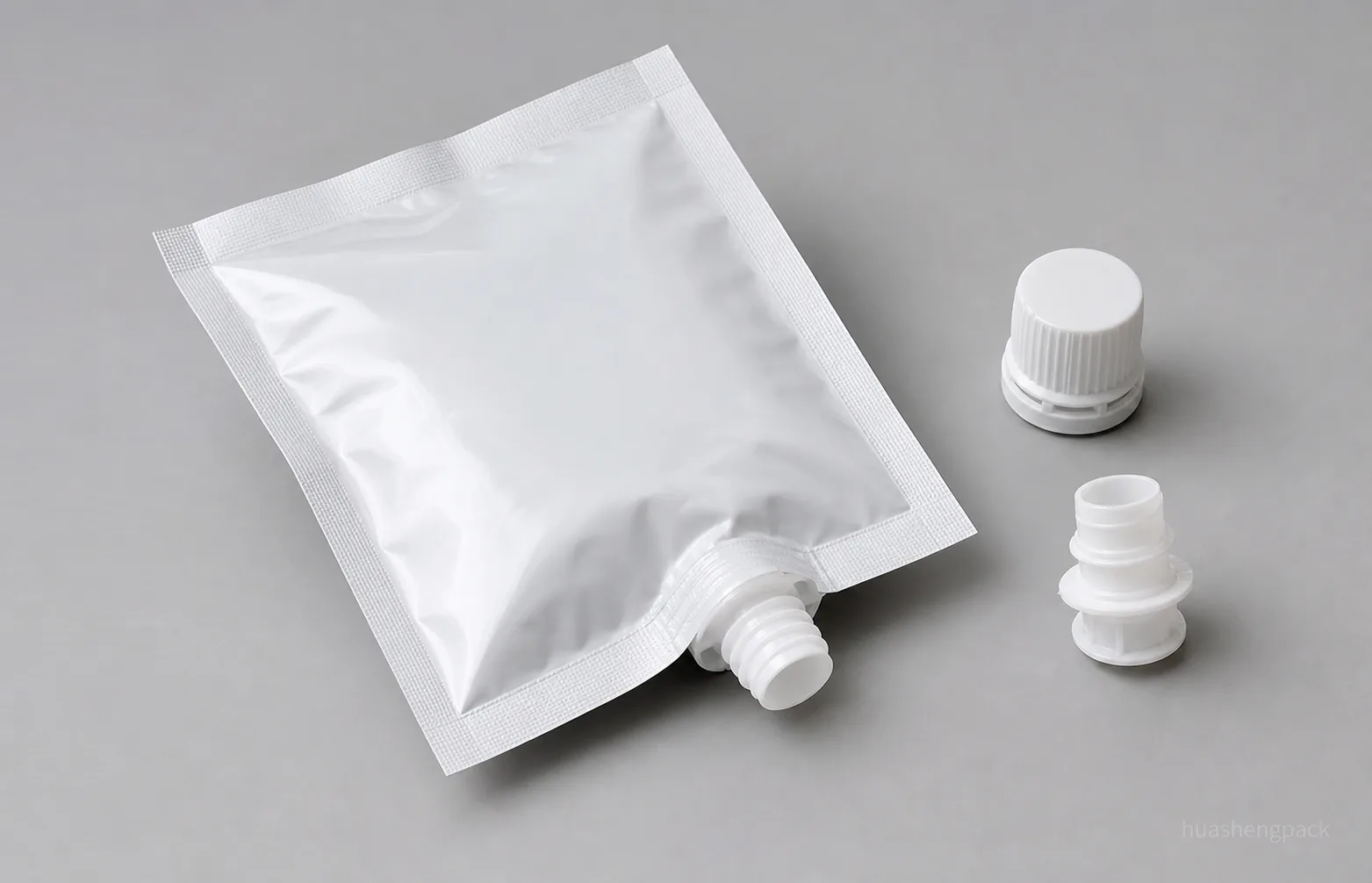 Spout welding, cap fit and pouch material should be confirmed together through project-specific samples.
What to Prepare Before Inquiry
Prepare the following information for an accurate quotation:
- Product type and viscosity (water-like, sauce, paste, jelly, etc.)
- Filling temperature (ambient, hot-fill, cold-fill)
- Target volume or weight
- Pouch dimensions or preferred size range
- Spout type preference (screw cap, flip-top, diameter, color)
- Required shelf life and barrier needs
- Quantity
- Filling method (manual, semi-automatic, automatic)
- Any specific cap torque requirement
- Reference sample or photo if available
Related Products
Related Packaging Guides
Frequently Asked Questions
What spout material should I choose for my product?
PE-based spouts are compatible with PE inner layer pouches and are most common for food products. PP-based spouts are used with PP inner layers and offer higher heat resistance. The choice depends on your pouch inner layer material and filling temperature.
Can spout pouches be used for hot-fill products?
Yes, but you need a heat-resistant spout and pouch structure (typically PP-based spout with a high-temperature-resistant inner layer). Specify the filling temperature when ordering so the correct materials can be selected.
What is the most common spout diameter?
Common spout diameters range from 8mm to 16mm. Thin liquids typically use 8-10mm, sauces use 10-12mm, and viscous products like yogurt or honey use 14-16mm wide-bore spouts.
How do I prevent spout leakage?
Spout leakage is usually caused by incompatible spout and pouch materials, insufficient welding temperature/pressure/time, or contamination in the welding area. Always confirm material compatibility and run filling trials.
Can I get spouts in a custom color?
Yes, spouts can be color-matched to your brand. Common colors include white, black, transparent, red, blue, green and custom Pantone-matched colors. Minimum order quantities may apply for custom colors.
What is the minimum order quantity for spout pouches?
Typical MOQ starts around 10,000-30,000 pieces depending on size and specification. Custom spout colors or special cap types may require higher MOQs for the spout supplier.