Biscuit Packaging Roll Film Specification: Barrier, Reel Data and Machine Validation
Huasheng Packaging Technical Content Review · Published: · Updated:
 Biscuit packaging roll film specification for barrier and machine compatibility.
Specify biscuit roll film by product risk, OTR/WVTR conditions, web data, COF, sealing and production-line validation.
Direct answer
Biscuit roll film should be specified as a product-machine-package system, not by price per kilogram or a laminate name. Crispness, oxidation risk, web geometry, friction, print registration and sealing all need defined evidence. This guide shows which data can be compared and which decisions still require a trial on the intended automatic packing line.
Evidence-reviewed technical guide
2026-08-12 · Huasheng Packaging Technical Content Review
Evidence scope
Biscuit product-risk translation, reel interface data, OTR/WVTR reporting conditions, COF interpretation and production-line trial requirements.
Scope and limitations
The guide does not prescribe a laminate, barrier target, COF value or machine setting. All remain dependent on product, film grade and equipment.
Key takeaways
- State method and conditions before comparing OTR or WVTR.
- COF supports quality control but does not prove machinability.
- Reel geometry, artwork interface and representative line trials belong in one approval record.
Translate Product Risk into Measurable Requirements
Dry biscuits, high-fat cookies, wafers, nut-filled products and chocolate-coated snacks do not have identical protection needs. Define the moisture and oxygen sensitivity, target shelf life, storage climate, product edges, pack size and filling atmosphere before selecting a structure. OTR and WVTR results are meaningful only with the test method, specimen, units, temperature and humidity. A structure name does not supply those missing conditions.
Do Not Rank Structures by Name Alone
BOPP/CPP, PET/PE, metallized BOPP laminates and PET/VMPET/PE can be evaluated as different directions. Metallized BOPP, VMPET and aluminum foil are not interchangeable. Film grade, coating, thickness, adhesive, printing, folds and seals affect the converted package. Compare supplier data under stated conditions and use finished packs for product validation instead of assigning a universal shelf life to one laminate.
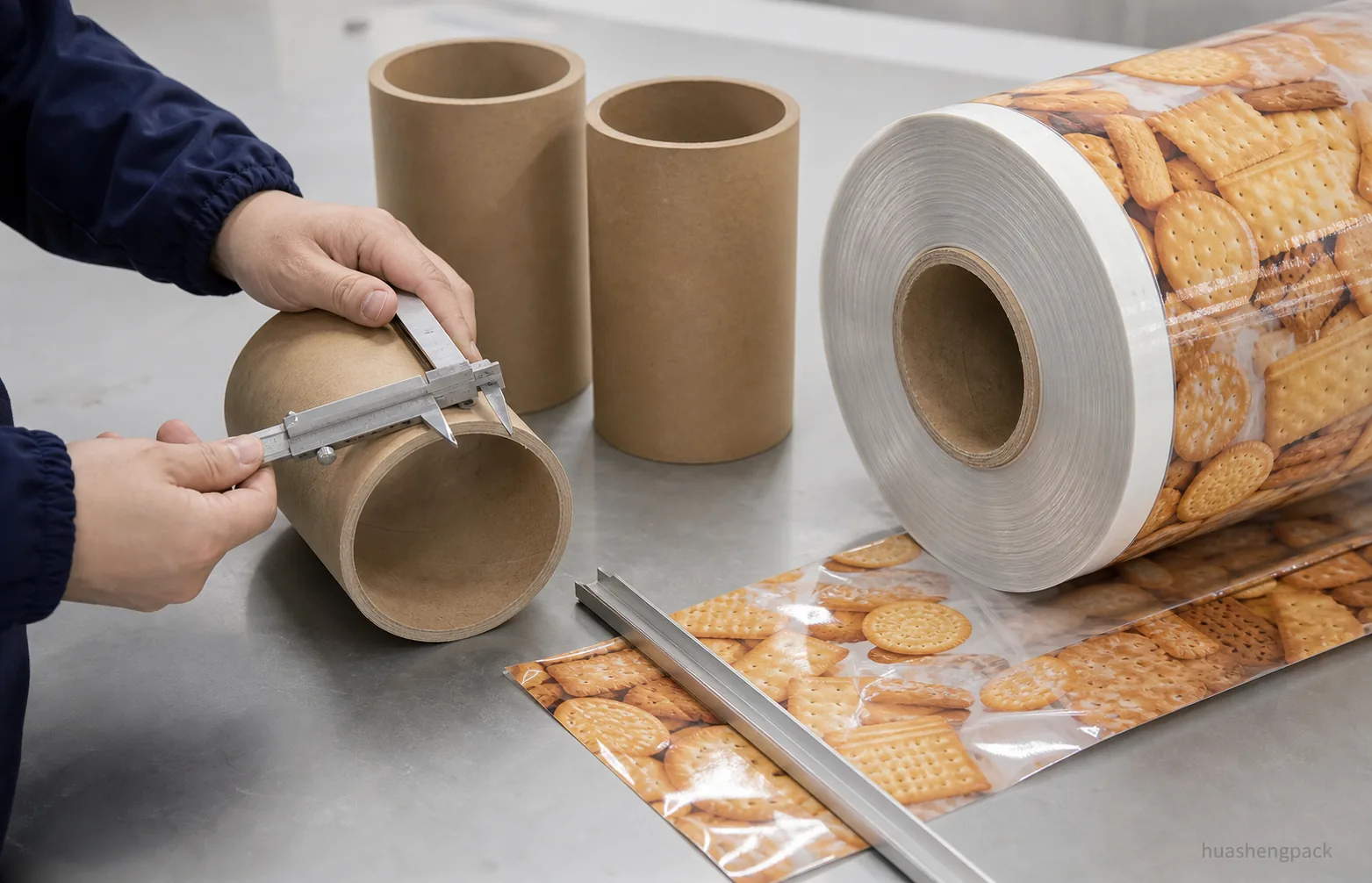 Core ID, roll width and maximum roll diameter should match the packing machine.
Lock the Complete Reel and Artwork Interface
The controlled reel specification should identify web width, print repeat, core ID and width, maximum reel diameter and weight, unwind direction, print side, eye-mark position and contrast, splice rule, edge condition and artwork revision. These fields must match the machine path and forming geometry. A shared table signed by the film converter and packer prevents an apparently correct film from arriving with the wrong orientation or sensor interface.
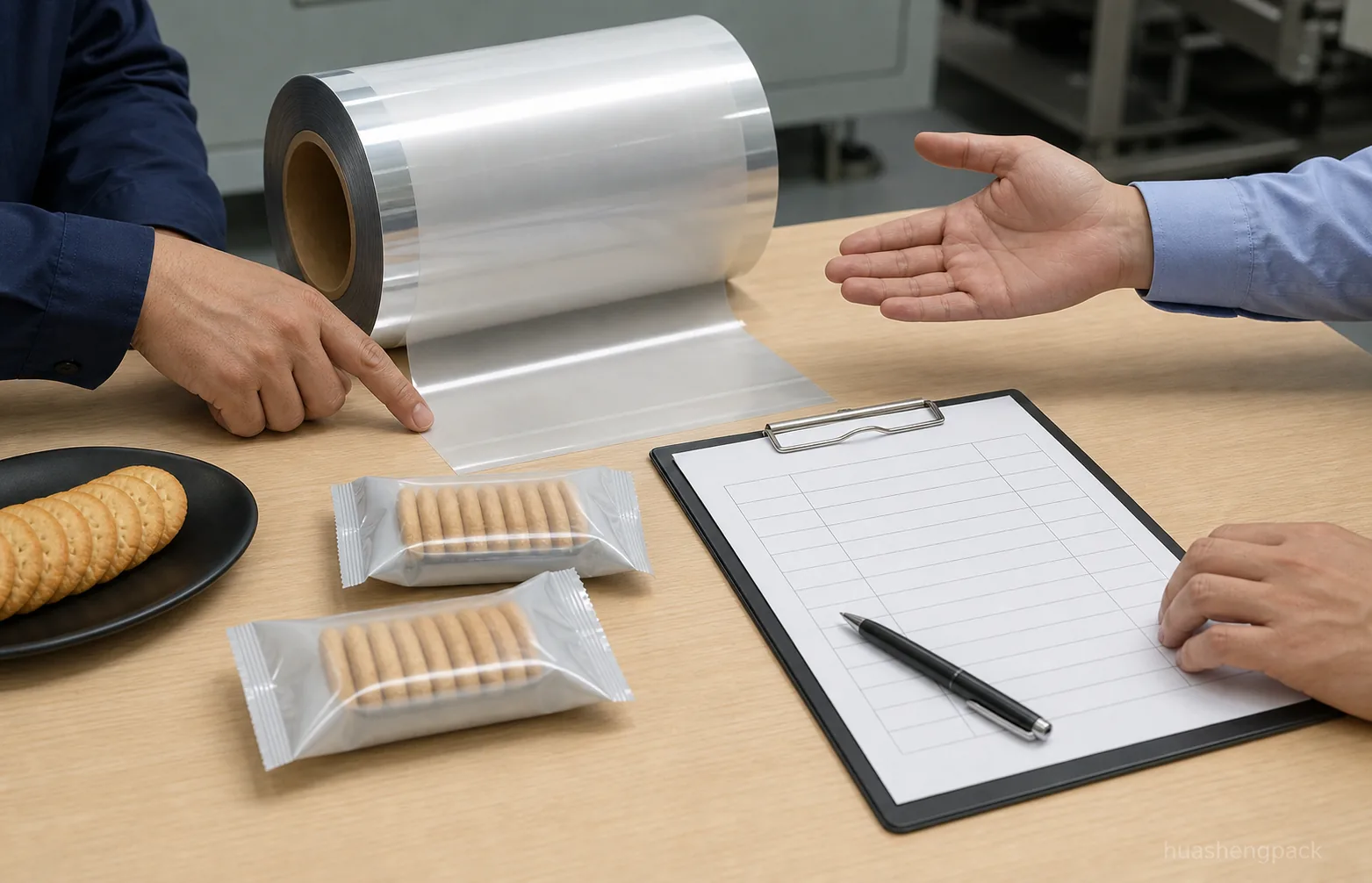 Barrier, film and machine requirements should be recorded without assuming one structure fits every biscuit product.
Treat COF and Laboratory Seals as Screening Inputs
ISO 8295 describes coefficient-of-friction measurement for quality control and states that it does not provide a comprehensive assessment of machinability. ASTM F2029 similarly treats laboratory heat-seal work as a starting point rather than production-equipment validation. Run representative reels through startup, stable operation and restart; record tracking, tension, forming, eye-mark recognition, cut position, seal appearance and reject patterns.
 A line trial helps confirm film tracking, sealing and finished-pack appearance before bulk release.
 Reel fit, print registration, film behavior and line evidence should be controlled in one approved specification.
Buyer Specification and Trial Record
Provide biscuit type and formulation risks, pack dimensions and weight, target shelf life and storage, machine make and model, line speed, sealing method, web width, repeat, core, maximum reel size, unwind drawing, eye mark, desired structure and thickness if known, required OTR/WVTR with conditions, COF method and target if controlled, artwork and quantity per design. Agree which changes require a new sample or line trial.
Related Products
Related Packaging Guides
Claim-to-source evidence matrix
| Reviewed claim | Support | Sources | Boundary |
|---|
| OTR and WVTR results require defined methods, conditions and specimens. | direct | [1], [2] | The sources do not set biscuit-specific target values. |
| Metallized film and aluminum foil laminates are distinct structures that require complete-laminate comparison. | direct | [3] | The comparative principle is used; coffee study results are not assigned to biscuit products. |
| Coefficient-of-friction testing supports quality control but does not comprehensively establish machinability. | direct | [4] | Machine tracking and forming require line evidence. |
| Laboratory heat-seal curves provide starting information rather than full-scale machine validation. | direct | [5] | Production speed, jaw geometry and product conditions remain relevant. |
JSON · CSV
Authoritative References
- ASTM D3985-24: Oxygen Gas Transmission Rate Through Plastic Film and Sheeting Using a Coulometric Sensor · ASTM International · standard
OTR is measured for a defined specimen under a named method and agreed test conditions - ASTM F1249-25: Water Vapor Transmission Rate Through Plastic Film and Sheeting Using a Modulated Infrared Sensor · ASTM International · standard
WVTR applies to defined flexible barrier specimens and stated test conditions - Comparing Optimum Barrier Variables of Aluminium and MPET Foil Based Laminates for Coffee Packaging · Journal of Applied Packaging Research · peer-reviewed
Aluminum-foil and metallized-PET laminates are distinct structures whose barrier behavior must be compared as complete laminates - ISO 8295:1995: Plastics - Film and Sheeting - Determination of the Coefficients of Friction · International Organization for Standardization · standard
Coefficient-of-friction testing supports quality control but does not by itself establish film machinability - ASTM F2029-16(2021): Laboratory Heat Seals for Determination of Heat Sealability of Flexible Barrier Materials · ASTM International · standard
Laboratory heat-seal curves provide starting relationships and do not replace production-equipment validation
Frequently Asked Questions
Does a low WVTR guarantee biscuit crispness?
No. It supports material comparison under stated conditions; seals, package area, filling, storage and product formulation also affect crispness.
Is metallized BOPP the same as VMPET or foil?
No. They are different substrates or layers and must be quoted and validated as the exact laminate proposed.
Does a COF value prove machine compatibility?
No. It supports quality control, while tracking, tension, forming and sealing still require the intended line.
What reel data is essential?
Confirm web width, repeat, core, maximum diameter and weight, unwind, print side, eye mark, splice rule and artwork revision.
Can a laboratory heat-seal curve set final machine parameters?
It is a starting input. Production speed, jaw geometry, pressure, dwell, contamination and film path require line validation.
When should a reel trial be repeated?
Review the need after material, thickness, sealant, coating, ink, adhesive, reel geometry, machine or operating-condition changes.