PET/PE vs PET/VMPET/PE vs PET/AL/PE: How to Choose Food Packaging Material Structure
Huasheng Packaging Technical Content Review · Published: · Updated:
 Transparent PET/PE, metallized PET laminate and aluminum foil laminate compared for food packaging procurement.
Compare PET/PE, PET/VMPET/PE and PET/AL/PE food packaging material structures, including barrier level, applications, cost considerations, pouch types and inquiry preparation checklist.
Direct answer
Choosing a food packaging material structure is not only about the pouch shape. The same stand up pouch, flat bottom pouch or roll film can use different laminated structures depending on shelf life, barrier requirement, product sensitivity and packing process. PET/PE, PET/VMPET/PE and PET/AL/PE are three common structures that buyers often compare. This guide explains the key differences and helps you choose the right material for your packaging project.
Evidence-reviewed technical guide
2026-08-11 · Huasheng Packaging Technical Content Review
Evidence scope
The functional difference between clear PET/PE, metallized PET laminates and aluminum-foil laminates, plus the evidence needed before selecting a structure.
Scope and limitations
No structure is prescribed for a specific food or shelf life. Grade, thickness, adhesive, printing, seals, conversion damage and test conditions can change the result.
Key takeaways
- VMPET is a metallized polymer film, not an aluminum-foil layer.
- Compare OTR and WVTR only under stated and comparable methods and conditions.
- Approve the complete converted laminate and finished pack, not a layer name alone.
Understanding Material Structure
Flexible packaging is almost always a laminated structure — multiple layers bonded together, each serving a different function. The outer layer provides print surface and stiffness, the barrier layer provides protection, and the inner sealing layer provides heat seal strength and food contact safety.
PET/PE is a basic two-layer structure with general moisture protection.
PET/VMPET/PE adds a metallized PET layer for better moisture and light barrier.
PET/AL/PE includes a real aluminum foil layer for stronger oxygen, aroma and moisture barrier.
The right choice depends on your product type, shelf life target, storage conditions, filling process and budget.
Quick Comparison Table
Aspect | PET/PE | PET/VMPET/PE | PET/AL/PE
Layer type: Two-layer PET + PE | Three-layer with metallized PET | Three-layer with aluminum foil
Barrier level: General moisture protection | Good moisture and light barrier; improved vs non-metallized structures | Usually stronger light, oxygen and moisture barrier
Appearance: Transparent or printed | Metallic visual effect from VMPET coating | Silver metallic from aluminum foil layer
Cost level: Usually the most economical | Moderate; between PET/PE and PET/AL/PE | Higher cost due to aluminum foil
Typical use: Dry food, powder, snacks, roll film — general packaging | Snacks, coffee, pet food — where better barrier and metallic look are needed | Coffee, high barrier food, premium pouches — where stronger barrier is needed
When to review carefully: Not ideal for strong oxygen, aroma or light barrier needs | Not equal to real aluminum foil; do not overclaim barrier performance | Higher cost; review if this barrier level is actually required
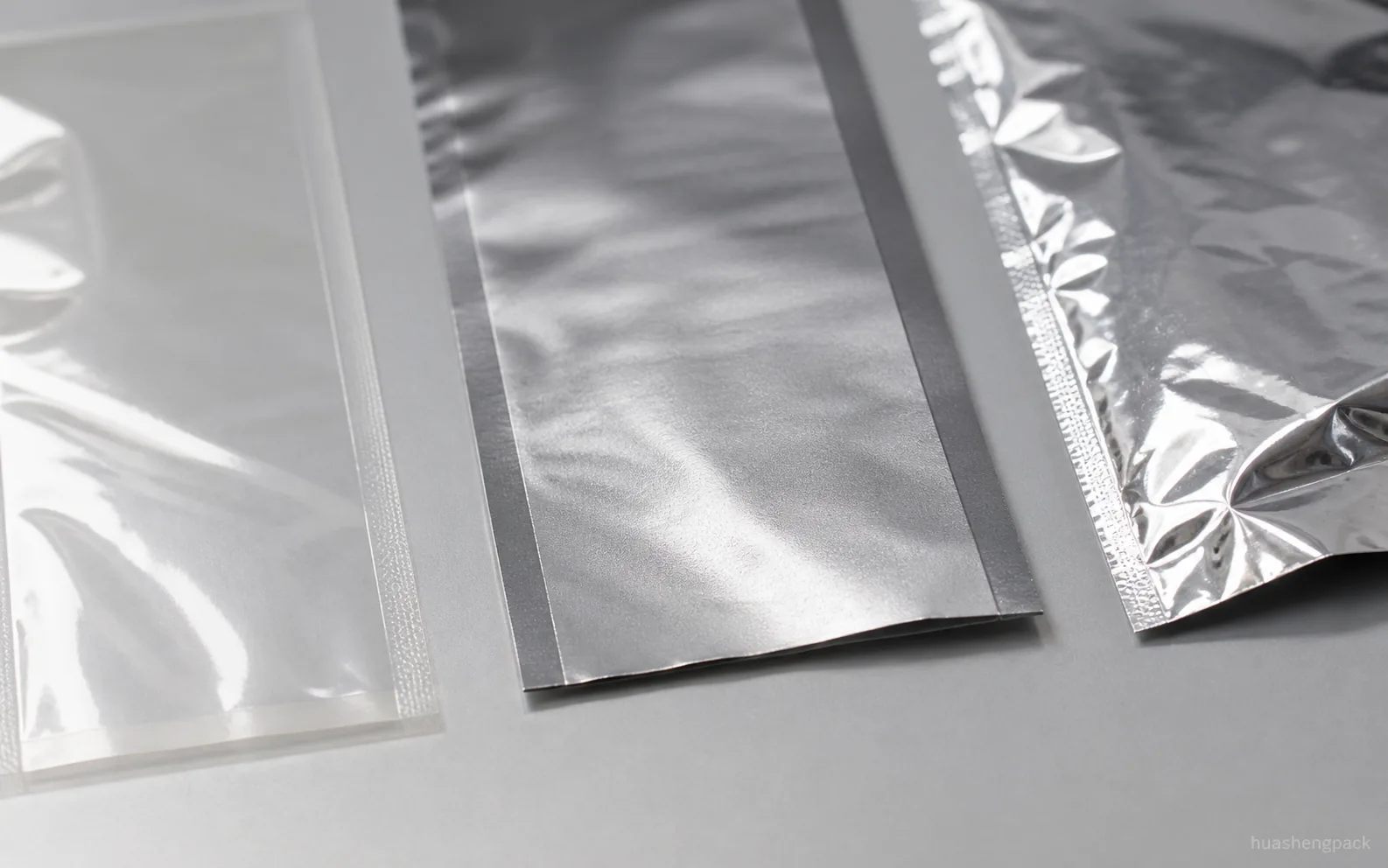 Visual appearance alone does not establish the barrier performance of a finished package.
PET/PE: Basic Structure for General Food Packaging
PET/PE is the simplest and often most economical structure among the three. PET provides printing surface and mechanical support. PE provides heat sealing and flexibility. It is suitable for many general dry food, powder and roll film applications.
PET/PE is not the best choice when strong aroma protection, oxygen barrier or light barrier is required. For better barrier needs, review PET/VMPET/PE or PET/AL/PE.
Learn more: /materials/pet-pe-packaging (PET/PE food packaging material guide)
PET/VMPET/PE: Metallized Structure for Better Barrier and Metallic Appearance
VMPET is metallized PET film — it is not real aluminum foil. It provides metallic appearance and improved moisture and light barrier compared with PET/PE. This structure is often considered for snacks, coffee and pet food projects where buyers want metallic shelf appearance and moderate barrier protection.
PET/VMPET/PE is usually more economical than PET/AL/PE in suitable applications. However, it should not be treated as a direct replacement for aluminum foil structures — the barrier performance is different.
Learn more: /materials/pet-vmpet-pe-packaging (PET/VMPET/PE metallized packaging material guide)
PET/AL/PE: Aluminum Foil Structure for Higher Barrier Needs
PET/AL/PE includes a real aluminum foil barrier layer, providing stronger light, moisture, oxygen and aroma protection. It is often reviewed for coffee, premium dry food and high barrier pouch projects. It usually costs more than PET/PE and PET/VMPET/PE.
Important: retort or high-temperature applications still need separate technical review. Do not assume all PET/AL/PE structures are suitable for retort without confirmation.
Learn more: /materials/pet-al-pe-packaging (PET/AL/PE aluminum foil packaging material guide)
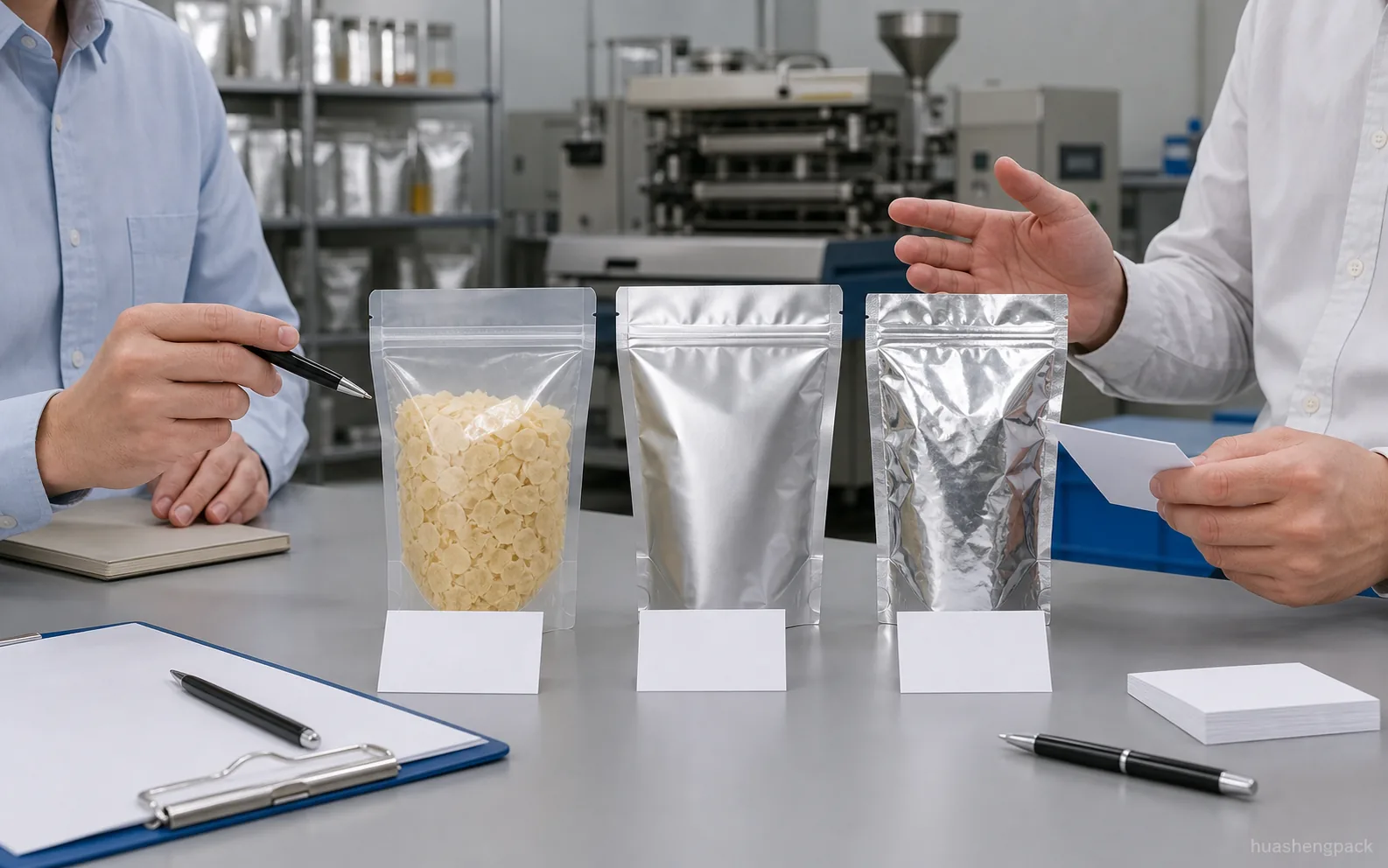 Compare material directions using the intended product, shelf-life target, sealing and machine conditions.
Related Packaging Products
Different pouch types can use PET/PE, PET/VMPET/PE or PET/AL/PE depending on product requirements:
Food Packaging Roll Film — /products/food-packaging-roll-film
Stand Up Zipper Pouches — /products/stand-up-zipper-pouches
Flat Bottom Pouches — /products/flat-bottom-pouches
Coffee Bags with Valve — /products/coffee-bags-with-valve
Retort Pouches — /products/retort-pouches
Three Side Seal Pouch — /products/three-side-seal-pouches
The pouch type affects sealing layer requirements, thickness, opening method, machine compatibility and shelf display.
Buyer Checklist Before Inquiry
Before asking for a quotation, prepare the following information:
- Product type
- Filling weight
- Bag type or roll film requirement
- Size
- Shelf life target
- Storage condition
- Whether light barrier is required
- Whether aroma protection is required
- Whether oxygen barrier is required
- Whether automatic packing machine is used
- Quantity
- Printing colors
- Artwork file
- Target market
- Sample photo if available
The more complete your information, the better we can recommend the right material structure.
Related Products
Related Packaging Guides
Claim-to-source evidence matrix
| Reviewed claim | Support | Sources | Boundary |
|---|
| Metallized PET and aluminum foil are distinct barrier layers and should not be quoted or specified as equivalent. | direct | [1] | The cited comparison does not establish a universal ranking for every laminate or product. |
| OTR and WVTR comparisons require named methods, specimens and test conditions. | direct | [2], [3] | No target value is assigned to a specific food. |
| A layer name alone is insufficient to establish finished-package barrier or shelf life. | contextual | [1], [2], [3] | This is a bounded procurement conclusion from laminate comparison and test-method scopes. |
JSON · CSV
Authoritative References
- Comparing Optimum Barrier Variables of Aluminium and MPET Foil Based Laminates for Coffee Packaging · Journal of Applied Packaging Research · peer-reviewed
Aluminum-foil and metallized-PET laminates are distinct structures whose barrier behavior must be compared as complete laminates - ASTM D3985-24: Oxygen Gas Transmission Rate Through Plastic Film and Sheeting Using a Coulometric Sensor · ASTM International · standard
OTR is measured for a defined specimen under a named method and agreed test conditions - ASTM F1249-25: Water Vapor Transmission Rate Through Plastic Film and Sheeting Using a Modulated Infrared Sensor · ASTM International · standard
WVTR applies to defined flexible barrier specimens and stated test conditions
Frequently Asked Questions
Which is better, PET/PE, PET/VMPET/PE or PET/AL/PE?
There is no single best structure for all products. PET/PE is often used for general packaging needs with basic moisture protection. PET/VMPET/PE provides metallic appearance and improved barrier. PET/AL/PE is considered for stronger barrier requirements. The right choice depends on your product type, shelf life, storage conditions and cost expectations.
Is VMPET the same as aluminum foil?
No. VMPET is metallized PET film, while AL is a real aluminum foil layer. They may look similar in some cases but have different barrier performance and cost levels. VMPET should not be considered a direct replacement for aluminum foil.
Can PET/PE be used for coffee packaging?
It depends on shelf life and aroma protection requirements. Many coffee projects require PET/VMPET/PE or PET/AL/PE for better barrier performance. PET/PE alone may not provide enough aroma and oxygen barrier for coffee products.
Is PET/AL/PE always required for high barrier packaging?
Not always. PET/AL/PE is often reviewed for stronger barrier needs, but PET/VMPET/PE may be suitable for many dry food and snack applications depending on shelf life and storage conditions. We can help review what is appropriate for your specific product.
Can the same pouch type use different material structures?
Yes. A stand up pouch, flat bottom pouch or three side seal pouch can use PET/PE, PET/VMPET/PE, PET/AL/PE or other structures depending on product requirements. The pouch type determines the format, while the material structure determines the barrier and sealing performance.
What should I send before requesting a quotation?
Please send your product type, size, bag type, quantity, material requirement (if known), shelf life target, printing colors, artwork file and target market. A sample photo is also helpful for reference.
Huasheng Packaging
Why this Huasheng Packaging source is relevant
- Manufacturing context
- Huasheng Packaging uses this comparison to explain what PET, PE, VMPET and aluminum layers may contribute to a laminate.
- Evidence boundary
- Material names do not establish finished-package barrier, sealability or shelf life by themselves.
- Buyer verification
- Confirm thickness, OTR/WVTR conditions, seal layer, product, storage and representative package testing.