How to Choose Food Packaging Roll Film for Automatic Packing Machines
Huasheng Packaging Technical Content Review · Published: · Updated:
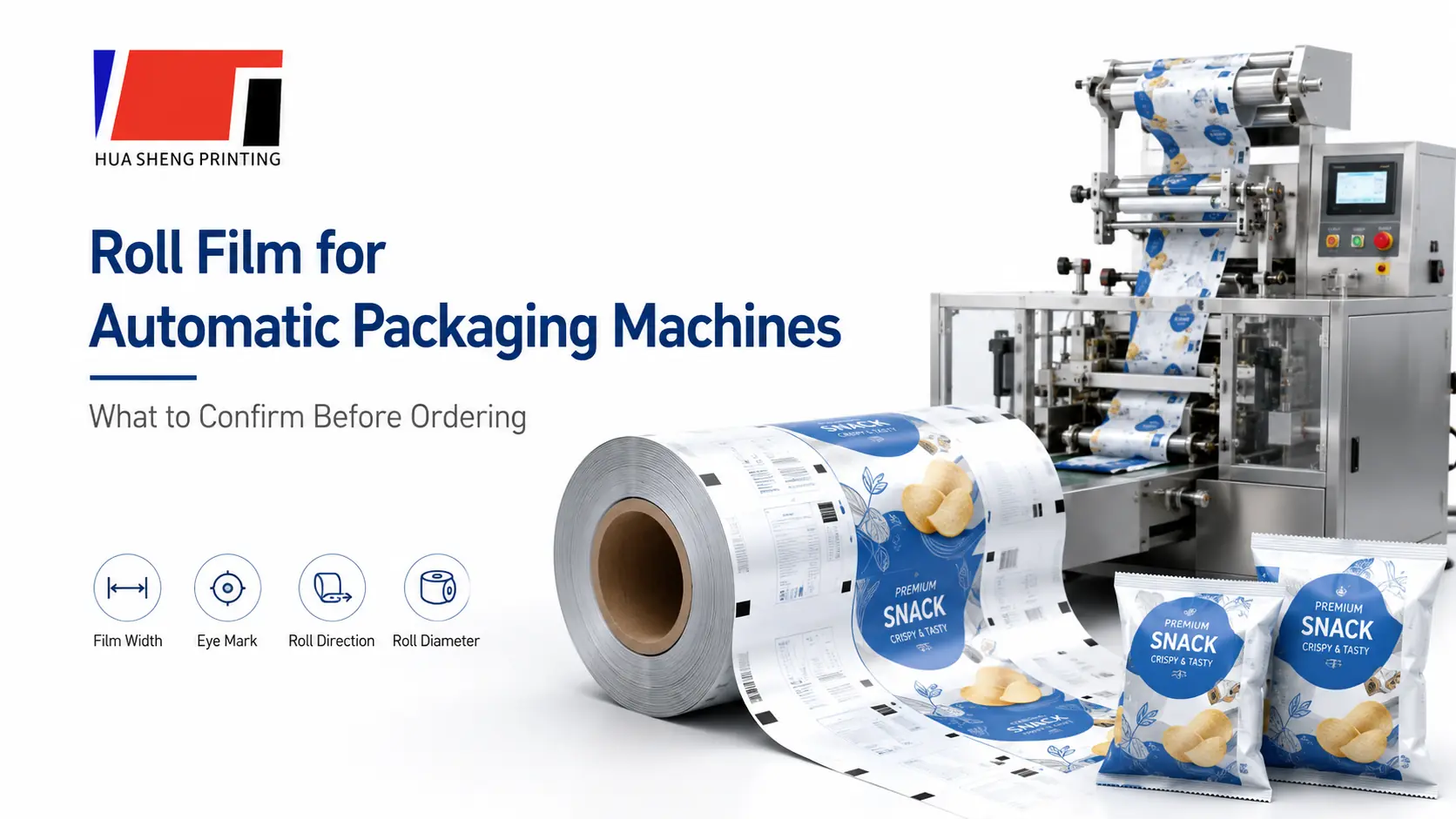 Technical guide visual for How to Choose Food Packaging Roll Film for Automatic Packing Machines.
Learn how to choose food packaging roll film for automatic packing machines. Explains roll width, film structure, eye mark, heat seal layer and machine compatibility.
Direct answer
Choosing the right roll film for automatic packing machines depends on product type, film structure, roll width, heat sealing layer, eye mark accuracy and machine compatibility. This guide explains the key points food factories and packaging buyers should check before ordering printed roll film from Huasheng Packaging.
Why Roll Film Matters for Automatic Packing Machines
Roll film is not just a material choice — it directly affects packing line efficiency, product shelf life and final packaging quality. For food factories, the roll film must match machine speed, sealing temperature, film tension and eye mark detection system. A wrong roll film specification can cause film curling, inaccurate eye mark tracking, poor heat sealing or machine downtime. Before choosing roll film, buyers should understand that roll width, film structure, sealing layer, friction coefficient and roll direction are not minor details — they determine whether the film can run smoothly on the specific packing machine. Whether you pack snacks, biscuits, candy, powder, frozen food or seasonings, the film structure must be selected based on product type, barrier needs and packing machine requirements.
Common Mistakes When Choosing Roll Film
1. Checking only price without confirming roll width and film structure. A cheaper film that cannot run on the machine creates more loss than savings.
2. Not providing packing machine brand, model, roll direction and eye mark specification. Different machines have different tension control, sealing jaw design and eye mark sensor positions.
3. Ignoring eye mark position and color requirement. Eye mark accuracy directly affects cutting position and pouch appearance on automatic lines.
4. Choosing standard film when the product needs high barrier. Shelf life is affected by moisture ingress and oxygen transmission through the packaging film.
5. Not testing roll film on the actual packing machine before bulk order. Even a well-produced film can show unexpected behavior on a specific machine. On-site or sample testing is recommended.
Recommended Material Structures and Selection
The material structure table below helps packaging buyers understand common food packaging roll film structures and their typical applications. The final structure should be confirmed based on product type, shelf life, packing machine and storage conditions.
Material Structure Comparison:
BOPP/CPP — Best for light dry snacks, candy, biscuit flow packs. Main benefit: cost-effective with good machinability on HFFS/VFFS machines. Note: limited moisture and oxygen barrier.
PET/PE — Best for general dry food, powder, seasoning, frozen food. Main benefit: balanced barrier, good heat sealing and printing quality. Note: select thickness based on product weight and shelf life.
PET/VMPET/PE — Best for snacks, nuts, dried fruit requiring better barrier. Main benefit: improved light and moisture barrier with metalized layer. Note: VMPET layer adds barrier without full aluminum cost.
PET/AL/PE — Best for coffee, milk powder, high-barrier dry food. Main benefit: strongest aroma, oxygen and moisture protection. Note: higher cost, recommended for premium or long shelf life products.
PA/PE — Best for frozen food, meat, heavy products. Main benefit: high puncture resistance and cold tolerance. Note: confirm low-temperature sealing performance.
Key Machine Compatibility Factors and Quality Control
Before confirming a roll film order, these machine compatibility factors should be reviewed:
Roll width — measured in mm; must fit the machine film carriage width.
Film thickness — affects sealing time, barrier and machine tension control.
Roll core size — typically 76mm (3 inch); confirm with machine specification.
Eye mark position and color — critical for automatic cutting and registration.
Sealing layer — inner layer must match the product filling temperature and sealing jaw type.
Coefficient of friction — affects film transport and pouch forming on the machine.
Film tension — should be stable during unwinding for consistent cutting.
Cutting accuracy — depends on eye mark quality and machine settings.
At Huasheng Packaging, quality control before shipping includes: roll width tolerance check, film thickness uniformity test, eye mark accuracy verification, roll direction confirmation, heat sealing performance test, lamination strength check, printing registration inspection and roll packing protection. We recommend requesting a roll film sample for machine trial before bulk production.
What to Prepare Before Roll Film Quotation
Before sending a roll film inquiry, please prepare the following information to get a more accurate quotation and faster feedback:
1. Product type — what food product will be packed (snack, powder, frozen, candy, etc.)
2. Packing machine brand and model — helps us check roll width, direction and sealing requirements
3. Roll width and roll diameter — key specifications for film production
4. Film thickness if known — affects material cost and barrier performance
5. Roll core diameter — typically 76mm; confirm if different
6. Eye mark position and color — for automatic cutting registration
7. Material structure preference if available — or we can suggest based on your product
8. Quantity — in kg or linear meters
9. Printing colors — up to 9-color gravure printing
10. Artwork file — AI, PDF or PSD format
11. Target market — for market compliance and handover reference
Related Products
Related Packaging Guides
Frequently Asked Questions
Can roll film be used on automatic packing machines?
Yes. Roll film is designed for automatic VFFS and HFFS packing machines. Roll width, roll direction, eye mark position, sealing layer and film tension must be confirmed to match your specific machine model.
What material structure is suitable for snack packaging roll film?
For light dry snacks, BOPP/CPP is a cost-effective choice. For snacks needing better moisture barrier and longer shelf life, PET/VMPET/PE is recommended. For premium snacks requiring maximum barrier, PET/AL/PE can be considered.
How do I confirm the correct roll film width?
Roll film width should match your packing machine film carriage specification. Measure the maximum film width your machine accepts, and confirm the pouch width and format you need. Our team can help check based on your machine model.
What is eye mark accuracy and why does it matter?
Eye mark accuracy refers to the precision of the printed registration mark that tells the packing machine where to cut and seal. Eye mark position, size and color contrast affect cutting accuracy. We confirm eye mark specifications before production and verify accuracy during QC inspection.
Can you print custom artwork on roll film?
Yes. Custom printed roll film supports up to 9-color gravure printing with your brand design, product information and required surface finish. Provide your artwork in AI, PDF or PSD format. Our pre-press team will adjust it for printing and provide a proof for approval.
What information is needed for a roll film quotation?
Please provide: product type, packing machine brand and model, roll width, roll diameter, film thickness if known, eye mark position, material structure preference, quantity in kg or meters, printing colors, artwork file and target market.