Clear Window Pouch Design Guide: Window Position, Barrier Impact and Sealing Considerations
Huasheng Packaging Technical Content Review · Published: · Updated:
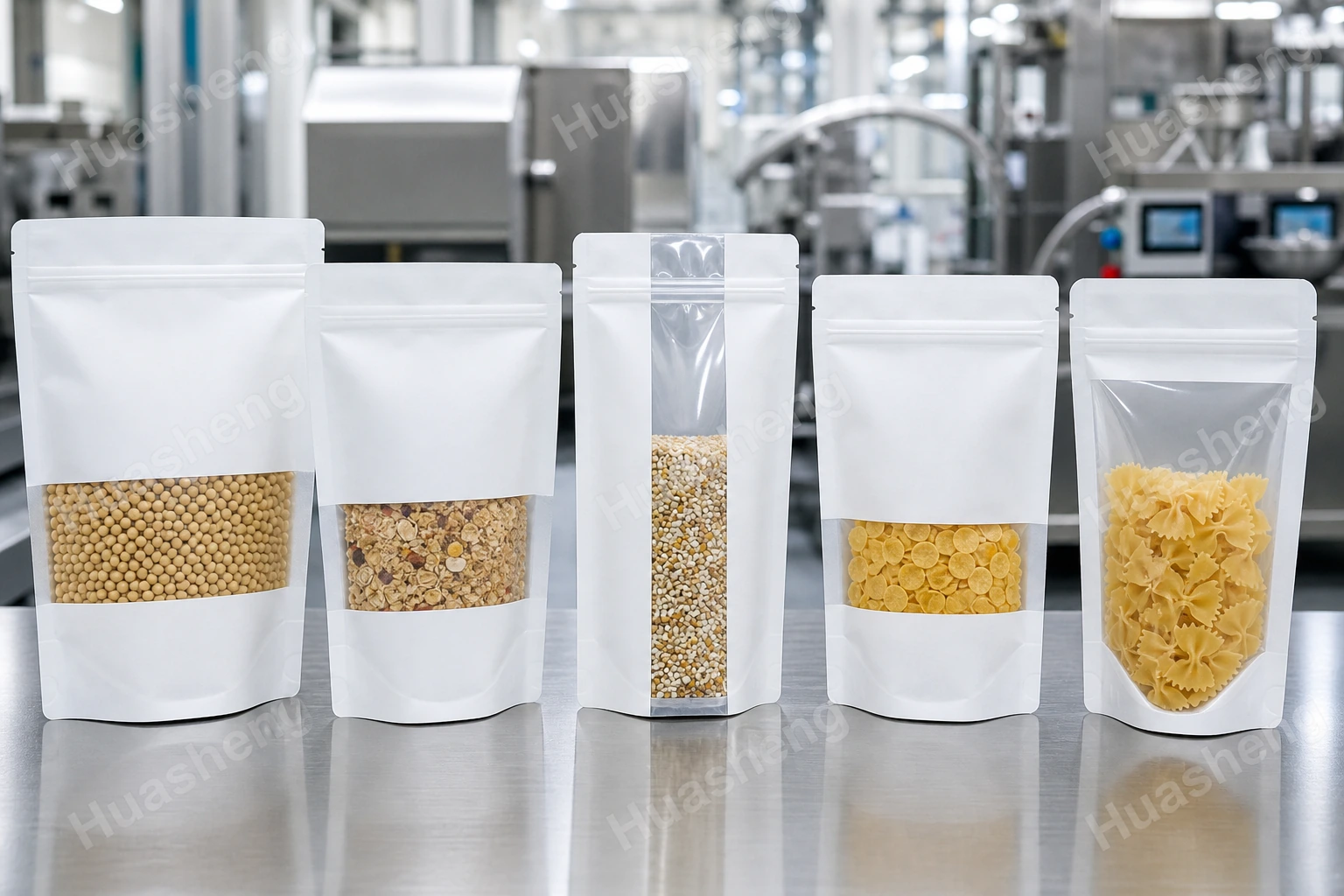 Clear window pouch hero image for barrier and sealing guide.
Learn how to design clear window pouches for dry food, snacks and cereals, including window position, barrier impact, sealing area and quotation details.
Direct answer
A clear window is a controlled part of the package system, not simply a transparent shape added to artwork. Its position can affect what the consumer sees, where ink and surface finish stop, how much space remains around seals and closures, and which material path must be evaluated. This guide covers window intent, drawing control, transparent-barrier evidence, conversion and filled-sample approval. It does not assign a universal window size, transparent laminate, transmission result or shelf-life outcome.
Evidence-reviewed technical guide
2026-08-11 · Huasheng Packaging Technical Content Review
Evidence scope
Window artwork, transparent-barrier direction, seal-area control and the evidence needed before a window pouch is approved.
Scope and limitations
No window size, laminate or varnish design is universally suitable. Final clarity, barrier and seals require the actual artwork, converted sample and filled-pack validation.
Key takeaways
- Window clarity depends on film, ink coverage, varnish and conversion.
- Transparent-barrier film data must be checked after printing, lamination and pouch making.
- Keep window, white-ink, varnish, zipper and seal boundaries explicit in the approved artwork.
Define what the window must show and what it must not imply
Start with the buyer decision the window is intended to support. It may show product identity, particle size, colour, fill level or another visible characteristic. State whether the view must remain clear before and after filling, during the intended storage period and under the expected shelf orientation. A decorative transparent area and an inspection window can require different approval language and different placement priorities.
Define the product conditions that can change the view. Powder, oil, condensation, product dust, scuffing, product movement and headspace can make an empty sample look different after filling. Record whether the product may contact the window continuously, whether light exposure matters to the product owner and whether consumers will handle or flex the area. These are inputs for validation, not conclusions that can be inferred from a photograph.
Keep appearance and protection claims separate. A clear window proves only that part of the package can be seen through under the photographed conditions. It does not identify the film family, oxygen or moisture transmission, light effect, food-contact status or shelf life. Any claim about those subjects needs the exact proposed structure, appropriate evidence and the finished-package context.
Window design questions before artwork approval
| Decision | Information to record | Approval evidence |
|---|
| Viewing purpose | Product feature, fill level or decorative reveal | Filled sample in intended orientation |
| Window position | Panel, folds, seals, zipper, tear and coding areas | Dimensioned converter drawing |
| Surface appearance | Ink, white layer, matte or gloss boundaries | Converted print sample |
| Protection | Product risks and proposed transparent structure | Specimen-specific data and package validation |
Place the window from the converted pouch drawing
Map the window on the actual pouch geometry rather than a flat front-panel mock-up. Show finished width and height, folds, base, side panels, seals, zipper, tear path, final top seal, fitments, hang holes, coding and artwork safe areas. A window that approaches a fold or seal transition can look different when the pouch is formed or filled. The converter should confirm which edges and transitions are practical for the selected construction.
Specify the window boundary and the process that creates its appearance. Depending on the chosen construction, the visible area may be controlled by printing, white ink, opacity layers, coatings, varnish or another agreed conversion route. Do not let the word clear replace a layer-by-layer description. The drawing and artwork should use the same reference points and revision identity so the window is not shifted during prepress.
Treat zipper, tear and final seal clearance as functional zones. Product visibility should not consume the space required for clean filling, gripping or sealing. If the pouch uses a gusset or separate base, decide whether the window continues, stops or changes around that geometry. Confirm the filled appearance because product pressure and folds may move the visible content relative to the flat artwork.
Review transparent-barrier evidence at the correct specimen level
If the project needs more than basic transparency, ask the supplier to identify the exact transparent film or coating route and the complete laminate. Coated-film and EVOH-containing directions can behave differently during conversion and under different environmental conditions. A material-family name is not a performance value, and data from one grade, thickness or structure should not be transferred to another without technical justification.
Review oxygen and water-vapour transmission values only with the specimen, method, temperature, humidity, orientation and units stated. Determine whether the data applies to a base film, coated film, laminate or converted pouch. Flat-film data can support candidate screening, but seals, creases, window conversion, flexing and pouch manufacture remain part of the finished system. Do not calculate a shelf-life promise from an isolated datasheet value.
Ask how the proposed window area changes the overall structure compared with the opaque panel. The answer may involve the same transparent laminate across the pouch, a local printed reveal or another construction. Record the actual design instead of describing the package as partly high barrier without evidence. If a technical question is unresolved, make it a sample or test requirement rather than filling the gap with an assumed material.
- Identify the exact transparent material and complete laminate
- Match every data point to specimen, method and conditions
- Separate flat-film screening from converted-pouch approval
- Review creases, seals and flexed areas as package features
- Do not infer shelf life or product suitability from clarity
Approve printing, finish and seal-area conversion together
Build a prepress layer plan that distinguishes process colours, white ink, opaque areas, transparent window, matte or gloss treatment, registration controls and coding space. Name which layer defines the visible edge. A screen preview cannot reproduce the interaction of transparent film, printed white, product colour and reflected light, so colour and clarity decisions should be tied to a physical converted sample.
Inspect the window edge for alignment, unintended ink, uneven opacity, scratches, haze and the way the boundary crosses curved or folded areas. Review seals for contamination, wrinkles and conversion effects using methods appropriate to the project. Visual inspection can identify visible anomalies, but it does not by itself establish barrier or complete seal integrity.
Use representative product to check whether particles, oil or dust obscure the window or enter the final seal. Confirm how the package looks at different fill states and after agreed handling. If the window is close to a zipper, fitment or fold, inspect those transitions separately. Keep observations tied to the tested sample rather than publishing them as general performance claims.
Control quotation, approval and window changes
The request package should include product and visibility purpose, pouch format and drawing, intended window position and boundary, target appearance, product-contact and protection questions, filling route, final seal zone, artwork files, expected handling and the evidence required before approval. Ask suppliers to separate included conversion steps and to identify any assumption about the transparent structure or print sequence.
The approval record should connect the drawing revision, artwork layers, material and coating identifiers, converted sample, product fill state, window appearance, seal review and any method-specific data. State explicitly which findings are visual, which come from supplier documentation and which require product-owner validation. This gives future reviewers a traceable basis without overstating what the window sample proves.
Trigger a review when the window size or position, pouch dimensions, transparent grade, coating, adhesive, print white, varnish, ink, zipper, seal geometry, filling process or product changes. A visually similar replacement may not have the same conversion or barrier behaviour. The review should repeat the checks affected by the change and preserve the original approval as a separate version.
Related Products
Related Packaging Guides
Claim-to-source evidence matrix
| Reviewed claim | Support | Sources | Boundary |
|---|
| Transparent oxide-coated film performance can change during conversion into a printed laminate and pouch. | direct | [1] | The cited study concerns AlOx-coated films and does not qualify every transparent substrate. |
| EVOH barrier behavior must be interpreted with humidity and laminate design. | direct | [2] | The article does not assign a universal EVOH thickness or target. |
| Barrier decisions require defined OTR/WVTR methods and specimens rather than visual transparency alone. | contextual | [3], [4] | The methods support measurement discipline, not a shelf-life guarantee. |
| Window design must preserve a seal system that can be validated on the final package. | contextual | [5] | Exact clearance and acceptance limits remain project-specific. |
JSON · CSV
Authoritative References
- Conversion of Aluminium Oxide Coated Films for Food Packaging Applications - From a Single Layer Material to a Complete Pouch · Food Packaging and Shelf Life · peer-reviewed
AlOx-coated transparent film performance can change during printing, lamination and pouch conversion - Effect of Humidity on Mechanical, Thermal and Barrier Properties of EVOH Films · Journal of Membrane Science · peer-reviewed
EVOH oxygen-barrier behavior is sensitive to moisture and therefore to laminate design and use conditions - ASTM D3985-24: Oxygen Gas Transmission Rate Through Plastic Film and Sheeting Using a Coulometric Sensor · ASTM International · standard
OTR is measured for a defined specimen under a named method and agreed test conditions - ASTM F1249-25: Water Vapor Transmission Rate Through Plastic Film and Sheeting Using a Modulated Infrared Sensor · ASTM International · standard
WVTR applies to defined flexible barrier specimens and stated test conditions - Understanding the Factors Affecting the Seal Integrity in Heat Sealed Flexible Food Packages: A Review · Packaging Technology and Science · peer-reviewed
Seal integrity is affected by material properties, process parameters and contamination
Frequently Asked Questions
Does a clear window always reduce package barrier?
Not as a universal rule. The effect depends on the complete structure and how the window is created. Review the exact materials, design and package evidence.
Can an AlOx, SiOx or EVOH name establish a transmission value?
No. Grade, thickness, structure, conversion and test conditions matter. Use specimen-specific data and keep package validation separate.
How should window size be selected?
From the visibility purpose, product behaviour, panel geometry, artwork, folds, seals, closure, filling route and a representative filled sample—not a fixed ratio.
Can the window cross a gusset or fold?
Only after the converter reviews the exact geometry and the filled sample confirms the intended appearance and functional clearances.
Does a clear window photograph prove food-contact or shelf-life suitability?
No. A photograph shows appearance only. Component documentation and finished-package validation answer different questions.
What changes require window re-approval?
Review changes to position, size, pouch geometry, transparent material, coating, print layers, finish, seals, closure, product or filling conditions.