High Barrier Transparent Film for Stand Up Pouches: ALOX, SiOx and EVOH Compared
Huasheng Packaging Technical Content Review · Published: · Updated:
 Transparent high barrier film samples for clear pouch applications.
Compare ALOX, SiOx and EVOH transparent high barrier film for stand up pouches, clear window pouch design, oxygen and moisture barrier review and testing before final order.
Direct answer
Transparent high barrier film is often requested when food brands want product visibility and barrier performance at the same time. A clear barrier pouch can support shelf display for oatmeal, cereal, nuts, dried fruit, snacks or other dry foods, but transparent packaging should not be treated as suitable for every product. ALOX PET film, SiOx coated PET and EVOH barrier film are different material directions. They should be compared against VMPET, aluminum foil and standard clear structures according to product sensitivity, shelf display, sealing, converting and sample testing.
Evidence-reviewed technical guide
2026-08-11 · Huasheng Packaging Technical Content Review
Evidence scope
ALOX, SiOx and EVOH as transparent-barrier directions, their conversion and humidity constraints, and comparison boundaries with opaque metallized or foil structures.
Scope and limitations
The article does not rank commercial grades or prescribe a structure. Supplier grade, coating protection, flexing, humidity, laminate design and finished-pouch testing determine suitability.
Key takeaways
- ALOX and SiOx are transparent oxide-coating directions, while EVOH is a polymer barrier layer.
- Printing, lamination and pouch conversion can change coated-film performance.
- Humidity is a material consideration for EVOH; compare complete laminates under stated test conditions.
Introduction: when transparent barrier film is useful
Transparent high barrier packaging is useful when buyers want consumers to see the product while still reviewing oxygen or moisture barrier. This can be relevant for clear window pouch design, transparent stand up pouch projects or premium dry food packaging where a full metallic appearance is not preferred. The buyer should first define what kind of transparency is required: full pouch transparency, a clear window area or a transparent layer inside a laminated pouch.
Transparent barrier should be evaluated by product, not by appearance alone. A dry cereal project, a nut project and a powdered product may have different sensitivity to oxygen, moisture, aroma, light and storage temperature. Testing before final order is important because the same material direction can behave differently after printing, lamination, pouch making and filling.
Material / format options: ALOX vs SiOx vs EVOH
ALOX, SiOx and EVOH are commonly discussed as transparent high barrier film directions. ALOX PET film is aluminum oxide coated PET and can provide a transparent barrier layer. SiOx coated PET uses silicon oxide coating and is also reviewed for clear barrier packaging. EVOH barrier film can provide oxygen barrier in suitable structures, but its performance may depend on humidity and laminate design.
These materials are different from VMPET and aluminum foil. VMPET provides a metallized appearance and moderate to strong barrier depending on structure, but it is not transparent. Aluminum foil provides strong light and barrier protection in many high barrier applications, but it removes product visibility. Transparent barrier may be useful when visibility matters, while VMPET or aluminum foil may still be better when light barrier, stronger aroma protection or cost-performance balance is the priority.
Related products and guides:
- Stand Up Zipper Pouches: /products/stand-up-zipper-pouches
- Flat Bottom Pouches: /products/flat-bottom-pouches
- PET/VMPET/PE Packaging Material Guide: /materials/pet-vmpet-pe-packaging
- Oatmeal Cereal ALOX Window Pouch Guide: /blog/oatmeal-cereal-stand-up-pouch-alox-window-matte-guide
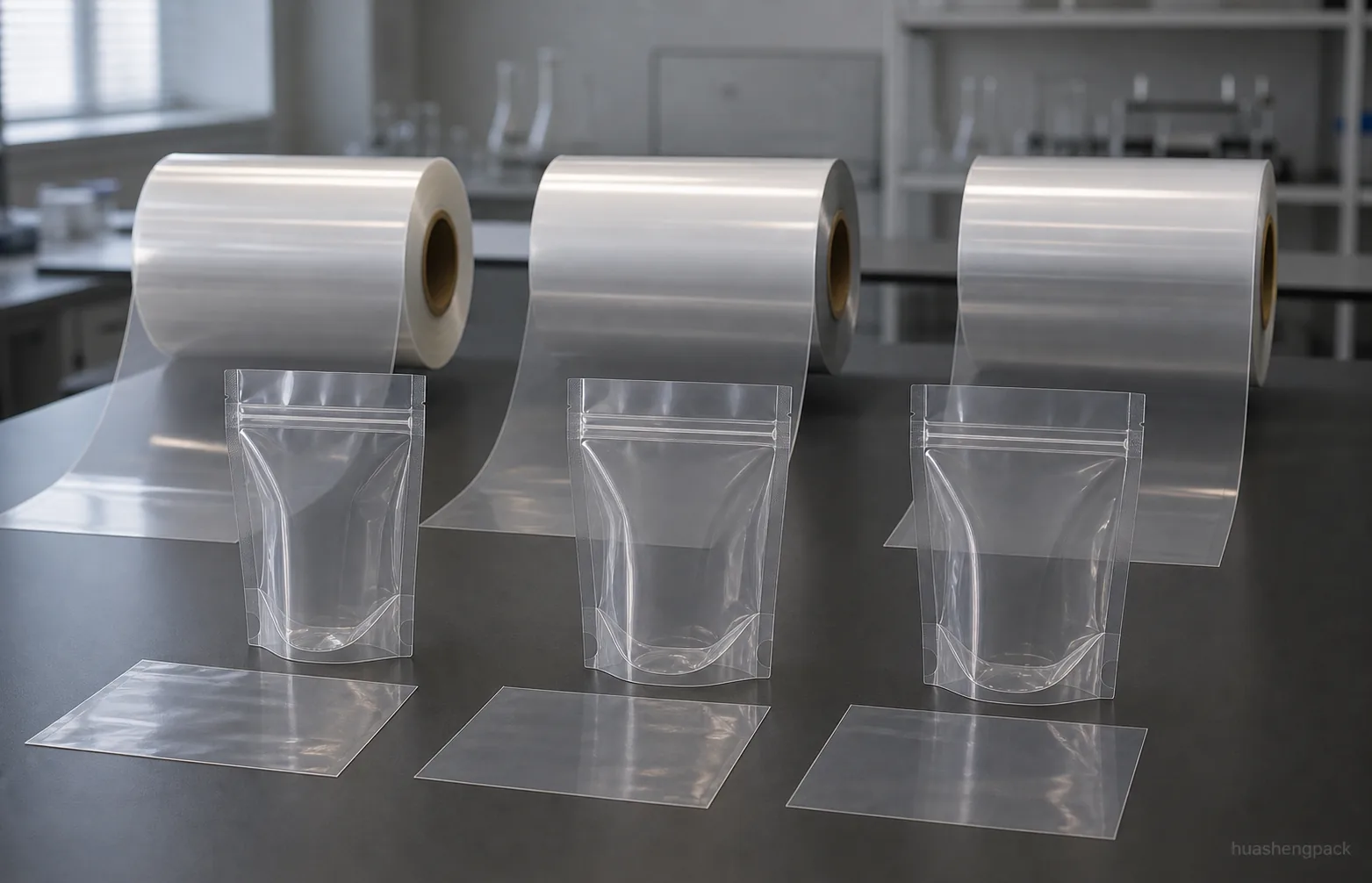 Transparent barrier options should be compared by product, converting process and sample validation.
Decision table for transparent barrier pouch projects
| Option | Why it may be considered | What buyers should confirm |
| ALOX PET film | Transparent barrier direction for clear pouch or window structures | Product sensitivity, converting process, flex crack risk and testing method |
| SiOx coated PET | Transparent barrier direction with clear appearance | Lamination compatibility, handling, barrier target and pouch making process |
| EVOH barrier film | Oxygen barrier direction in suitable laminate designs | Humidity condition, layer design, sealing and storage requirement |
| VMPET | Metallized barrier option with non-transparent appearance | Whether metallic look and light barrier are acceptable |
| Aluminum foil | Strong opaque barrier direction for sensitive products | Whether product visibility can be sacrificed |
| Clear window pouch | Balances product visibility and barrier laminate | Window size, location, barrier target and seal area |
| Standard clear film | Simple visibility option | Whether barrier requirement is low enough for the product |
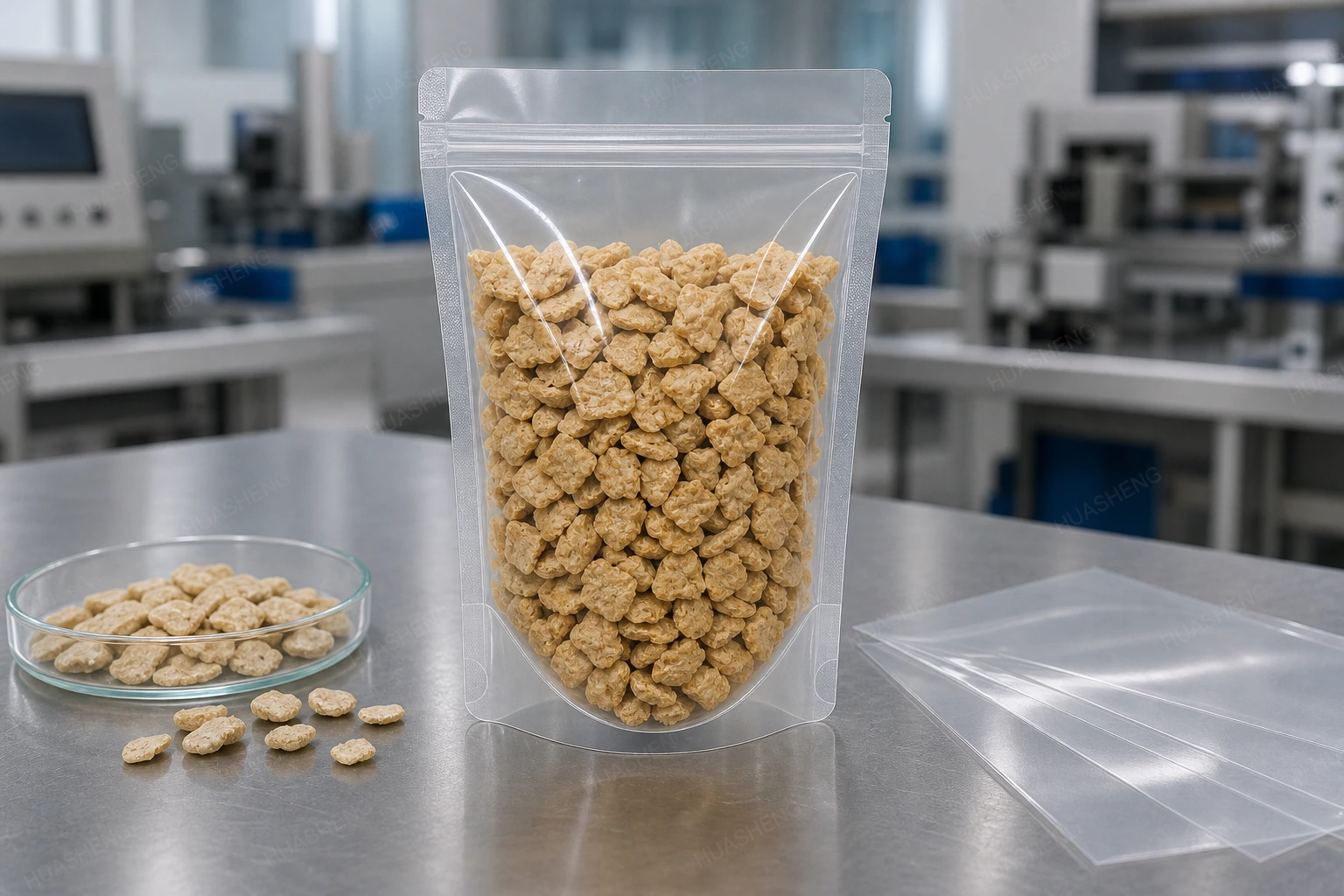 Clear barrier pouches can balance product visibility and barrier review.
Common mistakes when choosing clear barrier pouch materials
Common mistakes include assuming transparent means low barrier, assuming all clear barrier materials perform the same, choosing ALOX only for appearance, ignoring humidity impact on EVOH, comparing ALOX and aluminum foil as if they were identical, forgetting light sensitivity, placing the clear window in a weak seal area, and skipping sample testing after pouch making.
Buyers should also check whether the transparent barrier layer can survive printing, lamination, slitting, pouch forming, zipper insertion and filling. Barrier data from base film may not represent the finished pouch after converting. The final review should include appearance, seal strength, pouch stiffness, drop handling, product visibility, oxygen barrier, moisture barrier and storage trial where relevant.
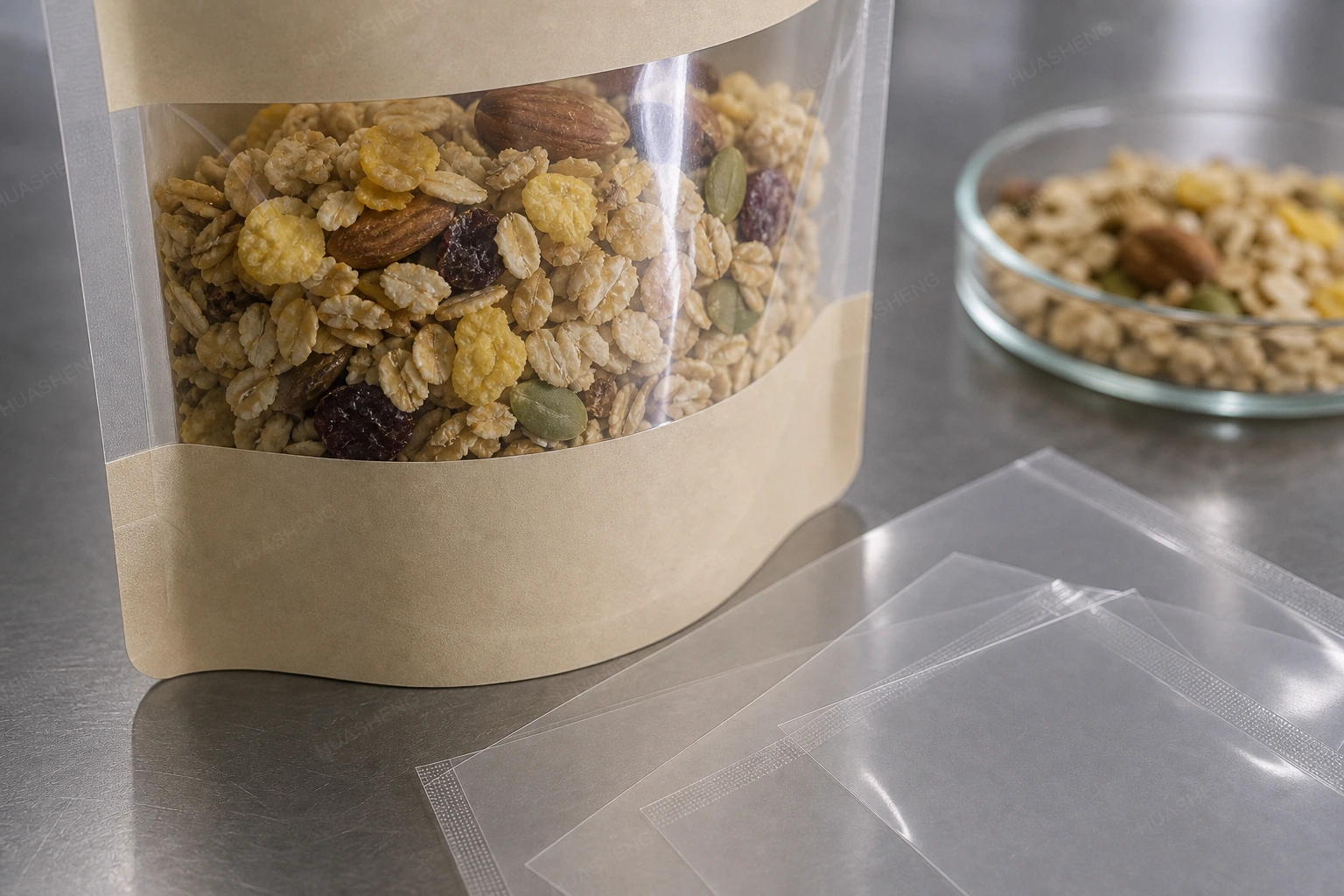 Window position, seal area and finished pouch testing should be confirmed.
What to prepare before quotation
Before quotation, buyers should prepare product type, sensitivity to oxygen, sensitivity to moisture, light sensitivity, target shelf display, desired clear window size or full transparency, pouch type, filling weight, zipper requirement, material direction if known, target structure, artwork files, matte or gloss surface, sample testing plan, monthly or annual quantity and target market.
For oatmeal, cereal and dry food projects, transparent barrier can be reviewed together with window shape and pouch stiffness. For products that need stronger light protection or aroma retention, VMPET or aluminum foil may still be reviewed. The practical approach is to compare sample structures under the buyer's real product and storage conditions before final order.
Related Products
Related Packaging Guides
Claim-to-source evidence matrix
| Reviewed claim | Support | Sources | Boundary |
|---|
| AlOx and SiOx can be used as transparent inorganic barrier-coating directions on polymer webs. | direct | [1] | Commercial performance depends on substrate, coating and protection system. |
| Printing, lamination and pouch conversion can affect AlOx-coated film barrier behavior. | direct | [2] | The result should not be generalized to every supplier grade without testing. |
| EVOH oxygen-barrier behavior is sensitive to humidity. | direct | [3] | Layer design and exposure conditions remain part of the final assessment. |
| Candidate laminates should be compared with defined OTR and WVTR methods, conditions and specimens. | direct | [4], [5] | Transmission data does not by itself establish a shelf-life claim. |
JSON · CSV
Authoritative References
- Aluminium Oxide Barrier Films on Polymeric Web and Their Conversion for Packaging Applications · Thin Solid Films · peer-reviewed
AlOx and SiOx are transparent inorganic barrier directions whose final behavior depends on coating and conversion - Conversion of Aluminium Oxide Coated Films for Food Packaging Applications - From a Single Layer Material to a Complete Pouch · Food Packaging and Shelf Life · peer-reviewed
AlOx-coated transparent film performance can change during printing, lamination and pouch conversion - Effect of Humidity on Mechanical, Thermal and Barrier Properties of EVOH Films · Journal of Membrane Science · peer-reviewed
EVOH oxygen-barrier behavior is sensitive to moisture and therefore to laminate design and use conditions - ASTM D3985-24: Oxygen Gas Transmission Rate Through Plastic Film and Sheeting Using a Coulometric Sensor · ASTM International · standard
OTR is measured for a defined specimen under a named method and agreed test conditions - ASTM F1249-25: Water Vapor Transmission Rate Through Plastic Film and Sheeting Using a Modulated Infrared Sensor · ASTM International · standard
WVTR applies to defined flexible barrier specimens and stated test conditions
Frequently Asked Questions
What is transparent high barrier film?
It is a clear or transparent film structure designed to provide product visibility while supporting oxygen or moisture barrier review in suitable packaging projects.
Is ALOX better than aluminum foil?
Not in every case. ALOX can support transparent barrier packaging, while aluminum foil is opaque and may be preferred when light barrier or stronger protection is more important.
How is SiOx different from ALOX?
Both are transparent coated film directions, but they use different coating systems and should be reviewed by structure, converting process and testing result.
Can EVOH be used for clear barrier pouches?
EVOH can be considered for oxygen barrier in suitable laminate structures, but humidity condition and final pouch design should be reviewed.
When is a clear window pouch useful?
It is useful when buyers want consumers to see the product while maintaining a barrier laminate around the rest of the pouch or within the window structure.
Should buyers test transparent barrier samples before bulk order?
Yes. Finished pouch testing helps confirm appearance, sealing, barrier direction and storage response after converting and filling.