Easy Open Packaging Design Guide: Tear Notch, Laser Score, Zipper or Easy Peel
Huasheng Packaging Technical Content Review
Huasheng Packaging Technical Content Review · Published: · Updated:
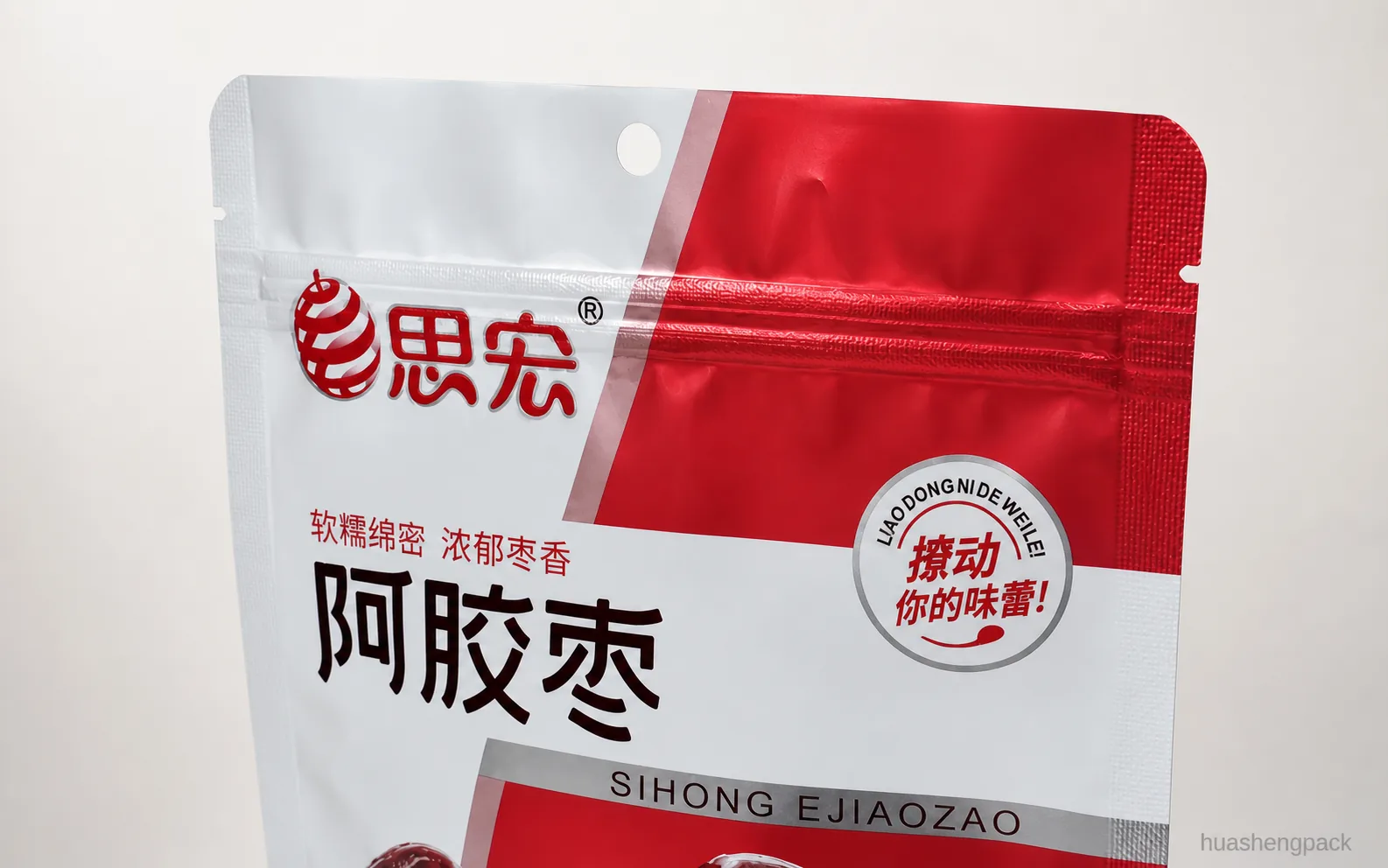 A photographed printed pouch shows tear notches above its zipper. Specify first opening and later reclosure as separate project requirements.
Fix hard-to-open pouch perforations by coordinating tear notch, laser score, zipper, film direction, seals and filled-pack testing.
Direct answer
Perforations or a tear notch do not guarantee that a flexible package will open easily. The film structure, machine direction, score or notch position, seals, grip area and filled product must work together. Decide the opening journey before artwork is locked, then validate it on filled packs rather than approving an empty sample.
Contents
Evidence-reviewed technical guide
Evidence-reviewed technical guide
2026-10-17 · Codex primary-source and agent-language review; not factory testing or native-human approval
Evidence scope
English source and Thai/Vietnamese article only: initial opening, reclosure, scoring depth limits and representative acceptance planning. No other language, equipment ownership or performance certification is approved.
Scope and limitations
Supplier descriptions concern their own systems. No Huasheng laser/closure availability, numeric opening force, shelf life, cost saving, airtight reclosure or user-rating improvement is established. Methods and acceptance remain project-specific.
Key takeaways
- Initial opening and later reclosure are different requirements.
- Score depth must fit the actual laminate and functional layers.
- Opening checks and package-integrity checks belong in the same project review.
1Choose the Opening Feature from the Use Case
Use a tear notch for a single-use pouch only when the laminate tears predictably. Add a zipper when consumers need to reclose the pack, while retaining a reliable first-opening method. Consider laser scoring when a defined tear path is required and the exact laminate can be scored without weakening package integrity. Match easy-peel lidding to the container material and rim; use a spout for controlled pouring of suitable liquids. Decide before artwork approval and consider grip area, spill risk, filling equipment and user needs.
2Common Easy-Open Design Failures
Typical failures include a notch too close to the zipper, artwork crossing the tear path, film that stretches instead of tearing, inconsistent scoring around folds, and peel force that changes with the container or sealing settings. Easy-open and resealable are separate requirements: a zipper recloses the package but does not by itself open the original top seal.
 1: top seal; 2: tear notch; 3: zipper. Diagram only; reclosure does not restore the initial seal.
3Coordinate Format, Film and Equipment
For sachets and three-side-seal pouches, confirm notch position and tear direction. For stand-up and flat-bottom pouches, leave enough material between top seal, notch and zipper to grip. For roll film, provide machine direction, repeat, eye mark and intended tear path. For lidding, provide container material, rim geometry and sealing-machine conditions.
 Photo-derived printed zipper-pouch presentation. Opening and reclosure require sample review.
4Test Opening and Integrity Together
Test filled packs made with the intended laminate under production-representative sealing conditions. Check tear initiation, direction, force consistency, debris, spilling, opening size and reclosure. For laser scoring, confirm score continuity and package integrity. For easy-peel lidding, test seal and peel behavior across the agreed sealing window and after relevant storage.
5Buyer Brief for Easy-Open Packaging
Provide product, fill weight, format, dimensions, laminate if known, single- or multi-use pattern, opening direction, reclosure need, filling and sealing equipment, container material for lidding, target market and artwork. Identify the grip point, required opening width and unacceptable failures such as powder spilling or tearing through the zipper.
Related Products
Related Packaging Guides
Claim-to-source evidence matrix
| Reviewed claim | Support | Sources | Boundary |
|---|
| First opening and reclosure should be specified separately; some closure designs integrate an opening feature. | contextual | [2] | One supplier example does not establish universal product availability or Huasheng equipment. |
| Excessive scoring depth can breach a seal or barrier layer, so the actual structure requires review. | direct | [1] | No universal depth, speed, film compatibility or retained-barrier guarantee is assigned. |
| Seal integrity is affected by the interaction of materials and process conditions. | direct | [3] | The review is context, not a finished Huasheng package validation or test protocol. |
| Representative opening and integrity checks are recommended together before project approval. | contextual | [1], [3] | Grip, spill, tear path, reclosure and handover lists are proposed project checks, not measured trial results. |
JSON · CSV
Authoritative References
- Laser Scoring · LasX Industries · manufacturer-data
A partial-depth score requires a structure-specific process window; excessive depth may breach a functional layer. - Perf-Zip consumer opening product sheet · Zip-Pak · manufacturer-data
The named zipper system integrates an initial-opening feature, so a separate notch is not mandatory for every closure design. - Understanding the factors affecting the seal integrity in heat sealed flexible food packages: A review · Packaging Technology and Science · peer-reviewed
Seal integrity depends on interacting material, process, contamination and subsequent handling factors.
Frequently Asked Questions
Why is packaging with perforations still difficult to open?
A perforation only defines a possible opening path. Film orientation, laminate toughness, score depth, seal position, grip area and product load can still prevent clean opening, so test production-representative filled packs.
Is a tear notch enough to make a pouch easy to open?
Only when the film tears predictably and the notch, seal and grip area are coordinated. Test filled pouches.
Do I need both a tear notch and a zipper?
Not always. First opening and later reclosure are separate functions. Some closure systems integrate initial opening, so confirm the actual pouch and closure design rather than requiring both a notch and zipper for every pack.
When is laser scoring appropriate?
When a controlled tear path is needed and the exact laminate can be scored while retaining required package integrity.
Can laser scoring affect barrier performance?
An unsuitable or excessive score can weaken a functional layer, so score depth and finished-pack performance must be validated.
How is easy-peel lidding selected?
Match the sealant to the container material and rim, then test seal integrity and peel behavior on the intended equipment.
How should buyers test easy-open samples?
Use filled, production-representative packs and check opening force, tear path, spill, reclosure and seal integrity.

About Huasheng
Stand up pouches, spout pouches, flat bottom pouches, coffee bags and printed roll film for food and beverage brands.
A legacy of quality in flexible packaging since 1997.
1997 · 6,880 m²
Chaozhou · Guangdong · China
Longshewei, Neipan Management District, Dongfeng Town, Chao'an District, Chaozhou City, Guangdong Province, China
Packaging design references
Compare the visible print, opening and display details. Confirm the actual dimensions, materials and intended use separately.
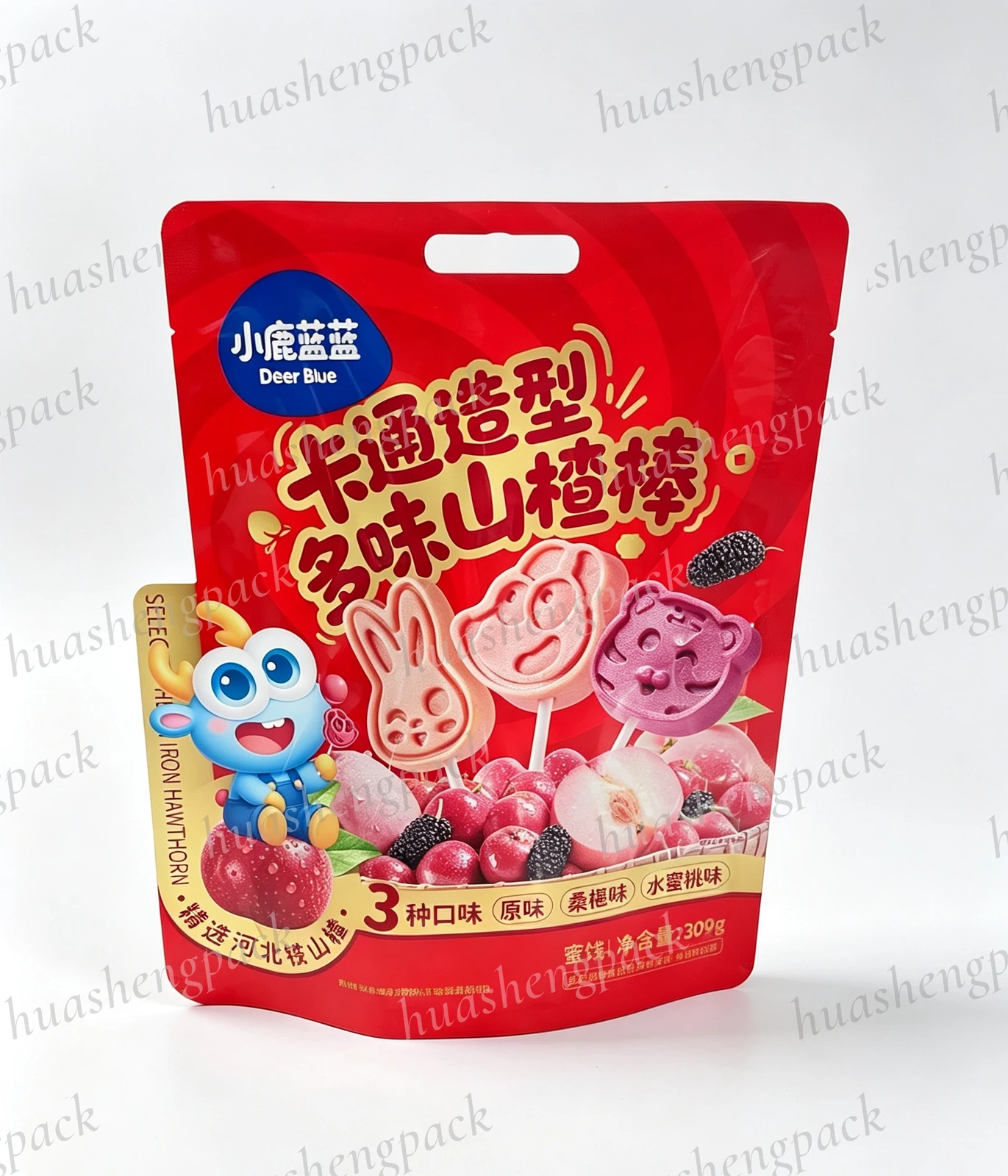 Red printed snack pouch with an integrated carry-handle cutout
A carry handle, hanging hole, tear notch and zipper serve different purposes. Confirm filled weight, opening method and seal clearance; photographs do not establish load capacity.
 Red dried-fruit pouch with zipper, tear notches and hanging hole
A carry handle, hanging hole, tear notch and zipper serve different purposes. Confirm filled weight, opening method and seal clearance; photographs do not establish load capacity.