How to Measure Your Existing Pouch or Film Sample Accurately Before Requesting a Factory Quote
Huasheng Packaging Technical Content Review
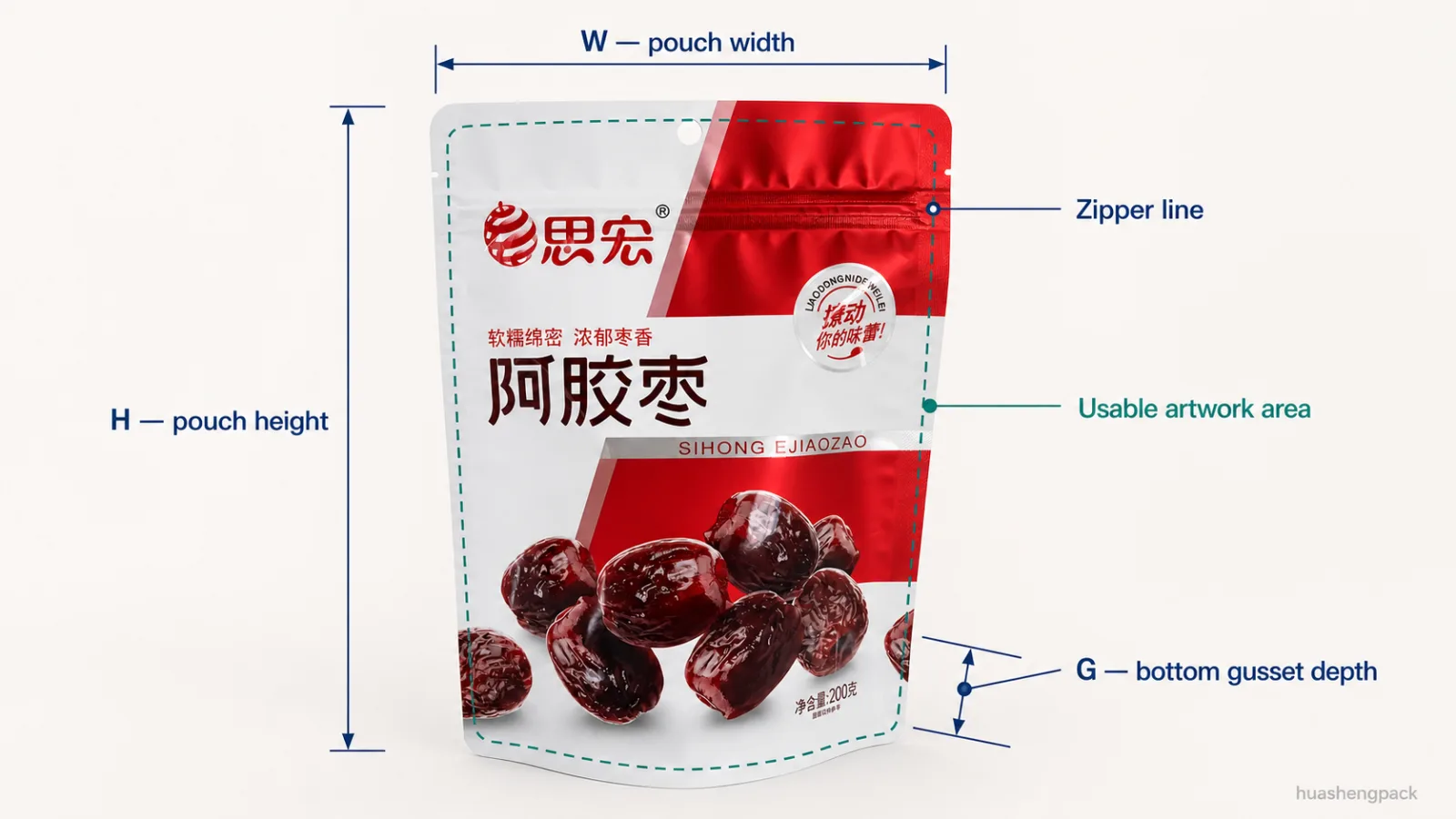
Step-by-step buyer guide to measuring an existing stand up pouch, flat bottom bag, side gusset, spout pouch, or roll film accurately (W × H + G, gusset depth, and photos) for fast factory quoting.
Direct answer
Over 60% of first-time custom packaging inquiries stall on the very first email because the quoted dimensions don't match how flexible converting factories measure bags. Measuring an inflated filled pouch with a soft tape measure, reporting half a bottom gusset instead of the full unfolded gusset, or quoting inner pocket size instead of outer edge-to-edge cut size causes costly sizing errors. Follow this 3-minute measurement guide so your very first inquiry unlocks an exact factory dieline and accurate quotation.
Contents
Evidence-reviewed technical guide
Evidence-reviewed technical guide
2026-11-26 · Huasheng Packaging Technical Editorial Review
Evidence scope
Applies to B2B custom flexible packaging specification review for sizing & rfq prep projects sourced from direct gravure converting plants.
Scope and limitations
General engineering bands and procurement guidelines do not replace filled-pack shelf-life testing, machine compatibility trials, or destination-market regulatory review.
Key takeaways
- Why Filled Bags Measure Differently Than Flat Converted Pouches
- Exact Measurement Formulas for Every Major Pouch & Roll Format
- Copy-Paste Measurement Template for Your First Factory Inquiry
Why Filled Bags Measure Differently Than Flat Converted Pouches
Flexible packaging factories cut, fold, and heat-seal pouches completely flat—so every converting machine and cost calculator runs on **exterior flat edge-to-edge dimensions** in millimeters (mm), including the 5–10 mm side and bottom heat-seal borders. When a pouch is filled with nuts, coffee, or sauce, the front and back panels bow outward and pull the apparent width and height inward by 10–25 mm. Measuring a filled bag instead of flattening it empty almost always produces an undersized replacement quote.
Five Common Measurement Mistakes Buyers Make With Reference Samples
First, measuring a Stand Up Pouch's bottom gusset only on one half (for example recording 40 mm from fold crease to bottom edge) instead of clarifying whether 40 mm is half-gusset or full unfolded gusset (80 mm)—always write out `Full Gusset = 80 mm (40 mm × 2)` so zero ambiguity exists. Second, measuring only inside the heat seals instead of outer cut-edge to cut-edge. Third, forgetting to note whether a zipper is present and measuring from the top cut edge down to the zipper center line (critical if your filling machine grips above the zipper). Fourth, measuring a Side Gusset or Flat Bottom bag's width without separating front face width from side gusset depth (`W × H + Side Gusset`). Fifth, quoting a Spout Pouch without measuring the inner bore diameter of the spout neck (commonly 8.6 mm, 10 mm, 13 mm, 16 mm, 20 mm, 22 mm, or 33 mm) and noting top-center vs. corner placement.
Exact Measurement Formulas for Every Major Pouch & Roll Format
Empty and flatten your sample pouch cleanly on a desk with a rigid ruler, then record outer edge-to-edge millimeters using these exact conventions: (1) Stand Up Zipper Pouch (Doypack) — `Width (W) × Height (H) + Full Bottom Gusset (BG)` (e.g., `160 mm W × 230 mm H + 80 mm Full BG`, meaning 40 mm folded on each side); (2) Flat Bottom (8-Side Seal Box) Pouch — `Front Width (W) × Height (H) + Side Gusset Depth (G)` (e.g., `130 mm W × 210 mm H + 75 mm G`, where the flat bottom depth matches the side gusset); (3) Side Gusset or Quad Seal Bag — `Front Width (W) × Total Height (H) + Side Gusset (G)` plus seal type (back center seal vs. 4-corner quad seal); (4) Three-Side Seal Flat Pouch — `Outer Width (W) × Outer Height (H)` plus side/bottom seal border widths and tear-notch distance from top; (5) Spout Pouch — `W × H + Full BG` PLUS inner spout bore diameter (mm) and top-center vs. angled-corner position; and (6) Automatic Roll Film — lay a cut pouch flat (slit open along the back fin seal) to measure `Flat Web Width (mm)` × `Cut-Off Repeat Length (mm)` (distance from one eye mark to the next identical eye mark).
How 3 Quick Smartphone Photos Eliminate Remaining Ambiguity
Alongside your millimeter numbers, snapping three crisp photos against a flat ruler lets Huasheng Packaging's Chaozhou engineers verify structure, seal style (round-bottom vs. K-seal vs. plow-bottom), finish (matte vs. gloss vs. window), and hardware instantly: (1) Front flat view next to ruler, (2) Side/bottom gusset open view showing fold geometry and inner barrier color (clear vs. silver VMPET/foil vs. white), and (3) Close-up of closure/hardware (press zipper, front pocket zipper, coffee valve, or spout neck).
Copy-Paste Measurement Template for Your First Factory Inquiry
Fill in this 6-line template and send it with 2–3 ruler photos to receive a matched quote fast: (1) Pouch Format (Stand Up / Flat Bottom / Spout / Side Gusset / 3-Side Seal / Roll Film), (2) Outer Flat Dimensions (`W ___ mm × H ___ mm + Full Gusset ___ mm`), (3) Hardware & Position (Zipper / Pocket Zipper / Valve / Spout Inner Ø ___ mm / Hang Hole / Tear Notch), (4) Inner Film Look (Clear / Silver Metallized or Foil / White / Kraft Outer), (5) Product Inside & Target Net Weight (___ g or ___ ml), and (6) Estimated Quantity per Artwork SKU.
Related Products
Related Applications
Related Packaging Guides
- Shipping Custom Packaging to Your China Freight Forwarder or Consolidation Warehouse (Guangzhou, Shenzhen & Yiwu)
- How Long Do Gravure Printing Cylinders Last? Storage, Reorder Savings & Artwork Change Rules
- Vacuum Pouch Micron Thickness & Nylon (PA/PE) Guide for Frozen Meat, Seafood, Cheese and Rice
Claim-to-source evidence matrix
| Reviewed claim | Support | Sources | Boundary |
|---|---|---|---|
| Final flexible packaging specifications require confirming product chemistry, barrier needs, dimensions, and filling conditions before bulk production. | contextual | [1], [3] | Engineering review boundary prior to cylinder engraving or commercial conversion. |
| Seal integrity and laminate suitability should be verified on representative samples using actual product and sealing equipment. | direct | [2] | Quantitative seal testing and line trials supersede nominal film descriptions. |
| Huasheng Packaging operates integrated 9-color gravure printing, lamination, and pouch converting in Chaozhou under ISO 22000:2018 (007FSMS2300214). | direct | [3], [1] | Factory capability and active management-system scope; product-specific export compliance confirmed per order. |
Authoritative References
- ISO 22000:2018 Food safety management systems · International Organization for Standardization (ISO) · standard
Food-contact packaging production management relies on documented food-safety management controls and traceability. - ASTM F88/F88M-23 Standard Test Method for Seal Strength of Flexible Barrier Materials · ASTM International · standard
Flexible pouch and roll-film heat-seal performance should be verified quantitatively rather than assumed from film appearance. - Huasheng Packaging Chaozhou In-House Converting & Quality Control Overview · Huasheng Packaging · internal-evidence
Describes Chaozhou in-house 9-color gravure printing, lamination, slitting, pouch converting, and ISO 22000:2018 scope.
Frequently Asked Questions
Should I measure my sample pouch from outer cut edge to outer cut edge, or only inside the seams?
Always measure outer cut edge to outer cut edge with the pouch emptied and flattened—that is the exact standard flexible packaging converting machines use for dielines and pricing.
How do I avoid confusion on stand up pouch bottom gusset measurements?
Always state clearly whether your number is the full unfolded bottom gusset (for example '80 mm full bottom gusset') or one folded half ('40 mm × 2'). Adding a quick ruler photo of the open bottom eliminates any misunderstanding.
What if I don't have an existing pouch yet—only my product weight?
Weigh one target fill dose of your actual product, pour it loosely into a graduated measuring cup to read real poured volume in milliliters (ml), and share that weight + ml figure—our engineers will recommend exact dimensions and send sizing sample bags.
How do I measure the inner diameter of a spout pouch cap?
Unscrew the cap and measure strictly the inside hollow pouring hole diameter of the plastic spout neck in millimeters (typical sizes are 8.6 mm, 10 mm, 13 mm, 16 mm, 20 mm, 22 mm, or 33 mm)—not the outer width of the screw cap.
Can I mail a physical sample pouch directly to Huasheng Packaging to duplicate its exact specs?
Yes. Mailing a reference pouch or film strip to our Chaozhou plant lets our technical team measure exact dimensions, single-wall micron thickness, layer structure, and closure profile with laboratory precision.

About Huasheng
In-house 9-color gravure printing, solventless lamination, slitting, and pouch converting across stand up pouches, spout pouches, retort bags, coffee bags, and automatic rollstock film.
A legacy of quality in flexible packaging since 1997.
1997 · 6,880 m²
Chaozhou · Guangdong · China
Longshewei, Neipan Management District, Dongfeng Town, Chao'an District, Chaozhou City, Guangdong Province, China