Biscuit Packaging: Freshness Inputs, Roll-Film Handoff and Machine Trials
Huasheng Packaging Technical Content Review · Published:
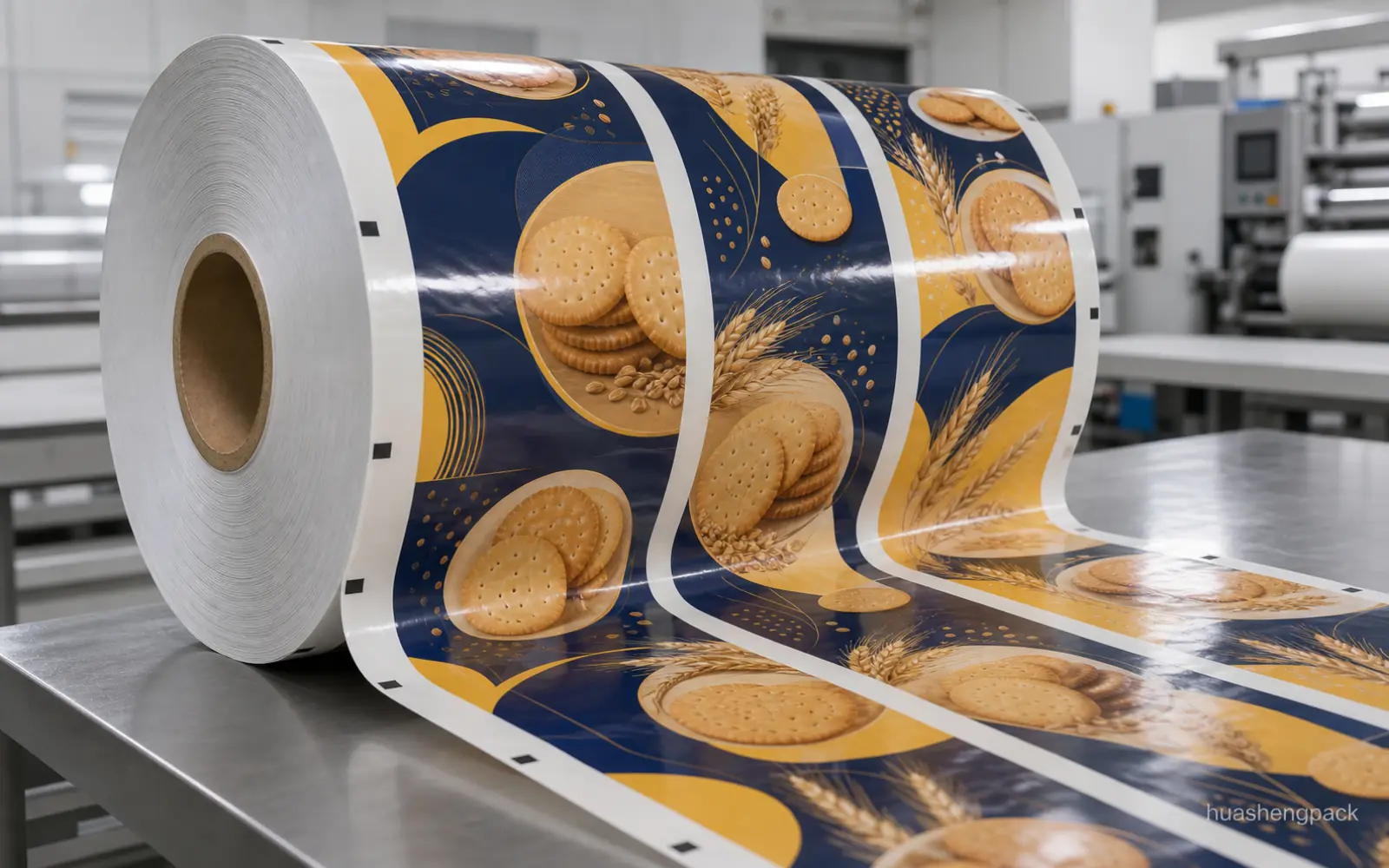 The image supports visible appearance or setting only. It does not prove material structure, performance, certification, a customer relationship or project suitability.
Connect biscuit fragility, moisture sensitivity, pack geometry, roll-film data, sealing and line trials without promising shelf life from film alone.
Direct answer
Biscuit packaging must protect a product that may be moisture-sensitive, fragile and sensitive to seal contamination by crumbs. The brief must connect the biscuit, desired quality life, pack geometry, roll-film or pouch format, machine interfaces and finished-pack checks instead of assigning shelf life from one film name.
Evidence-reviewed technical guide
2026-08-31 · Huasheng Packaging Technical Content Review
Evidence scope
Biscuit Packaging: Freshness Inputs, Roll-Film Handoff and Machine Trials
Scope and limitations
No customer identity, transcript, order-specific price, fixed MOQ, universal material recipe, performance promise, machine approval or shelf-life guarantee is published.
Key takeaways
- Record shape, dimensions, edge fragility, fat or flavor sensitivity, initial moisture or water activity where controlled, number per pack and acceptable breakage. Define quality endpoints such as loss of crispness, aroma change, oxidation, breakage or seal contamination with the product owner.
- Review moisture and oxygen sensitivity, light where relevant, distribution climate, package surface area and seals. Compare OTR and WVTR only when specimen and conditions are stated. Film-family names and metallic appearance do not establish the finished biscuit shelf life.
- Evaluate seal and integrity risks, breakage through handling and the defined storage endpoints under conditions linked to the intended route. Packaging data can screen candidates, but the biscuit producer should own the shelf-life conclusion and the acceptance rules for product quality.
1. Define the Biscuit and Failure Endpoints
Record shape, dimensions, edge fragility, fat or flavor sensitivity, initial moisture or water activity where controlled, number per pack and acceptable breakage. Define quality endpoints such as loss of crispness, aroma change, oxidation, breakage or seal contamination with the product owner.
The image supports visible appearance or setting only. It does not prove material structure, performance, certification, a customer relationship or project suitability.2. Match the Pack Geometry
A horizontal flow wrap, tray-and-wrap, premade pouch or grouped pack presents the biscuit differently. Confirm product feed direction, stack or count, clearances, fin or lap seal, end seals and cut position. Protecting the biscuit mechanically may change film area and seal placement.
3. Translate Freshness into Measurable Inputs
Review moisture and oxygen sensitivity, light where relevant, distribution climate, package surface area and seals. Compare OTR and WVTR only when specimen and conditions are stated. Film-family names and metallic appearance do not establish the finished biscuit shelf life.
Build the trial around the real biscuit presentation: single piece, stack, tray, row or multipack. Measure product dimensions and breakage before the run, then record feed disturbances, crumb generation, seal contamination, pack tightness, registration and damage after cartoning. The film trial and product-protection trial share samples but answer different questions and should retain separate results.
4. Trial the Actual Line
Use current biscuits, target speed and a representative reel. Check feeding, product contact, tracking, registration, longitudinal seal, end seal, cutting, crumb contamination and pack appearance through startup and steady operation. Preserve reel and machine settings with the accepted sample.
Before the trial, agree on a pack-quality scorecard: biscuit count and orientation, breakage before and after cartoning, crumbs in each seal, seal appearance, registration, pack tightness, opening and the product endpoints that will be followed during storage. Sample startup, stable running and restart separately. Keep machine settings, reel identity and biscuit batch with every set. If a trial improves seal appearance by squeezing the product or increasing breakage, it has shifted the failure rather than solved it.
5. Validate the Finished Route
Evaluate seal and integrity risks, breakage through handling and the defined storage endpoints under conditions linked to the intended route. Packaging data can screen candidates, but the biscuit producer should own the shelf-life conclusion and the acceptance rules for product quality.
Shelf-life work should name the product endpoint, storage condition, sampling interval and accepted test pack. Pair barrier data with the complete construction and stated conditions, then observe finished seals and product quality through the intended route. If biscuit recipe, oil content, dimensions, count, machine speed or pack geometry changes, reassess the affected assumptions rather than carrying forward the old conclusion.
Professional evidence used in this guide includes: Water Activity (aw) in Foods; ASTM D3985-24: Oxygen Gas Transmission Rate; ASTM F1249-25: Water Vapor Transmission Rate; Horizontal Flow Wrapping; ASTM F88/F88M-23: Seal Strength of Flexible Barrier Materials. Its mapped scope is: Water activity and moisture content are different product controls; OTR requires a defined specimen and stated test conditions; WVTR requires a defined specimen and stated test conditions; Horizontal flow wrapping forms and seals roll material around horizontally fed products; Seal strength is interpreted with specimen, technique and failure mode. These sources answer specific method, use-condition or equipment-input questions; they do not automatically approve the complete package, a particular machine, commercial shelf life or the current order. To apply this guide to a Biscuit Packaging decision, maintain a four-column condition–evidence–limitation–action record: state the current condition, identify the sample or record supporting it, name the risk that remains outside that evidence and assign the next action with its acceptance condition. Reopen the affected conclusion whenever the product, specification, process or controlling evidence changes.
Related Products
Related Packaging Guides
Claim-to-source evidence matrix
| Reviewed claim | Support | Sources | Boundary |
|---|
| Water activity and moisture content are different product controls | direct | [1] | The cited source supports only the named method, boundary or equipment input and does not approve the complete packaging project. |
| OTR requires a defined specimen and stated test conditions | direct | [2] | The cited source supports only the named method, boundary or equipment input and does not approve the complete packaging project. |
| WVTR requires a defined specimen and stated test conditions | direct | [3] | The cited source supports only the named method, boundary or equipment input and does not approve the complete packaging project. |
| Horizontal flow wrapping forms and seals roll material around horizontally fed products | direct | [4] | The cited source supports only the named method, boundary or equipment input and does not approve the complete packaging project. |
| Seal strength is interpreted with specimen, technique and failure mode | direct | [5] | The cited source supports only the named method, boundary or equipment input and does not approve the complete packaging project. |
JSON · CSV
Authoritative References
- Water Activity (aw) in Foods · U.S. Food and Drug Administration · government
Water activity and moisture content are different product controls - ASTM D3985-24: Oxygen Gas Transmission Rate · ASTM International · standard
OTR requires a defined specimen and stated test conditions - ASTM F1249-25: Water Vapor Transmission Rate · ASTM International · standard
WVTR requires a defined specimen and stated test conditions - Horizontal Flow Wrapping · Syntegon · manufacturer-data
Horizontal flow wrapping forms and seals roll material around horizontally fed products - ASTM F88/F88M-23: Seal Strength of Flexible Barrier Materials · ASTM International · standard
Seal strength is interpreted with specimen, technique and failure mode
Frequently Asked Questions
Does metallized film guarantee crispness?
No, the complete package and product require validation.
Why do crumbs matter?
They can affect seal presentation and integrity.
Is film width enough for a quote?
No, repeat, machine, product and reel data are needed.
Can lab seals approve the line?
No, run a representative machine trial.
Who approves shelf life?
The product owner using suitable evidence.
What should be retained?
Accepted packs, reel identity, settings and test records.